
 By Lina Irawan
In a move that has left industry analysts and casual observers alike scratching their heads, Canon Inc. has unveiled its latest foray into public relations: a whimsical, extraterrestrial-themed corporate introduction booklet titled The Secret of Canon Star. While corporate brochures are typically dry, text-heavy documents meant for shareholders or potential B2B partners, Canon’s latest offering pivots sharply toward a younger demographic—specifically, children in the third through sixth grades.
The document, which is currently available for viewing and printing as a PDF on the official Canon Global website, is a surrealist exploration of the company’s manufacturing prowess, core values, and technological impact, all wrapped in a vibrant, cartoon-laden narrative.

Main Facts: A Voyage to Planet Canon
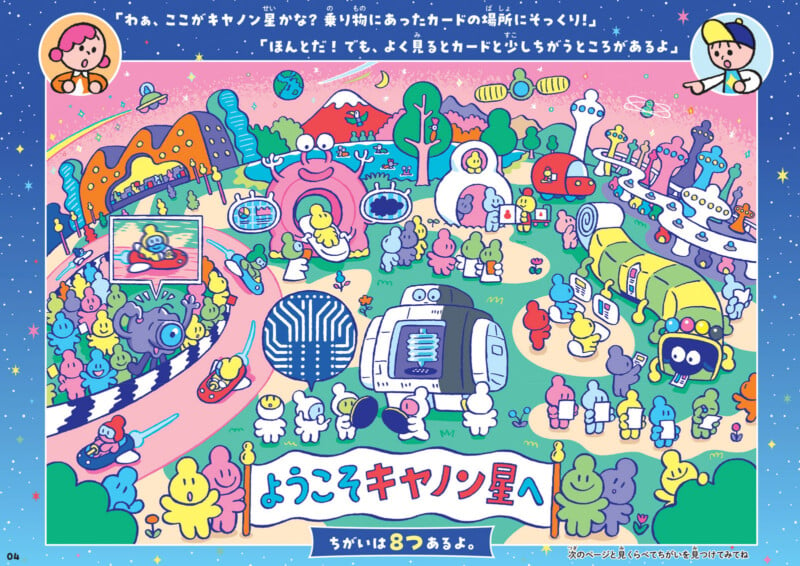
At its core, The Secret of Canon Star is an educational narrative that attempts to distill the complexities of optical engineering, semiconductor manufacturing, and medical imaging into a format accessible to a ten-year-old. The premise follows a pair of Earth-bound children who board a spaceship to visit "Canon Planet." Upon arrival, they are greeted by a cast of anthropomorphic alien creatures—many of whom are living, breathing manifestations of Canon’s hardware.
The illustrations are bright, chaotic, and undeniably charming, featuring a wide array of characters, including a walking, talking camera with a lens for a face and a sentient, caterpillar-like printer that churns out paper with CMYK ink colors displayed proudly on its head. The booklet doesn’t shy away from the technical, either; it features a dedicated section on CT scanners and MRI machines, depicting the latter as multi-armed, ocular entities that provide diagnostic services to smaller, wide-eyed aliens.

The core objective of this surreal adventure is to explain exactly what Canon does. It details how the company utilizes high-precision robotics to manufacture its massive portfolio, which ranges from high-end cameras and lenses to advanced semiconductors and medical diagnostic equipment.
Chronology: How the Project Emerged
The existence of The Secret of Canon Star was first brought to broader international attention by the Japanese tech outlet DC.Watch. While the exact timeline of the booklet’s development remains internal to Canon, it represents a significant shift in the company’s outreach strategy for the mid-2020s.

- Conception: Recognizing a need to inspire the next generation of engineers, Canon’s internal communications team sought a creative vessel to explain its diverse industrial portfolio.
- Development: Collaborating with artists and educators, the company crafted a multi-page narrative (varying between 11 and 20 pages depending on the version) that prioritized interactive elements—such as "spot the difference" puzzles and comic-style breakdowns of technical jargon.
- Release: The digital version was published to the Canon Global website, intended for use in schools or home-learning environments, signaling a long-term commitment to STEM education.
- Public Reception: Following its discovery by technology journalists, the booklet has become a viral curiosity, praised for its boldness while simultaneously being labeled as "bizarre" by Western media outlets accustomed to more conservative corporate communications.
Supporting Data: Translating Tech into Cartoons
The brilliance—and the strangeness—of the booklet lies in how it handles technical pedagogy. Rather than using technical manuals, the authors utilize a "character-driven" approach to complex concepts.
For instance, the document tackles the fundamental physics of photography. A purple, octopus-like alien acts as a guide, explaining the "holy trinity" of camera settings: shutter speed, ISO, and aperture. These are presented not as daunting mathematical constraints, but as variables in a visual game. The booklet then bridges the gap between physics and consumer application, detailing how lenses collect light and focus it onto a CMOS sensor, which then converts photons into the electrical signals that form a digital image.
The efficacy of this approach is supported by the inclusion of practical examples. In one segment, the booklet showcases the prowess of Canon’s autofocus technology, using a sequence of images—a dog running, an airplane in flight, and a bird perched on a branch—to explain how the camera "tracks" subjects. It is a simplified but accurate breakdown of phase-detection autofocus, framed within a storybook aesthetic.
Official Responses and Corporate Strategy
Canon has described the project simply as a "company introduction booklet for children." While the company has not issued a formal press release explaining the artistic choice behind the alien-led narrative, the existence of such a document reflects a growing trend among Japanese conglomerates to humanize their brands.

In a statement often echoed by corporate entities in Japan, the goal is to foster a sense of "technological literacy" among children. By positioning themselves as creators of "magic" tools that can peer into the human body or capture the far reaches of space, Canon is attempting to build brand loyalty that starts in elementary school. The company is essentially betting that if a child understands the "secret" of how a camera works today, they may become a loyal customer or a future employee tomorrow.
Implications: The Future of Corporate Outreach
The existence of The Secret of Canon Star poses an interesting question: is the future of B2B and industrial marketing moving toward gamification and narrative-based storytelling?

The "Humanization" of Robotics
By depicting MRI machines and printers as characters, Canon is stripping away the intimidation factor often associated with high-tech industrial machinery. For children, a machine that is "scary" or "complex" becomes "friendly" when given a face and a role in a story. This strategy could theoretically be applied to other complex industries—such as renewable energy or aerospace—to make them more palatable to a general audience.
The Educational Gap
Critics of the move might argue that the booklet is a form of early-stage indoctrination. However, the educational value of the material cannot be ignored. The content provides a legitimate introduction to optics, signal processing, and medical physics. If corporations are willing to spend the resources to create high-quality, free educational materials, the public benefit may outweigh the "bizarre" nature of the presentation.

A New Standard for Transparency?
Canon’s decision to publish these materials openly suggests a high level of confidence in their manufacturing processes. By explaining how their factory robots assemble cameras and sensors, they are offering a level of transparency that few other companies provide. It invites the reader to look behind the curtain of the factory floor, not as a suspicious observer, but as a curious explorer.
Conclusion: A Bold, If Unusual, Step
Whether or not The Secret of Canon Star will actually lead to a surge in interest in optical engineering among third graders remains to be seen. However, it is undeniable that the booklet stands as a unique artifact of corporate culture. It is a reminder that even the most massive, multinational technology corporations are capable of stepping away from the spreadsheet and the quarterly report to embrace the absurd.

As the old adage from The Simpsons goes, "Won’t someone think of the children?" In this instance, Canon has not only thought of them, but they have also invited them to a technicolor, alien-populated planet to see exactly how the world—and the light that captures it—truly works. It is a strange, whimsical, and unexpectedly educational journey, and it proves that even in the world of high-end imaging, there is still room for a little bit of magic.
 Raul Delapena Setiawan
  rifanmuazin
  Ammar Sabilarrohman