
 By Siti Muinah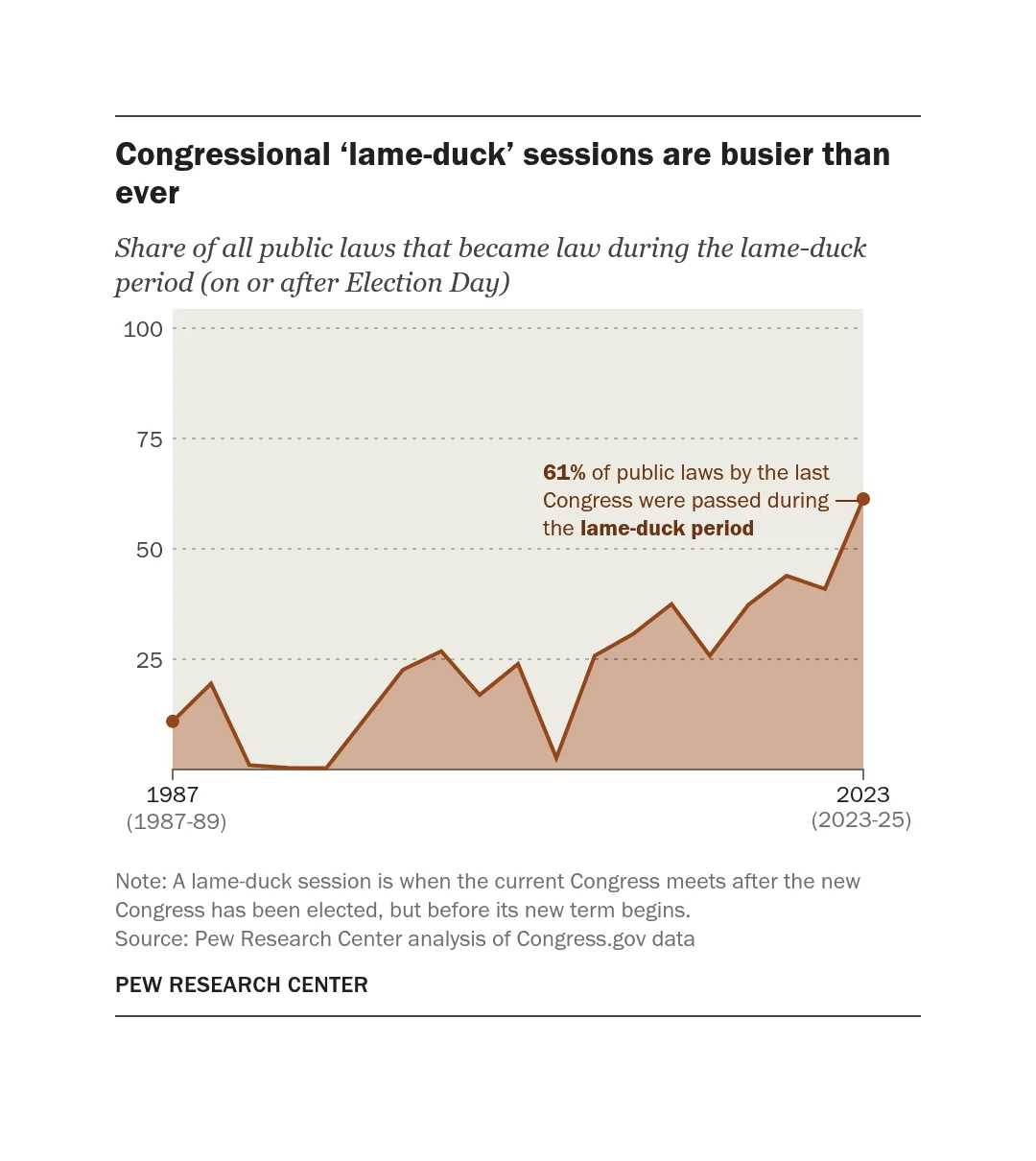
WASHINGTON — While the U.S. Capitol remains a focal point of intense political theater, the fundamental engine of American governance—the passing of laws—has slowed to a historic trickle. According to a comprehensive data analysis conducted by the Pew Research Center, the 119th Congress has cemented its place among the least productive legislative bodies of the past four decades, continuing a multi-decade slide in lawmakers’ ability to routinely pass public laws.
As lawmakers dispersed for the final stretch of the campaign trail ahead of the midterm elections, the numbers paint a stark picture of a deeply polarized and logjammed legislative branch. Since convening in January 2025, the current Congress has enacted just 121 public laws ahead of Election Day. That figure represents the second-fewest laws enacted by any Congress at this point in its two-year term over the last 40 years. The only legislative body to perform worse during the same timeframe was its immediate predecessor, the 118th Congress, which had managed a meager 106 laws by this stage.
Main Facts: A Historic Low in Legislative Output
To understand the scope of this slowdown, researchers look beyond the sheer volume of bills to examine their weight and substance. Pew Research Center’s methodology separates public laws into two categories: "ceremonial" measures (such as naming post offices, minting commemorative coins, or awarding Congressional Gold Medals) and "substantive" measures (bills that spend money, create or amend permanent law, alter federal land ownership, or otherwise exert a tangible, real-world impact).
Using these generous criteria, the 119th Congress has enacted 109 substantive laws as of mid-October 2026. While that number edges out the historic low of 84 substantive laws logged by the 118th Congress at the same point in its lifecycle, it pales in comparison to historical norms.
The contrast with the late 20th and early 21st centuries is stark. Between the 100th Congress (1987–1989) and the 110th Congress (2007–2009), a typical Congress produced an average of roughly 440 laws overall—including about 306 substantive laws—before breaking for Election Day. In other words, legislative output during that era was roughly double what the nation has witnessed over the past four years.
Despite the overarching environment of stagnation, the 119th Congress has still managed to rubber-stamp a handful of high-profile, major legislative items. Most notably, lawmakers pushed through a massive tax and spending reconciliation package in July 2025, colloquially nicknamed the "One Big Beautiful Bill," which fundamentally reshaped portions of the federal tax code and domestic spending allocations. Additionally, the current Congress has leaned heavily into using the Congressional Review Act, successfully passing 23 separate resolutions to overturn various regulations enacted during the Biden administration, alongside a measure to void a local Washington, D.C., statute. These regulatory reversals alone account for roughly 20% of all public laws passed during the current term.
Chronology: The Decades-Long Slide in Congressional Productivity
To trace how Capitol Hill arrived at this point of chronic legislative paralysis, one must look at the shifting rhythms of American politics over the last 40 years.
- The Late 1980s and 1990s (The 100th to 105th Congresses): This era was characterized by robust legislative output. The 100th Congress (1987–1989) led the modern baseline with 388 substantive laws and 247 ceremonial laws enacted prior to Election Day. While partisan friction certainly existed between a Democratic-controlled legislative branch and the Reagan-Bush White House, committees routinely churned out bipartisan bills covering infrastructure, trade, and social policy.
- The Turn of the Millennium (The 106th to 110th Congresses): Productivity remained relatively high, though occasional dips began to appear—such as the 107th Congress (2001–2003), which dropped to 199 substantive laws as the nation pivoted abruptly to post-9/11 security priorities. Still, major legislative bargains on education, healthcare, and tax cuts were common.
- The 2010s and the Rise of Gridlock (The 111th to 116th Congresses): Following the 2010 midterms and the onset of fierce, divided-government gridlock during the Obama administration, the baseline for substantive laws dropped dramatically, hovering mostly in the 140-to-170 range. Committees struggled to find consensus on major issues, and routine authorizations often stalled.
- The 2020s Collapse (The 118th and 119th Congresses): The modern era has broken previous floors entirely. The 118th Congress (2023–2025) plummeted to just 84 substantive laws before Election Day. The current 119th Congress has seen a similarly depressed output, recording only 109 substantive measures as it prepares for its post-election sessions.
Supporting Data: The Numbers Behind the Decline
A closer examination of the Pew Research Center’s long-term tracking data highlights just how systematically congressional output has withered.
| Congress Term | Pre-Election Substantive Laws | Pre-Election Ceremonial Laws | Total Pre-Election Laws |
|---|---|---|---|
| 100th (1987–1989) | 388 | 247 | 635 |
| 102nd (1991–1993) | 387 | 197 | 584 |
| 106th (1999–2001) | 344 | 105 | 449 |
| 110th (2007–2009) | 286 | 162 | 448 |
| 112th (2011–2013) | 53 | 196 | 143 |
| 115th (2017–2019) | 206 | 71 | 277 |
| 117th (2021–2023) | 160 | 54 | 214 |
| 118th (2023–2025) | 84 | 22 | 106 |
| *119th (2025–2027)** | 109 | 12 | 121 |
*Note: Data for the 119th Congress is current as of October 14, 2026, ahead of the post-election lame-duck session.
This structural decline is mirrored by another profound shift in congressional behavior: the rise of the "lame-duck" session. Historically, lawmakers wrapped up their business before facing voters in November. Today, an overwhelming share of a Congress’s legislative output is crammed into the weeks and months after Election Day, when members who have lost their bids for reelection return to Washington for a final, high-stakes sprint.
In the 100th Congress, just 10.9% of all measures became law during the post-election lame-duck window. For the next two decades, that share rarely breached 25%. However, starting in the 2010s, lame-duck sessions became the primary vehicle for passing must-pass appropriations bills, debt ceiling adjustments, and omnibus packages.
By the 113th Congress (2013–2015), 37.5% of all laws were enacted during the lame-duck period. By the 118th Congress, that figure reached an astonishing 61.3%, with 168 out of 274 total measures signed into law after voters had already cast their ballots. Political analysts note this trend reflects a growing reliance on end-of-year fiscal cliffs and manufactured crises to force bipartisan compromises when electoral pressures are temporarily removed.
Official Responses and Institutional Perspectives
Capitol Hill leadership offers sharply divergent explanations for why the legislative machinery moves so slowly, reflecting deep ideological fractures over how Congress should function.
Congressional leaders from the majority party often defend lower raw output by pointing to a shift in quality over quantity. Defenders argue that modern legislative bodies should focus on rigorous oversight, checking executive overreach, and reining in federal spending rather than passing hundreds of pages of expansive new federal mandates. From this perspective, fewer laws mean fewer unnecessary burdens on American businesses and citizens.
Conversely, minority party members and institutional watchdogs argue that the numbers reflect a systemic failure to govern. Critics point out that routine authorizations—such as defense bill reauthorizations, transportation funding, and agricultural policies—frequently get bogged down in messaging amendments, partisan infighting, and procedural roadblocks. Many former lawmakers have noted that the disappearance of regular order, where committees openly debate and amend bills before bringing them to the floor, has hollowed out the legislative process, leaving leadership to craft massive, take-it-or-leave-it packages behind closed doors.
Implications: What a Slow Congress Means for American Governance
The persistent slowdown in congressional productivity carries profound implications for the checks and balances envisioned by the U.S. Constitution.
When the legislative branch struggles to pass substantive laws or maintain regular budgeting schedules, the vacuum is rarely left empty. Instead, power frequently shifts toward the executive branch. Presidents of both parties have increasingly relied on executive orders, administrative rulemakings, and emergency declarations to enact policy changes that Congress is too gridlocked to pursue. This dynamic accelerates the rise of the "imperial presidency," transforming the executive branch into the primary engine of national policy-making.
Furthermore, chronic legislative gridlock fuels public cynicism toward democratic institutions. When citizens watch Congress lurch from one self-inflicted fiscal crisis to the next, relying on panicked, post-election lame-duck sessions to keep the government funded, faith in representative democracy erodes.
As the 119th Congress heads into its final weeks, all eyes will be on Washington to see whether the post-midterm lame-duck session can salvage its productivity metrics through last-minute omnibus packages. Yet, regardless of how many bills are squeezed out before the clock runs out on this term, the broader trend remains clear: America’s legislative branch is operating at a historic low gear, with structural paralysis becoming the new normal on Capitol Hill.
 Suro Senen
  Ammar Sabilarrohman
  Evan Lee Salim