
 By Laily UPN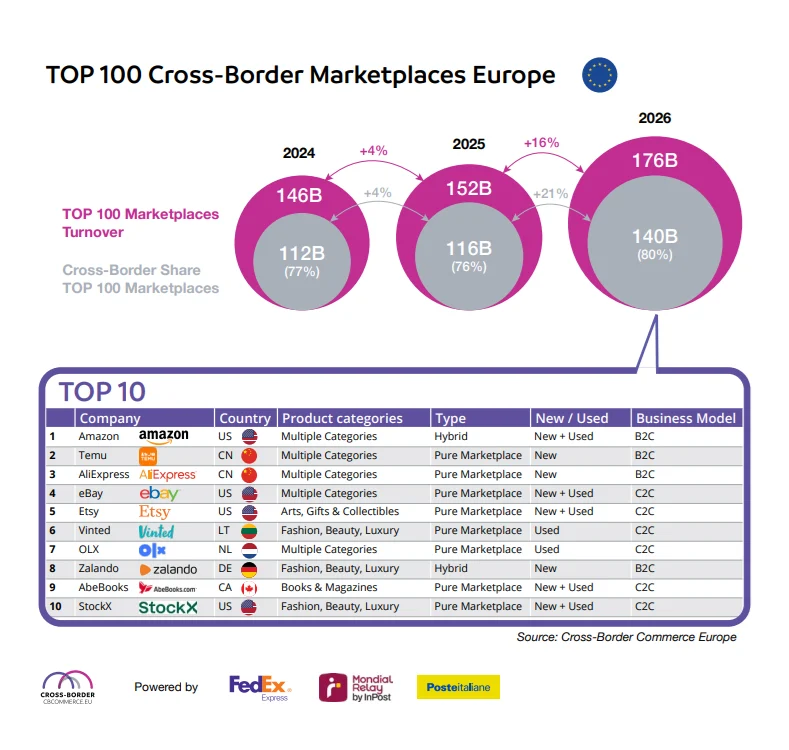
The European e-commerce landscape is undergoing a structural transformation of significant proportions. According to the seventh edition of the "Top 100 Cross-Border Marketplaces Europe" report, published by Cross-Border Commerce Europe (CBCommerce), the continent’s most influential digital marketplaces are not merely growing—they are evolving into a borderless ecosystem where geography is increasingly irrelevant to the consumer experience.
The figures underscore a compelling narrative: the 100 largest marketplaces active in Europe are currently tracking toward a combined gross merchandise volume (GMV) of 175.8 billion euros. Perhaps more telling is the composition of this revenue. A staggering 79.5 percent of this volume is derived from cross-border sales, a metric that analysts expect to climb steadily over the coming years as digital barriers continue to dissolve.
Main Facts: The New Era of European Retail
The report serves as a definitive benchmark for the industry, mapping the trajectory of the titans that dominate the European digital space. With a total GMV projection of 175.8 billion euros, the top 100 marketplaces represent the engine room of European digital consumption.
However, the headline isn’t just the sheer volume of trade; it is the dominance of cross-border activity. For years, European e-commerce was fragmented by language, logistics, and localized consumer preferences. Today, the "Top 100" are dismantling these silos. By 2026, the report projects that these marketplaces will facilitate 139.8 billion euros in cross-border sales, representing nearly 80 percent of their total GMV.
This shift is not accidental. It is the result of massive investments in localized infrastructure, sophisticated algorithmic discovery, and a harmonized approach to European trade policies. As these platforms optimize their supply chains to serve a pan-European customer base, they are effectively turning the continent into a single, cohesive retail market.
Chronology: A Roadmap to 2027
To understand the current momentum, one must look at the progression of these marketplaces over the recent fiscal cycles.
2024–2025: Consolidation and Infrastructure
The past year has been defined by a pivot toward "hyper-localization." International players—most notably those hailing from East Asia and North America—have shifted from mere cross-border shipping to establishing local fulfillment hubs. By moving inventory closer to the European consumer, these platforms have significantly reduced delivery times, which historically served as the primary barrier to cross-border adoption.
2026: The Inflection Point
The current year marks the seventh iteration of the CBCommerce study, which highlights that the market has reached an inflection point. The report notes that 2026 is characterized by the integration of AI-driven product discovery. Consumers are no longer searching for products in the traditional sense; they are being guided by predictive algorithms that span inventory across multiple borders, making the origin of the product secondary to price and availability.
2027: The 81 Percent Milestone
Looking ahead, the growth curve remains aggressive. Projections indicate that the total GMV of the top 100 marketplaces will expand by approximately 8 percent next year, reaching an estimated 190 billion euros. Within this growth, the cross-border segment is expected to outpace the domestic segment, rising by 10 percent to hit 154 billion euros. By the end of 2027, the ratio of cross-border sales to total GMV is forecasted to reach 81 percent, cementing the "cross-border" model as the standard rather than the exception.
Supporting Data: Ranking the Titans
The "Top 100 Cross-Border Marketplaces Europe" report utilizes a rigorous methodology to determine its rankings. The criteria go beyond simple revenue, encompassing SEO performance, geographic footprint, cross-border traffic volume, and consumer engagement metrics.

At the summit of this hierarchy sit three undisputed leaders: Amazon, Temu, and AliExpress.
- Amazon: Continues to leverage its mature European logistics network and Prime ecosystem to maintain its top position. Its ability to integrate third-party sellers from across the globe into a seamless European delivery experience remains the gold standard.
- Temu: Has seen explosive growth, utilizing a high-frequency, social-commerce-centric model that has disrupted traditional retail pricing models across the EU.
- AliExpress: Remains a cornerstone for consumer electronics and budget-friendly goods, successfully adapting its logistics to meet stricter European import regulations.
These companies do not merely hold market share; they set the technological pace for the entire industry. Their success is driven by massive investment in data analytics, which allows them to predict demand shifts across different European countries with startling accuracy.
Official Responses and Strategic Implications
Industry observers and stakeholders view these findings with a mix of optimism and caution. The rise of these giants has triggered a ripple effect across European regulatory bodies and local brick-and-mortar retailers.
The Regulatory Layer
The European Commission has been increasingly active in regulating the digital space, introducing frameworks like the Digital Services Act (DSA) and the Digital Markets Act (DMA). These regulations are designed to ensure that the "fierce competition" mentioned in the report remains fair.
"The complexity of operating in Europe has never been higher," notes a lead analyst at CBCommerce. "While the market is more open than ever, the regulatory burden—ranging from VAT compliance to sustainability reporting—requires these platforms to invest heavily in legal and compliance infrastructure. It is a ‘pay-to-play’ environment where only the largest, most sophisticated players can thrive."
The Technological Shift: AI and Social Commerce
The report emphasizes that the "discovery phase" of shopping is being fundamentally rewritten. Social commerce—where products are bought directly through social media platforms or via influencers—is capturing a significant share of the youth demographic. Simultaneously, AI-driven recommendation engines are narrowing the gap between a consumer’s intent and the actual transaction, reducing the friction that previously existed when shopping on a foreign, cross-border platform.
Implications for the Future of Retail
The implications of this data for the broader European economy are profound:
- The Death of Geographic Limitations: For the average European consumer, the "local shop" is becoming a digital concept. Whether a product ships from a warehouse in Poland, a hub in Germany, or a factory in Asia, the expectation is now uniform delivery speed and customer service.
- The Infrastructure Arms Race: Competition is no longer just about who has the best website; it is about who has the most efficient fulfillment network. Companies that cannot invest in local European infrastructure are finding themselves squeezed out of the top rankings.
- Sustainability Pressures: With increased cross-border movement comes increased scrutiny regarding carbon footprints. The next phase of competition will likely involve "green logistics," as platforms look to differentiate themselves through eco-friendly shipping and circular economy models.
- The Rise of Niche Marketplaces: While the top three dominate, the report highlights that there is still room for specialized, vertical-specific marketplaces. Fashion, luxury goods, and sustainable products are seeing niche platforms carve out significant cross-border volumes by focusing on community and expertise rather than just raw volume.
Conclusion
The seventh edition of the "Top 100 Cross-Border Marketplaces Europe" report paints a picture of a continent fully integrated into the global digital economy. With cross-border sales set to command over 80 percent of the top marketplaces’ volume by 2027, the traditional boundaries of European retail have effectively evaporated.
For consumers, this evolution brings increased choice, competitive pricing, and unparalleled convenience. For businesses, it serves as a stark reminder that in the modern era, the "market" is no longer defined by national borders, but by the strength of one’s digital presence and the efficiency of one’s logistical network. As we look toward 2027, the question is no longer whether European commerce will be cross-border, but rather how much further this trend can push before it reaches a new, digital equilibrium.
 Suro Senen
  Ammar Sabilarrohman
  rifanmuazin