
 By Asep Darmawan
As the global social media management software market expands toward an estimated $33.46 billion, marketing leaders face mounting pressure to optimize their technology stacks. At the center of many modern software evaluations is a recurring friction point: the total cost of ownership associated with Sprout Social.
While widely recognized for its polished user interface, Sprout Social faces frequent criticism from enterprise and mid-market organizations regarding its strict per-seat pricing model—starting at $199 per seat per month for the Standard plan and climbing to $299 for Professional tiers—coupled with advanced social listening features tucked safely behind premium add-on paywalls.

For organizations managing large, multi-tiered marketing operations against the backdrop of a global social media advertising market projected to hit $338.75 billion, these economic and structural barriers have triggered widespread market scans. To help marketing executives, agency directors, and operations leads navigate this landscape, we have analyzed the top Sprout Social alternatives across pricing, governance, social listening, and core feature sets.
Main Facts: The Core Drivers Behind the Search for Alternatives
When evaluating alternatives to Sprout Social, industry analysts and procurement teams typically focus on three primary pain points:

- Per-Seat Cost Escalation: Because Sprout Social bills strictly per user, scaling a social team across multiple regions or departments causes subscription expenses to compound rapidly. A 10-user team can easily rack up thousands of dollars per month purely on access fees.
- Gated Social Listening: Comprehensive consumer intelligence and advanced listening capabilities often require expensive enterprise add-ons rather than being native to baseline tiers, alienating research-driven teams.
- Enterprise Governance Gaps: Highly regulated industries—such as financial services, pharmaceuticals, and healthcare—require rigorous approval workflows, comprehensive audit trails, and strict compliance controls that standard mid-market tools frequently fail to supply out of the box.
To address these gaps, the market offers a diverse array of competitors, ranging from comprehensive enterprise social operating systems to agile tools tailored for small businesses and creative agencies.
Chronology and Evolution of the Social Management Market
The demand for robust social media management tools has evolved dramatically over the last decade.
- Early 2010s: Social media tools functioned primarily as simple scheduling calendars designed to queue up basic text and image posts across Facebook and Twitter.
- Late 2010s to 2020s: As platforms diversified into TikTok, Instagram, LinkedIn, and YouTube, businesses required centralized inboxes, customer care tracking, and basic cross-channel analytics.
- The 2026 Landscape: Today’s market is defined by AI orchestration, deep CRM integrations, and advanced compliance architecture. Social media is no longer viewed merely as an organic broadcasting channel; it is an integrated ecosystem driving revenue, customer service, and real-time consumer intelligence. Consequently, platforms that fail to unify listening, publishing, and governance under a single data architecture are increasingly being swapped out for more cohesive solutions.
Supporting Data and Comparative Analysis
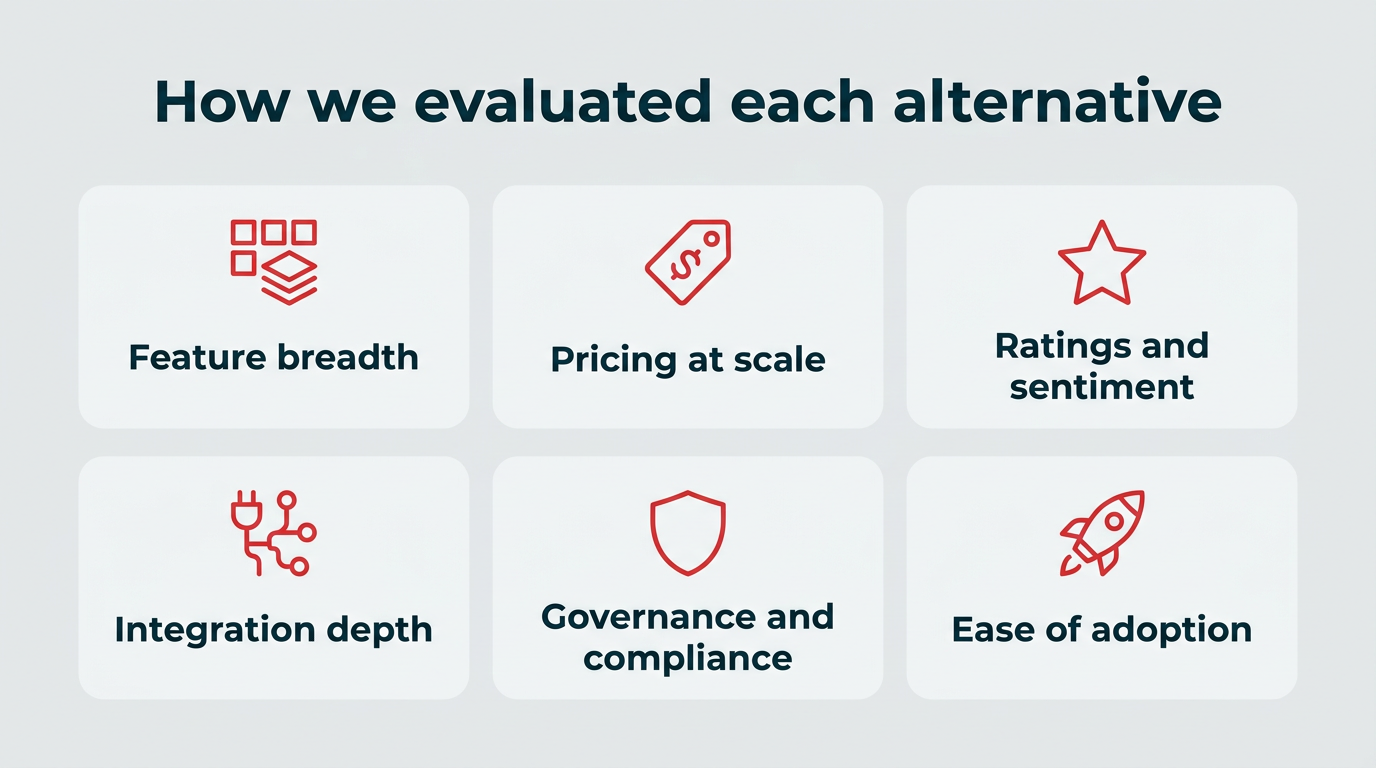
To keep our evaluation framework rigorous, we assessed candidates across five objective criteria: starting price points, G2 user ratings, social listening depth, governance controls, and ideal user profiles.
The Top 12 Alternatives at a Glance
| Tool | Best For | Starting Price (2026) | G2 Rating | Key Differentiator |
|---|---|---|---|---|
| Hootsuite | Enterprise teams & regulated industries | $99/user/month | 4.3/5 | AI-first social OS with advanced listening and Vigil governance |
| Sprinklr | Large global enterprises | $299/month | 4.1/5 | Unified CXM platform across 30+ channels |
| Brandwatch | Enterprise research & insights teams | Custom pricing | 4.4/5 | Deep consumer intelligence and market research |
| Emplifi | Retail and commerce-led brands | Custom pricing | 4.3/5 | Social commerce and influencer marketing suite |
| Khoros | Multinational corporations | Custom pricing | 3.8/5 | Community management and strict compliance |
| Agorapulse | Mid-size marketing teams | $79/user/month | 4.5/5 | Unified social inbox with built-in ROI tracking |
| HubSpot | Teams using HubSpot CRM | $890/month (Marketing Hub) | 4.4/5 | CRM-integrated social within a full marketing suite |
| SocialBee | Small teams with categorized content | $29/month | 4.8/5 | Content categories and evergreen recycling |
| Sendible | Digital marketing agencies | $29/month | 4.5/5 | White-label reporting and multi-client management |
| Zoho Social | Teams in the Zoho ecosystem | $10/month | 4.6/5 | Deep Zoho CRM integration |
| Buffer | Small teams and creators | Free (Paid from $6/mo/channel) | 4.3/5 | Simple, affordable scheduling and analytics |
| Later | Visual content creators | $25/month | 4.5/5 | Visual calendar and Instagram-first planning |
Deep Dive: Leading Contenders by Enterprise and Mid-Market Fit
1. Hootsuite: The Comprehensive Social Operating System
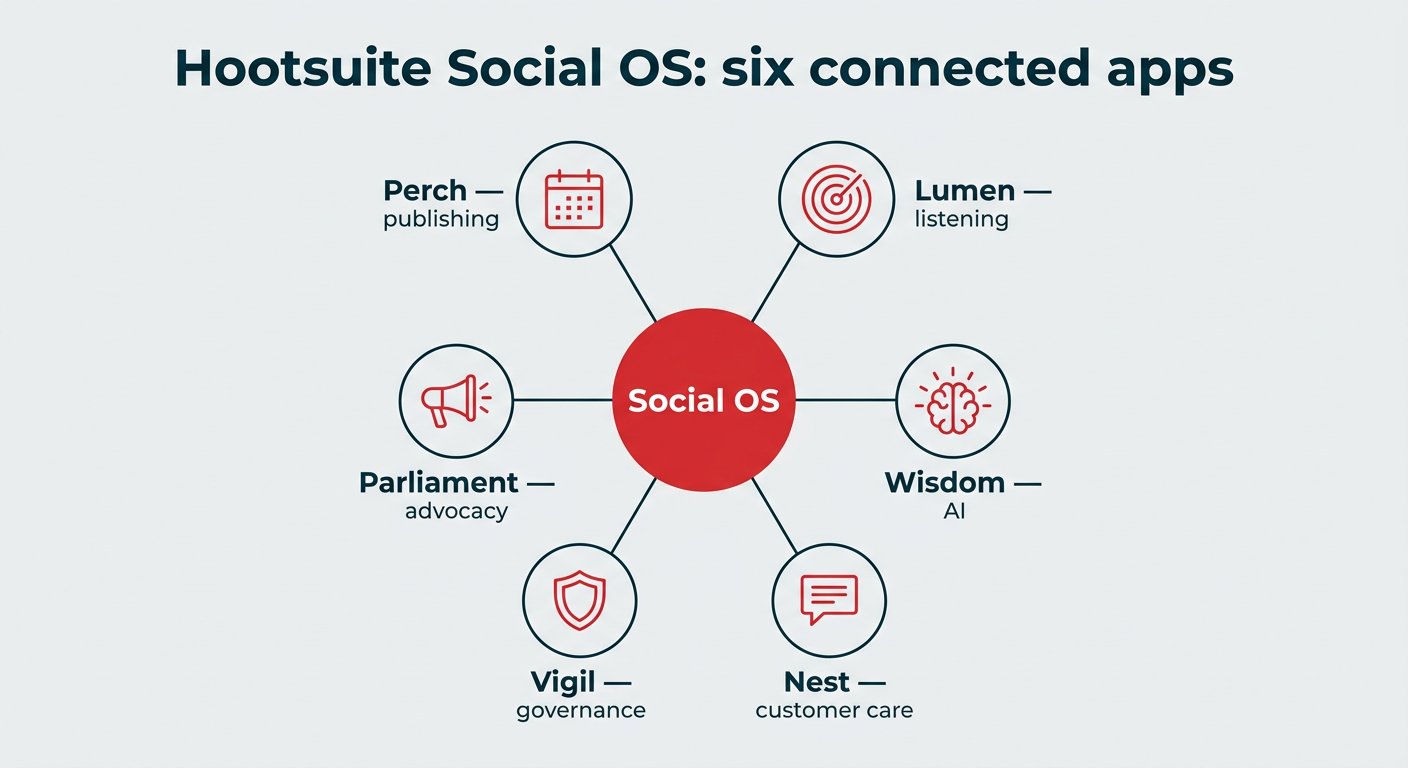
For organizations seeking a direct enterprise-grade alternative to Sprout Social without the punishing per-seat inflation, Hootsuite Social OS stands out. It unifies publishing, analytics, social listening, customer care, and governance into a single connected platform supporting major networks like Facebook, Instagram, LinkedIn, TikTok, Pinterest, and YouTube.
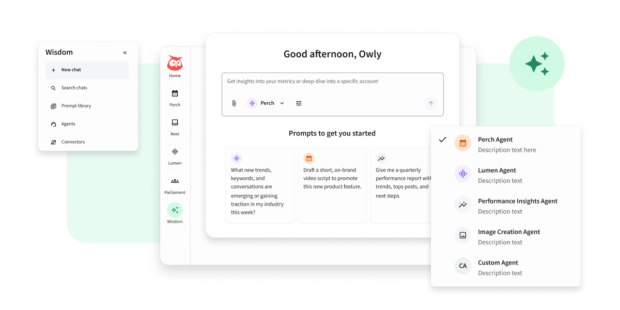
- Key Strengths: Hootsuite’s architecture relies on interconnected apps that share real-time context. Its Lumen listening tool taps into over 150 million sources across 187 languages, while Wisdom AI orchestration ties insights directly into publishing and customer care workflows.
- Security & Compliance: Particularly notable for heavily regulated sectors, Hootsuite provides robust compliance and auditing tools that safeguard enterprise brands against security breaches.
- Pricing: Starting at $99/user/month for standard tiers—roughly half of Sprout Social’s entry point—Hootsuite scales cost-effectively for growing teams.
2. Agorapulse: The Mid-Market Favorite
Agorapulse bridges the gap for mid-size marketing teams desiring a clean, unified social inbox and transparent ROI tracking without enterprise overhead.
- Key Strengths: Boasting a high G2 rating of 4.5/5, Agorapulse offers intuitive queue management, reliable publishing, and straightforward analytics starting at $79/user/month. While it lacks the massive listening depth of dedicated intelligence tools, it delivers exceptional user-friendliness for in-house teams.
3. Sprinklr: Unified Customer Experience Management (CXM)
Designed strictly for large multinational corporations, Sprinklr consolidates customer interactions across more than 30 digital channels.
- Key Strengths: It functions as a complete customer experience ecosystem, blending social media management, care, and automated AI analytics.
- Trade-offs: This immense power introduces significant implementation complexity and onboarding times, making it best suited for global enterprises with dedicated operations teams. Self-serve plans start at $299/month, with custom enterprise pricing upon request.
4. Brandwatch: The Insights-First Choice
If your organization’s primary frustration with Sprout Social lies in limited listening depth rather than publishing mechanics, Brandwatch is a premier alternative. Built primarily for enterprise research and brand health monitoring, its consumer intelligence capabilities are top-tier. However, day-to-day publishing execution is lighter compared to dedicated management suites.
Official Responses and Market Perspectives
Industry analysts and brand executives emphasize that software selection must be rooted in clear operational roadmaps rather than feature accumulation. According to recent enterprise software evaluations, procurement teams are increasingly favoring platforms that offer transparent, predictable pricing tiers alongside modular AI capabilities.

Vendors like Hootsuite have publicly leaned into this demand by emphasizing total cost of ownership reductions, noting that per-user models must deliver immediate cross-departmental utility—such as combining customer care, employee advocacy, and secure governance into a single invoice—to justify enterprise expenditure.
Strategic Implications: How to Choose Your Next Platform
Transitioning away from Sprout Social requires a methodical, three-step evaluation process to ensure the chosen platform aligns with your organization’s trajectory:

Step 1: Define Your Must-Haves vs. Nice-to-Haves
Catalog your operational bottlenecks. Do you need advanced social listening to track macroeconomic consumer sentiment, or are you primarily struggling with multi-channel publishing and approvals? Distinguish core functional requirements before viewing sales demos.
Step 2: Model the Total Cost of Ownership (TCO)
Calculate your team size today and project your growth over the next 12 to 18 months. Because tools like Sprout Social scale aggressively with every added seat, switching to a per-user platform like Hootsuite ($99/mo) or Agorapulse ($79/mo) can yield substantial budgetary relief without sacrificing enterprise capabilities.

Step 3: Run a Pilot Program
Never migrate an entire marketing operation blind. Narrow your shortlist to two contenders, secure a trial or pilot period (such as Hootsuite’s 30-day trial or shorter agency trials with Sendible and SocialBee), and test the platform with a small cross-functional pod. This guarantees that workflow frictions, reporting gaps, and permission structures are fully vetted before rolling out the system company-wide.
Conclusion
Sprout Social remains a capable platform, but rising per-seat expenses, gated listening modules, and enterprise governance limitations are driving modern marketing teams to explore leaner, more powerful alternatives. Whether you opt for the robust, security-focused architecture of Hootsuite Social OS, the agency-friendly workflows of Sendible, or the consumer intelligence depth of Brandwatch, aligning your tool choice with clear business goals will secure a higher return on your digital marketing investment for years to come.
 Nila Kartika Wati
  Basiran
  Nana Muazin