WASHINGTON — Public sentiment toward U.S. Immigration and Customs Enforcement (ICE) has grown increasingly sour, according to a sweeping new nationwide survey released by the Pew Research Center. As the federal agency sits squarely at the bleeding edge of the Trump administration’s high-profile, aggressive deportation operations, a clear majority of Americans now hold an unfavorable view of the organization.
The nationwide poll, which surveyed 5,062 U.S. adults between September 28 and October 4, 2026, reveals that 56% of Americans express an unfavorable opinion of ICE. By contrast, only 35% view the agency favorably, while 9% remain undecided or unsure. These numbers cement ICE’s position as the least favorably evaluated among the 12 major federal agencies and departments tracked in the center’s ongoing governance research.
The findings arrive against a backdrop of intense domestic debate surrounding border sovereignty, executive overreach, and humanitarian concerns. With President Donald Trump prioritizing mass deportations in his secondterm—a cornerstone of his political platform that frequently frames undocumented immigration as a national security threat—the institutional friction surrounding ICE has become a defining flashpoint in modern American politics.
Main Facts and Core Findings
The Pew Research Center data highlights a distinct erosion of public goodwill across nearly every major demographic and political category compared to the previous year.
Overall Favorability Decline: Unfavorable views of ICE rose from 49% in 2025 to 56% in 2026, while favorable ratings dropped correspondingly from 40% to 35%.
Partisan Polarization Persists: While a wide chasm remains between the two major political parties, negative sentiment has crept upward within both camps. Two-thirds (67%) of Republicans and Republican-leaning independents view ICE favorably—a notable dip from 72% a year prior. Meanwhile, 84% of Democrats and Democratic leaners view the agency unfavorably, up from 78% last year.
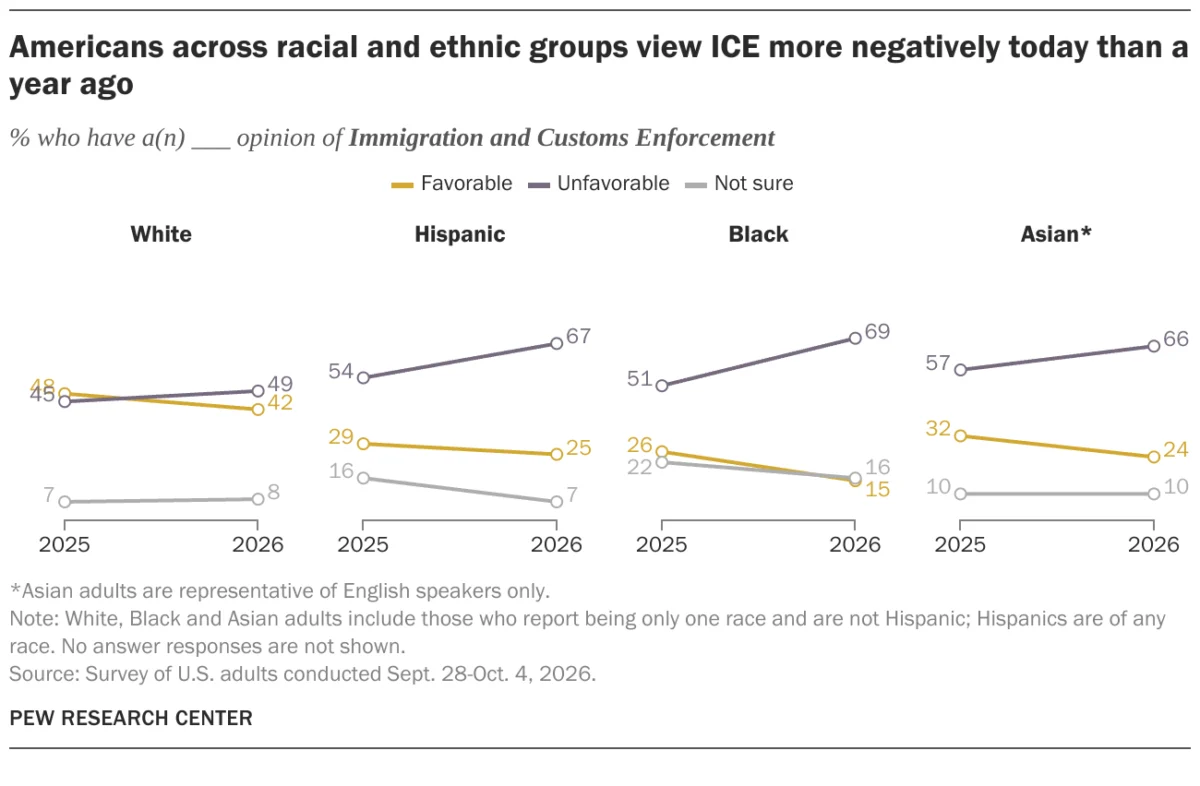
Racial and Ethnic Divides: Discontent spans across racial and ethnic demographics. Substantial majorities of Black (69%), Hispanic (67%), and Asian adults (66%) now express negative views of the agency, marking steep climbs from 2025 figures. While White adults remain the demographic most likely to view ICE favorably, even that group has experienced a shift: 49% now hold an unfavorable view, up from 45% last year, eclipsing the 42% who report a positive opinion.
Chronology: The Escalation of Immigration Enforcement and Public Backlash
To understand the current hostility surrounding ICE, observers must look back at the historical trajectory of the agency and its modern political evolution.
The Post-9/11 Genesis
Established in 2003 under the Homeland Security Act following the terrorist attacks of September 11, ICE was forged by merging enforcement arms of the former Immigration and Naturalization Service (INS) and the U.S. Customs Service. Its dual mandate—overseeing Homeland Security Investigations (HSI) and Enforcement and Removal Operations (ERO)—was initially designed to dismantle transnational criminal organizations and secure internal borders.
The First Trump Term and "Abolish ICE"
During Donald Trump’s first term in the White House (2017–2021), ICE shifted from a relatively low-profile bureaucratic entity to a lightning rod for national controversy. High-profile enforcement actions, including workplace raids and the controversial "zero tolerance" family separation policy at the southern border, thrust the agency into the headlines. Progressive activists and progressive lawmakers launched the "Abolish ICE" movement, arguing that the agency’s tactics violated human rights and eroded community trust.
The Biden Interregnum
Under the Biden administration, ICE faced competing pressures. While the administration attempted to prioritize enforcement against individuals who posed threats to public safety or national security rather than conducting sweeping workplace or community roundups, critics on the political right argued the agency was hamstrung and ineffective. Border apprehensions surged to historic highs during parts of this period, keeping immigration at the forefront of the national consciousness.
The Second-Term Surge (2025–2026)
Following his successful reelection campaign—heavily anchored on promises to deport millions of undocumented immigrants and combat what he termed an "invasion" of criminals—President Trump returned to office with an emboldened mandate. Throughout 2025 and into 2026, ICE personnel have operated at maximum tempo. Masked federal agents have executed targeted arrests in courthouses, workplaces, and neighborhoods across major metropolitan hubs, such as New York City’s Federal Plaza. This ramped-up enforcement has accelerated the polarization of public opinion captured in the latest Pew data.
Supporting Data: Breaking Down the Numbers
A deeper examination of the Pew Research Center’s data tables illustrates how partisan identity intersects with race and ethnicity to shape opinions on federal immigration enforcement.
Partisan Nuances Within Demographic Groups
While Republicans overwhelmingly support ICE, internal variations exist based on race and ethnicity. Among Republican and Republican-leaning respondents:
White Republicans maintain strong backing for the agency, with 71% expressing a favorable opinion and only 20% holding an unfavorable view.
Hispanic Republicans are notably cooler in their assessment. Just 53% view ICE favorably, while 39% report an unfavorable view (though this subgroup carries a relatively small sample size with a margin of error of +/- 10.1 percentage points).
Conversely, opposition among Democrats is nearly universal, though intensity varies slightly by race:
White Democrats register the highest levels of hostility, with 89% holding an unfavorable view and a mere 6% viewing the agency favorably.
Asian Democrats report an 82% unfavorable rating.
Hispanic Democrats report a 79% unfavorable rating.
Black Democrats register a 75% unfavorable rating, accompanied by a higher proportion of "not sure" responses (12%).
+---------------------------------------------------------------------------------+
|                        SUMMARY OF ICE OPINIONS (2026)                           |
+------------------------------+-------------------+------------------------------+
| Demographic Group            | Favorable (%)     | Unfavorable (%)              |
+------------------------------+-------------------+------------------------------+
| Total U.S. Adults            | 35%               | 56%                          |
| Rep / Lean Rep               | 67%               | 23%                          |
| Dem / Lean Dem               | 9%                | 84%                          |
| White Adults                 | 42%               | 49%                          |
| Hispanic Adults              | 25%               | 67%                          |
| Black Adults                 | 15%               | 69%                          |
| Asian Adults (English only)  | 24%               | 66%                          |
+------------------------------+-------------------+------------------------------+
Source: Pew Research Center Survey of U.S. Adults (Sept. 28 – Oct. 4, 2026).
Official Responses and Political Reactions
The divergence in public opinion is mirrored precisely in the halls of Washington, where lawmakers remain deeply divided over the future and funding of immigration enforcement agencies.
The Administration Defense
Proponents of the administration’s agenda argue that public polling reflects a campaign of misinformation rather than a rejection of public safety. White House and Department of Homeland Security (DHS) officials maintain that ICE is executing the clear mandate handed down by voters in the 2024 election.
"The American people voted decisively for secure borders and the rule of law," a senior administration official noted following the release of enforcement metrics earlier this year. "Immigration and Customs Enforcement is doing the courageous, necessary work of removing dangerous criminal aliens, drug traffickers, and gang members from our communities. Law enforcement agencies should be judged on their fidelity to the Constitution and public safety, not transitory political winds."
Congressional Criticisms
On the other side of the aisle, congressional Democrats point to the rising unfavorable metrics as validation of their concerns regarding due process, civil rights, and community destabilization.
Progressive lawmakers have renewed calls for aggressive congressional oversight of ICE facilities, budget restrictions on mass deportation operations, and legislative protections for long-term undocumented residents with deep community ties.
"When over half of the country—and supermajorities of communities of color—view an agency with deep disfavor, it is a flashing red light," said a prominent Democratic member of the House Judiciary Committee. "Mass roundups tear apart families, strike fear into our neighborhoods, and fail to reflect American values. We need comprehensive immigration reform, not militarized policing that alienates millions of our residents."
Implications for Governance and the Midterm Landscape
As the United States navigates the political landscape of late 2026, the cratering public approval of ICE carries profound implications for upcoming legislative battles and the broader political climate.
1. Legislative Battles Over Agency Funding
With control of Congress hanging in a delicate balance, appropriations bills funding DHS and ICE are expected to become major battlegrounds. Fiscal conservatives will push to expand detention bed capacity and hiring quotas, while progressive and moderate Democrats may leverage the threat of government shutdowns to demand operational guardrails and increased transparency.
2. Electoral Calculus
The deep polarization over immigration enforcement ensures that border security and interior enforcement will remain potent mobilization tools for both parties. For the GOP, maintaining enthusiasm among their base—two-thirds of whom still back ICE—is critical heading into electoral cycles. For Democrats, the overwhelming opposition to ICE among Hispanic, Black, and Asian voters reinforces the urgency of galvanizing multi-ethnic coalitions around progressive immigration frameworks.
3. Operational Strains on Local Communities
As ICE ramps up enforcement in urban and suburban centers alike, local municipal leaders, law enforcement agencies, and community organizations face mounting operational pressures. Questions regarding local cooperation with federal detainee requests, sanctuary city policies, and the psychological impact of visible enforcement actions on local economies and schools will continue to dominate civic discourse.
Ultimately, the Pew Research Center data paints a portrait of a nation profoundly divided over how to manage its borders and population. As long as ICE remains the frontline instrument of federal immigration policy, it will continue to serve as a barometer for America’s deepest ideological fractures.

 By Neng Nana


 rifanmuazin
 Sagoh
 Pevita Pearce
