
 By rifanmuazin
As artificial intelligence systems like ChatGPT, Claude, and specialized automation software redefine the modern professional landscape, labor economists are racing to understand their long-term societal impacts. While early public anxieties centered broadly on mass layoffs, a new comprehensive study from the Pew Research Center suggests a more nuanced, complex reality.
An analysis of U.S. government data reveals a distinct and growing gender gap in the labor market. Across occupations heavily exposed to AI, employment growth for women has noticeably lagged behind that of men. This disparity becomes even more pronounced when examined through the lens of educational attainment, pointing toward structural labor market shifts that policy makers, economists, and corporate leaders can no longer afford to ignore.
Main Facts: The Emergence of the AI-Driven Gender Gap
The core finding of the Pew Research Center analysis is clear: employment growth has been slower for women than for men in occupations with a higher degree of exposure to artificial intelligence.
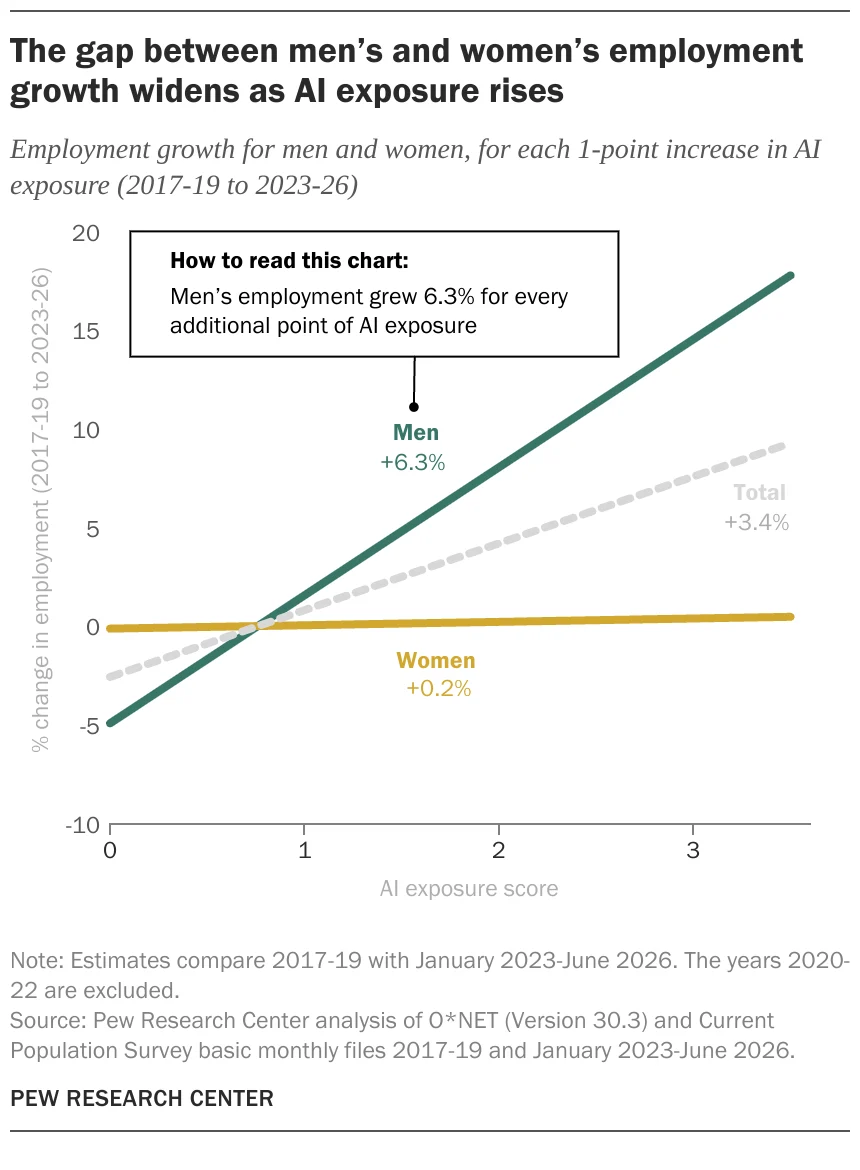
To quantify this, researchers evaluated 480 occupations using data from the U.S. Department of Labor’s Occupational Information Network (O*NET) and the Current Population Survey (CPS). Every occupation was assigned an "AI exposure score" ranging from zero to 3.5. This metric measures the extent to which generative AI can perform, assist with, or automate the primary tasks required in a specific job.
The study established that for every 1-point increase in an occupation’s AI exposure score:
- Men’s employment grew by an average of 6.3%.
- Women’s employment remained virtually unchanged, registering a negligible 0.2% growth.
This divergence means that as occupations become more susceptible to AI integration—typically fields heavy in reading, writing, and information processing—men are experiencing significantly greater job expansion than women within those same career categories. At the lowest end of the AI exposure scale, however, this dynamic reverses: in fields least impacted by AI, women’s employment growth outpaces that of men.
Chronology: Tracing the Evolution of Work Before and After Generative AI
To isolate the effects of artificial intelligence from general economic fluctuations, researchers structured their timeline around the technological inflection point marked by the public release of modern generative AI tools.
Pre-Generative AI Era (2017–2019)
Before the widespread commercial availability of advanced conversational models and generative tools, baseline employment trends for men and women across various occupations followed traditional trajectories. This baseline period serves as the control benchmark for the study, establishing pre-existing labor patterns free from the disruptive influence of contemporary AI.

The Pandemic Disruption (2020–2022)
To maintain analytical integrity, researchers deliberately excluded the years 2020 through 2022. The COVID-19 pandemic triggered unprecedented, structural shocks to the global and domestic workforce—ranging from remote work mandates and supply chain collapses to mass resignations and healthcare strains—reasons entirely unrelated to artificial intelligence.
The Generative AI Era (January 2023–June 2026)
Following the explosive public rollout of tools like ChatGPT in late 2022, the subsequent years mark the deployment phase of AI in workplaces nationwide. Comparing this current window (January 2023 through June 2026) against the 2017–2019 baseline allowed researchers to measure the precise differential in employment growth along gender lines as AI adoption accelerated.
Supporting Data: Examining Exposure Scores and Education Levels
Understanding why this gender gap exists requires a closer look at the types of jobs men and women hold, as well as their educational backgrounds.
Occupational Exposure Scores
AI exposure is not a measure of job quality or economic importance; rather, it indicates how deeply generative tools can penetrate daily duties.
- Very Low Exposure (0 to ~0.7): Occupations such as truck drivers, construction laborers, and maids/housekeeping cleaners score near the bottom. These roles heavily rely on physical mobility, manual dexterity, and in-person spatial manipulation.
- Low Exposure (~0.8 to ~1.2): Carpenters, retail salespersons, and home health aides.
- Medium Exposure (~1.5 to ~2.0): Medical assistants, tellers, receptionists, and administrative assistants.
- High to Very High Exposure (2.1 to 3.5): Customer service representatives, accountants, auditors, software developers, and financial managers. These fields are defined by data management, code writing, ledger balancing, and customer communication—tasks where large language models excel.
The Educational Divide
The data reveals that the gender gap in AI-exposed job growth is not uniform across all demographics; rather, it is deeply tied to educational attainment.
- Workers with a High School Diploma or Less: Among individuals without a college degree, the disparity is stark. For every 1-point increase in AI exposure, men’s employment rose by 8.8%, while women’s employment fell by 9.5%.
- Workers with Some College Education: A similar, though slightly less severe, trend emerges for those with associate degrees or partial college attendance, where men’s employment grew by 3.6% compared to a 6.0% decline for women.
- Workers with a Bachelor’s Degree or Higher: For college graduates, the gender gap largely vanishes. Neither men’s nor women’s employment changed significantly as AI exposure increased, with growth hovering near parity (+0.8% for men and +0.7% for women).
Crucially, researchers note a compositional effect regarding where these workers are employed. Men without a college degree who work in AI-exposed roles represent a relatively small share of the male workforce, as most non-college-educated men are concentrated in low-exposure physical jobs like construction and freight moving. Conversely, women without a four-year degree are heavily represented in mid-to-high exposure administrative and support roles—such as receptionists, secretaries, and customer service representatives—putting them directly in the path of AI automation and restructuring.
Official Responses and Methodological Clarifications
In releasing the findings, the Pew Research Center emphasized precise methodological boundaries to prevent misinterpretation of the data.
Researchers stressed that the analysis measures employment growth within specific occupations, comparing the rate of change for men against women inside those same job categories. The study does not compare different occupations against one another, nor does it endorse outdated tropes labeling certain fields as inherently "men’s work" or "women’s work."

Furthermore, researchers acknowledged that the correlation between AI exposure and differential job growth is not necessarily direct or isolated. While the study compares job figures before and after the commercialization of generative AI, broader macroeconomic shifts, changing corporate outsourcing patterns, and shifting consumer demands during the 2023–2026 window may have simultaneously influenced employment figures.
Labor experts, trade associations, and corporate diversity officers have begun reviewing the data to understand whether automated workflows are inadvertently displacing administrative support and customer-facing roles—sectors traditionally dominated by female workers—while tech-adjacent and operational expansions favor male-dominated hiring pools.
Implications: Preparing for the Next Phase of Workforce Transformation
The revelation that employment growth is diverging along gender lines in AI-exposed industries carries profound implications for economic policy, corporate governance, and educational planning.
1. Re-evaluating Upskilling and Reskilling Initiatives
Traditional corporate responses to AI disruption have focused heavily on general digital literacy programs. However, the stark divide among non-college-educated workers suggests that upskilling initiatives must be precisely targeted. If women without four-year degrees are disproportionately concentrated in administrative and clerical roles facing high AI exposure, training programs must provide direct pathways into resilient, higher-growth technical or operational sectors.
2. Corporate Accountability and Internal Audits
As companies rapidly integrate AI to boost productivity and cut administrative overhead, human resources departments and executive leadership must monitor the downstream effects on workforce demographics. Without intentional oversight, automated efficiency measures risk hollowing out mid-level support roles that have historically served as crucial entry and advancement points for female professionals.
3. Future Economic Resilience
As artificial intelligence continues to mature from an emerging workplace novelty into standard enterprise infrastructure, the long-term health of the U.S. labor market will depend on inclusive growth. Ensuring that the economic dividends of AI innovation are distributed equitably across genders and education levels remains one of the defining policy challenges of the decade.
 Sagoh
 Pevita Pearce
