
 By Ammar Sabilarrohman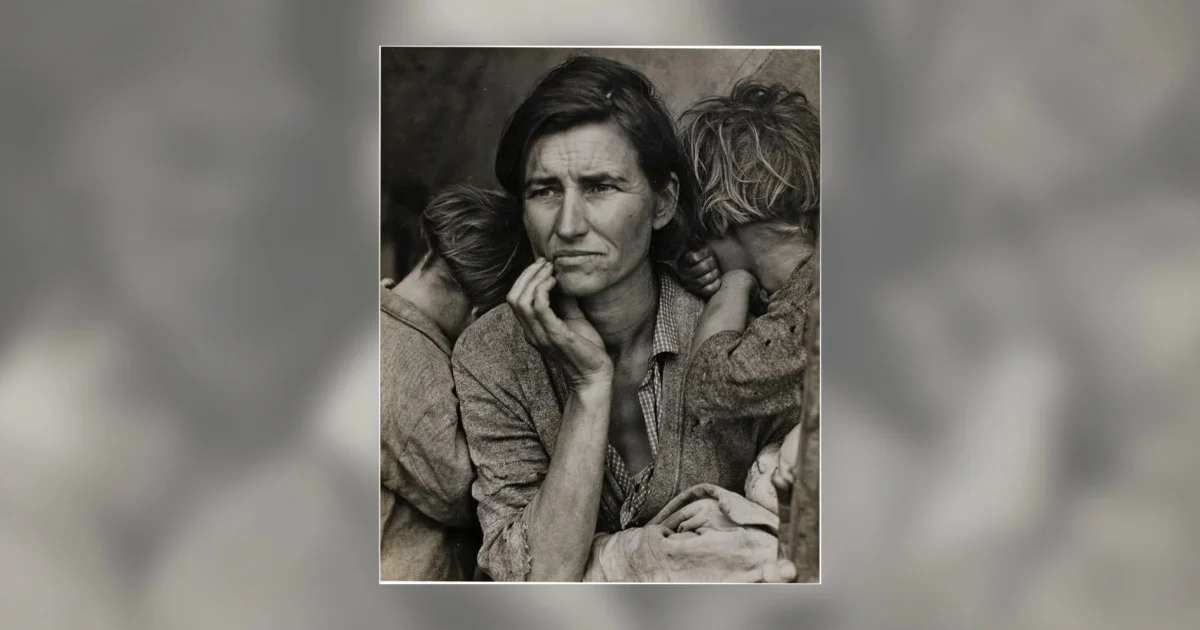
NEW YORK — The global art market has turned its collective gaze toward Sotheby’s as its marquee online Prints and Photographs auction officially gets underway. While the catalog features numerous historic and contemporary masterworks, two exceptional lots have instantly captured the attention of collectors, curators, and photography historians alike.
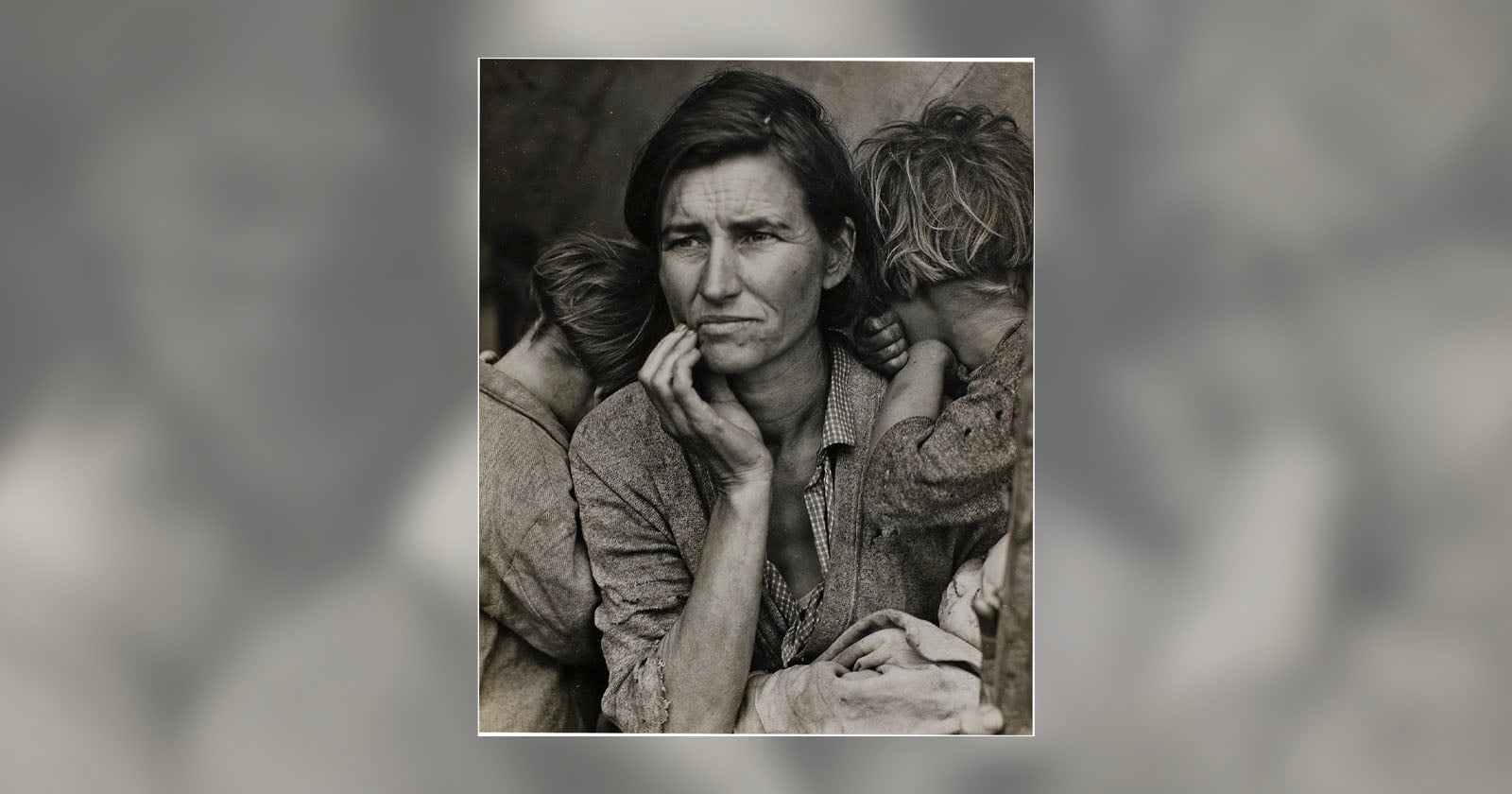
Leading the charge is an extraordinarily rare, first-generation vintage print of Dorothea Lange’s 1936 masterpiece, Migrant Mother—an image universally recognized as one of the definitive visual artifacts of the 20th century. Expected to command between $100,000 and $150,000, this particular physical artifact boasts unique provenance details that distinguish it from the thousands of later reproductions circulating in museums and textbooks worldwide.
Running neck-and-neck in both historical significance and estimated market value is a monumental, museum-scale print from Hiroshi Sugimoto’s celebrated Theaters series: Radio City Music Hall, New York City. Estimated at $200,000 to $300,000, this breathtaking single-edition print represents the pinnacle of conceptual architectural photography and has never before appeared on the public auction block.
Main Facts: The Highlights of the Sotheby’s Sale
The ongoing Sotheby’s online photography auction brings together seminal works that trace the evolution of the medium from documentary photojournalism to conceptual fine art. However, the undisputed anchor of the sale is Lange’s iconic portrait of Florence Owens Thompson, captured in Nipomo, California, during the height of the Great Depression.
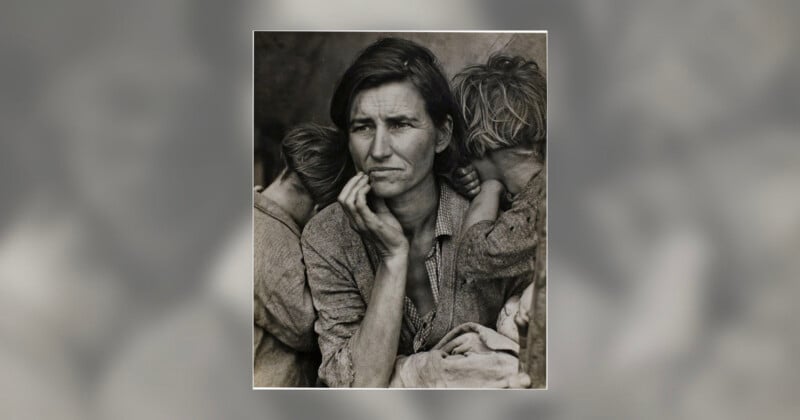
What separates this specific offering from standard prints of Migrant Mother is its status as a primary source document. Executed in 1936 and printed no later than 1937, the physical photograph has never previously been offered at public auction. It retains the original credit stamp of the Resettlement Administration—the federal New Deal agency that employed Lange—and features a minute, highly revealing anatomical detail: the subject’s thumb visibly resting in the lower right corner of the frame. In subsequent cropping and later printings for public distribution, this detail was routinely edited out, making this early print a literal window into Lange’s initial framing decisions.
Simultaneously, Hiroshi Sugimoto’s Radio City Music Hall, New York City offers a masterclass in temporal compression. Captured using an ultra-long exposure that spans the entirety of a feature film, the image transforms the famous Art Deco theater from a space of consumption into an ethereal glowing cavern. Because the projector’s light continuously illuminates the grand interior for hours, the physical audience entirely vanishes, leaving behind only the ghostly, reverberating architecture of the hall and a brilliantly luminous, completely blank movie screen.
Chronology: The Journey of an Icon
To understand the immense value and cultural weight of the Migrant Mother print heading to auction, one must retrace the harrowing historical sequence that birthed the image in the spring of 1936.
March 1936: The Chance Encounter in Nipomo
Though the acute panic of the 1929 stock market crash had subsided by 1936, rural poverty remained a devastating reality across the United States. Thousands of agricultural laborers wandered the West Coast, trapped in cycles of seasonal unemployment and destitution. Dorothea Lange, working as a documentary photographer for the federal Resettlement Administration (which would soon transition into the Farm Security Administration), spent nearly a month navigating California’s agrarian corridors to capture these conditions.
On a rainy day in March 1936, Lange was driving back to her base in Berkeley when she passed a hand-lettered sign pointing toward a makeshift camp of stranded pea pickers near Nipomo, California. Initially, she drove past. Overcome by a professional and moral compulsion, she turned her car around, entered the squalid camp, and approached a mother camped out in a tent made of frozen-pea pickers’ lean-tos.
Using her heavy 4×5-inch Graflex camera, Lange worked deliberately, moving closer through a sequence of increasingly intimate compositions. The final, definitive shot captured 32-year-old Florence Owens Thompson—her weathered face carved by exhaustion and acute worry—flanked by two of her children, who turn their faces away from the lens and burrow into her shoulders.
March 10–11, 1936: Hitting the Press
Within days of the shoot, Lange’s urgent negatives were developed. Recognizing the immediate journalistic value, the San Francisco News published a series of articles detailing the desperate plight of California’s migrant workers.
On March 11, 1936, Migrant Mother served as the emotional centerpiece for an article titled, “What Does the ‘New Deal’ Mean to This Mother and Her Child?” The photograph instantly galvanized public sympathy, prompting the federal government to rush emergency food supplies and aid to the starving camp at Nipomo before the pea pickers starved or succumbed to disease.
1936–1937: Crafting the Vintage Print
During this immediate post-shoot window, primary prints were produced for official agency archives and distribution to select news outlets. It was during this period that the currently auctioned print was physically realized. Bearing the administrative stamps of the Resettlement Administration and retaining the untouched margins showing Thompson’s thumb, this artifact represents the earliest material phase of the photograph’s existence—long before it was elevated to the pantheon of global art history.
Supporting Data and Market Valuations
The economics of fine art photography have shifted dramatically over the past several decades, with early vintage prints by master photojournalists achieving price points traditionally reserved for paintings and sculptures.
-
Dorothea Lange’s Migrant Mother (Nipomo, California, 1936):
- Estimated Auction Value: $100,000 – $150,000 USD.
- Format/Medium: Vintage gelatin silver print.
- Unique Identifiers: Retains original Resettlement Administration credit stamp; includes Florence Owens Thompson’s thumb visible in the lower right corner (cropped out of later versions).
- Auction History: Never previously offered at public auction; emerging directly from a private collection.
-
Hiroshi Sugimoto’s Radio City Music Hall, New York City (1978):
- Estimated Auction Value: $200,000 – $300,000 USD.
- Format/Medium: Gelatin silver print (Museum scale: 47 by 58 3/4 inches).
- Edition Rarity: Print number 1 from an ultra-limited edition of only 5.
- Auction History: Making its inaugural public auction debut.
The valuation disparity between the two lots highlights how contemporary conceptual photography—when executed with extreme rarity and monumental scale, as in Sugimoto’s work—can sometimes outpace even the most historically vital historical photojournalism in raw market speculation. However, vintage prints with direct association to the New Deal era remain among the most fiercely contested assets among institutional buyers and museum acquisition boards.
Official Responses and Expert Analysis
Sotheby’s specialists have released extensive catalog notes detailing the profound art-historical weight of both photographs.
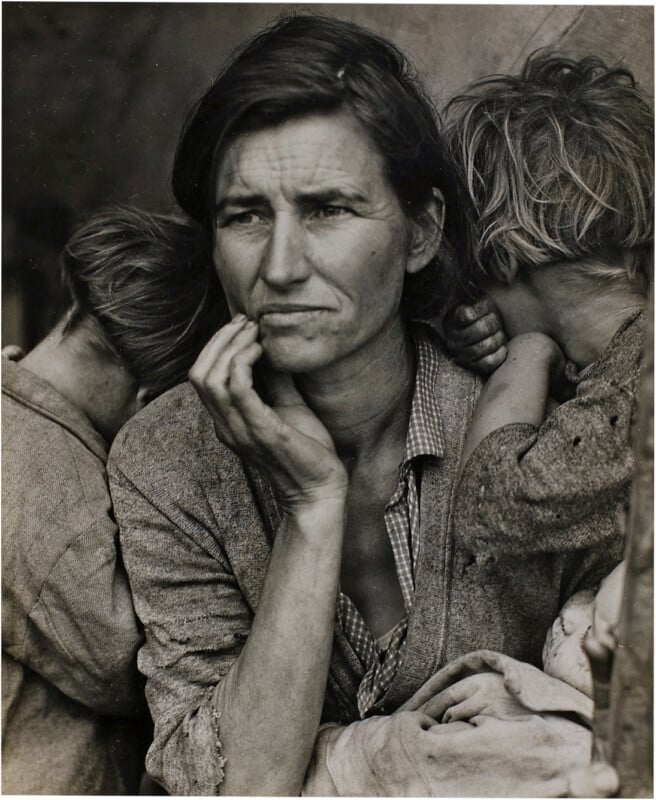
Regarding the Lange lot, auction specialists emphasize the unique intersection of documentary necessity and accidental artistic composition. "Although neither Lange nor her editors could have anticipated the photograph’s future significance, the image has assumed a life far beyond its original journalistic purpose," Sotheby’s noted in their catalog statement. "The work is appearing at auction for the first time, offering an unmediated look at a cornerstone of American visual culture."
Art historians have long debated the ethics and impact of Migrant Mother. While Florence Owens Thompson later expressed mixed feelings about the fame the photograph brought—note that her identity remained anonymous to the public for decades—she acknowledged its power to focus national attention on systemic poverty. The retention of her thumb in this specific early printing serves as a physical reminder of the human interaction that occurred inside that tent in Nipomo—a photographer and a subject collaborating, however briefly, to bear witness to an American crisis.
Turning to Hiroshi Sugimoto’s architectural portrait, critics have hailed the Theaters series as a meditation on the passage of time. Writing on the mechanics of the Radio City Music Hall print, curators noted:
"Sugimoto’s vast interior, rendered in remarkable detail by the accumulated light of the projection, becomes the true subject of the photograph. During the long exposure, the audience disappears, leaving behind only the residual evidence of its presence in the illumination that fills the space. The staggered rows of seating and glowing aisle lights buzz with a rhythmic pattern of converging waves, activating the picture’s perspective structure."
Implications for the Photography Market
The inclusion of these two heavyweight lots in Sotheby’s October sale carries broad implications for the contemporary photography market.
- The Premium on Provenance: As the market matures, collectors are increasingly prioritizing vintage prints over modern restrikes. The presence of the Resettlement Administration stamp and the uncropped thumb on the Lange print establishes a gold standard for authenticity and historical completeness that modern reprints simply cannot match.
- Institutional Demand vs. Private Collecting: Both lots are expected to draw intense bidding from both deep-pocketed private collectors and museum acquisition committees looking to fill gaps in their permanent twentieth-century holdings.
- The Fusion of Documentary and Conceptual Art: By placing Lange’s human-centric social realism side-by-side with Sugimoto’s austere, ghost-filled architectural minimalism, the auction underscores the wide spectrum of photography as both a tool for historical documentation and a high-art medium capable of profound philosophical inquiry.
As the online auction progresses toward its final closing bids, all eyes in the art world remain fixed on New York. Whether these historic works will shatter their high estimates or quietly set new benchmarks for their respective creators, the sale has already reaffirmed the enduring, irreplaceable power of the photographic print in the digital age.
 Iffa Jayyana
  Reynand Wu
  Asep Darmawan