
 By Asro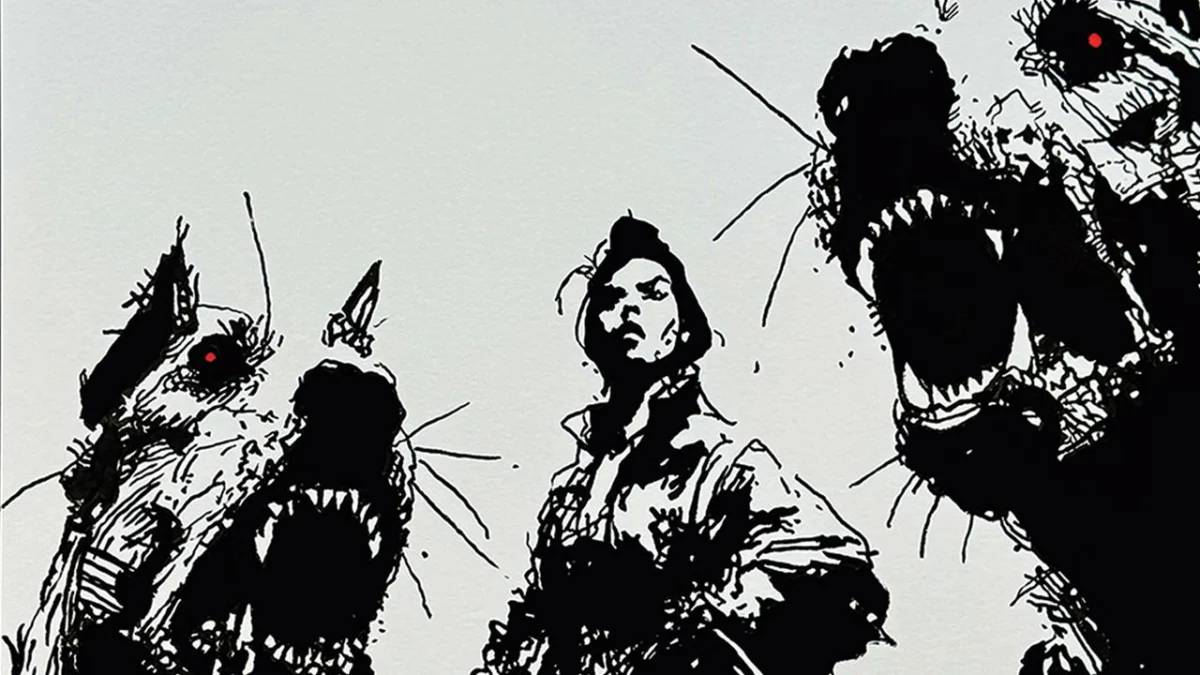
In the quiet corners of the contemporary art world, where digital polish often obscures the raw potential of traditional media, artist Will Thompson—known to his digital community as @The300ChickenNuggets—is carving out a distinct, monochromatic niche. Based in Georgia, Thompson has pioneered a hybrid aesthetic he calls “Southern American Sumi-e.” By marrying the disciplined, gestural fluidity of traditional Japanese ink wash painting with the rigid, Western structural integrity of Bristol vellum, Thompson has created a visual language that feels simultaneously ancient and extraterrestrial.
The Evolution of an Artist: From the Courtroom to the Canvas
The trajectory of Will Thompson’s career is as unconventional as his artistic output. A former law student, Thompson spent years navigating the rigid, analytical corridors of legal theory. However, the intellectual rigor required by the courtroom soon gave way to a burgeoning need for tactile, visual expression.
This pivot was not merely a change in profession but a complete restructuring of his creative process. Thompson describes his method as a “Self-Creating Prophecy.” Unlike artists who begin with a pre-determined sketch, Thompson allows his compositions to emerge through a rhythmic, iterative process. He utilizes minute, repetitive ticks and fine brush strokes that accumulate like geological strata.
“It is a balance,” Thompson explains, “between the obsessive, granular detail required by the medium and a spontaneous, ADHD-fueled creativity that allows the piece to dictate its own direction.” This approach turns every session into a dialogue with the ink; he does not merely illustrate a concept—he cultivates it on the page until it achieves a definitive depth and shadow.
The Technicality of ‘Southern American Sumi-e’
The term “Southern American Sumi-e” is a deliberate juxtaposition. Sumi-e (ink wash painting) is traditionally associated with simplicity, negative space, and the “breath” of the brush. Thompson, however, applies this philosophy to a dense, detail-driven style that reflects the humid, overgrown, and complex landscapes of the American South, blended with the speculative wonder of science fiction.
The Medium as Catalyst
Thompson’s primary tools are deceptively simple: Sumi ink and Diamine ink, applied to the smooth, non-absorbent surface of Bristol vellum. The choice of vellum is critical; because the ink does not soak into the fibers as it would with traditional rice paper, it sits atop the surface, allowing for sharper lines and a distinct, reflective quality that enhances the “dark and encapsulating” nature of his work.
Chronology of Creation
- The Foundation: Each piece begins with a singular, intuitive mark. Thompson avoids preliminary pencils, preferring to commit to the permanence of ink immediately.
- The Growth Phase: Through a series of rhythmic, microscopic lines, the artist builds form. This is where the “Self-Creating Prophecy” takes hold, as the shadow defines the light, and the negative space begins to represent the void of his sci-fi themes.
- The Refinement: Finally, the artist utilizes fine brush strokes to deepen the contrast, often pushing the ink to its saturation limits to create the “violent purple voids” and “crumbled stone” textures that define his portfolios.
Supporting Data: The Anatomy of a Scene
To understand the efficacy of Thompson’s technique, one must analyze the thematic pillars of his work. His pieces typically draw from two primary wells: the natural world—with its chaotic, organic entropy—and science fiction, which provides the structural, often cold, framework for his narratives.
Case Study: ‘Space-time Mage’
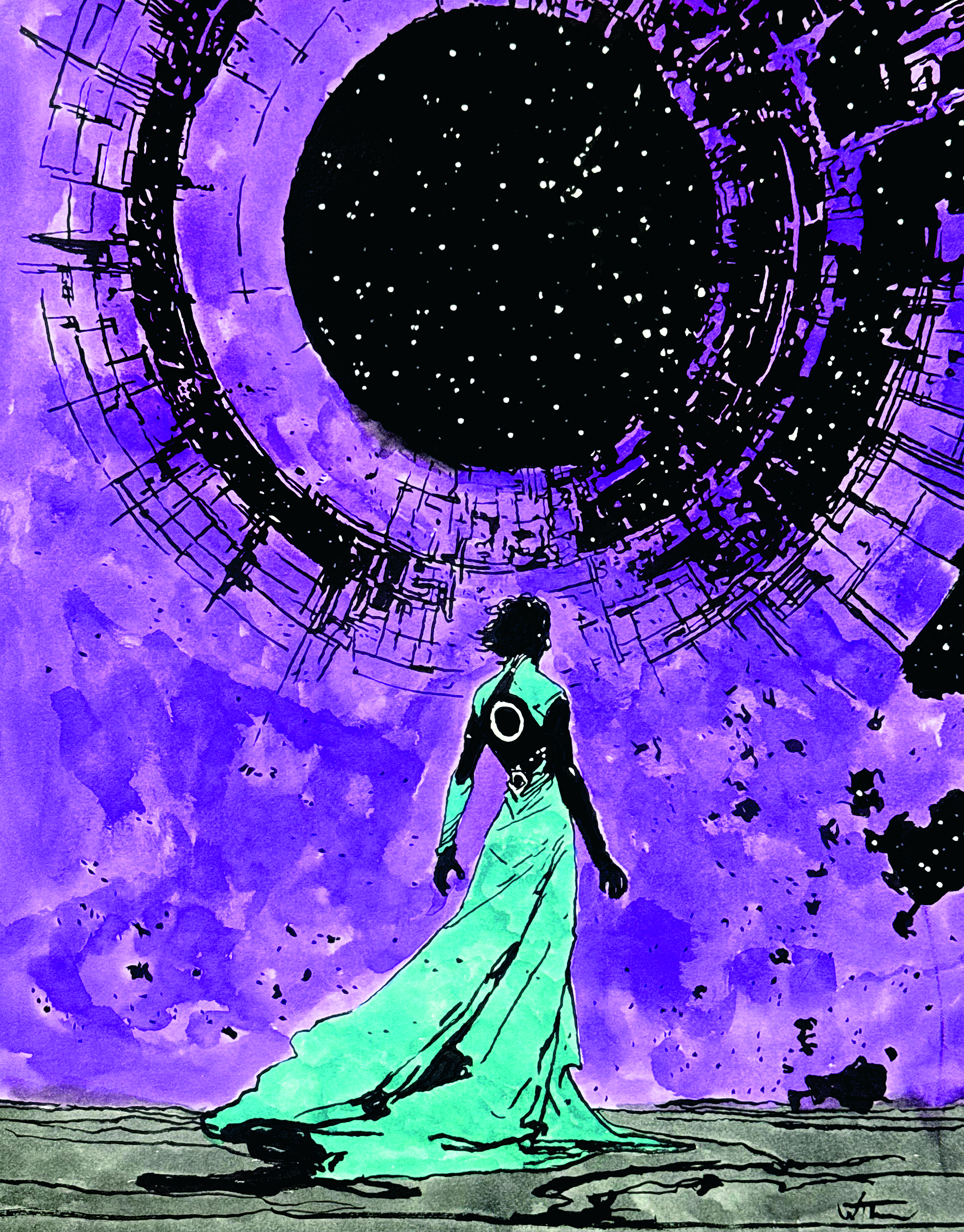
In this piece, Thompson explores the intersection of the arcane and the cosmic. The central figure, a lone mage cloaked in deep teal, stands against a swirling, violent purple void. The composition uses the contrast between the static, determined posture of the mage and the chaotic, fluid motion of the background to suggest a narrative of isolation. The viewer is left to wonder: is the mage protecting the universe, or is he the catalyst for its unraveling?
Case Study: ‘Prey’
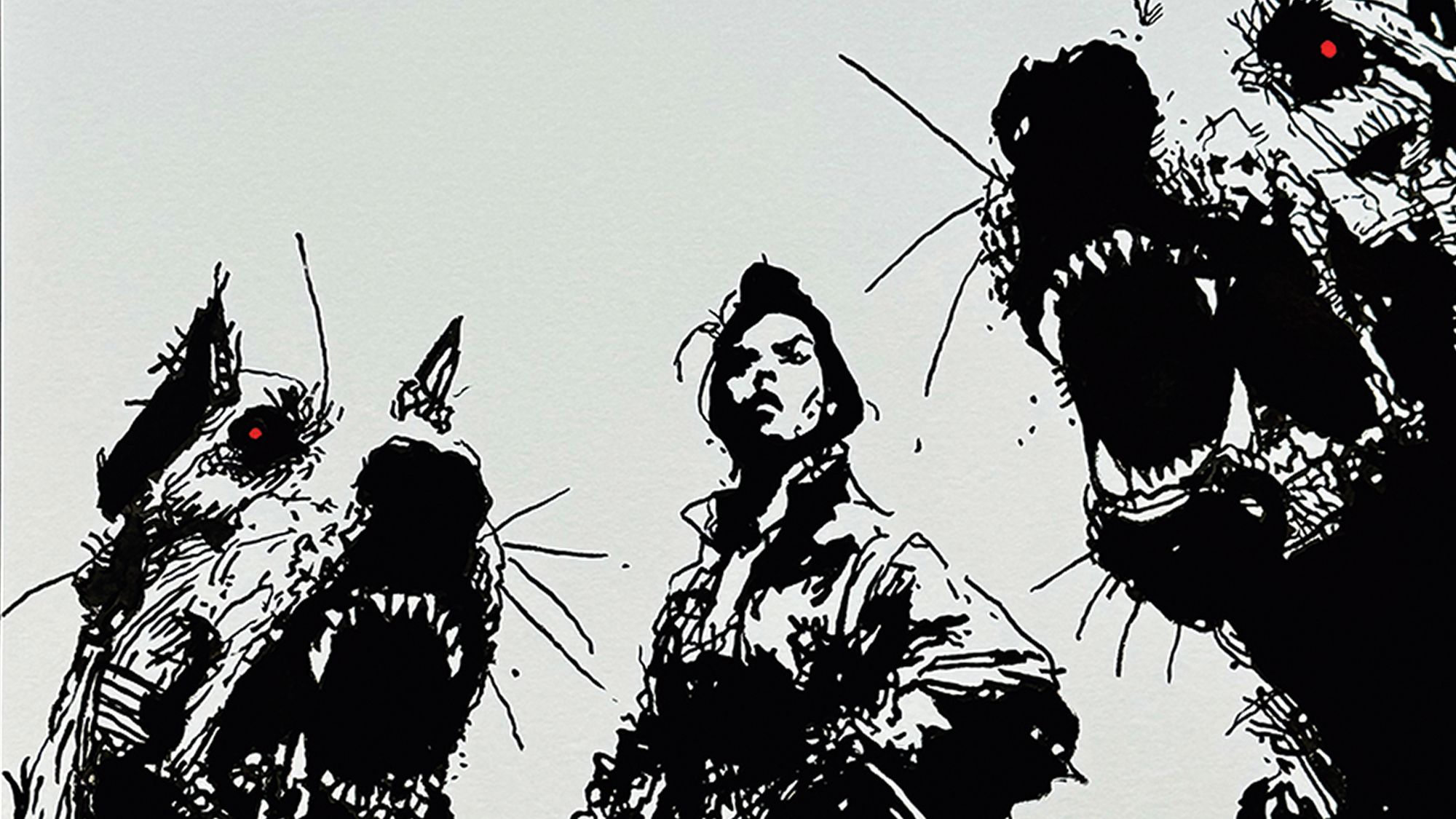
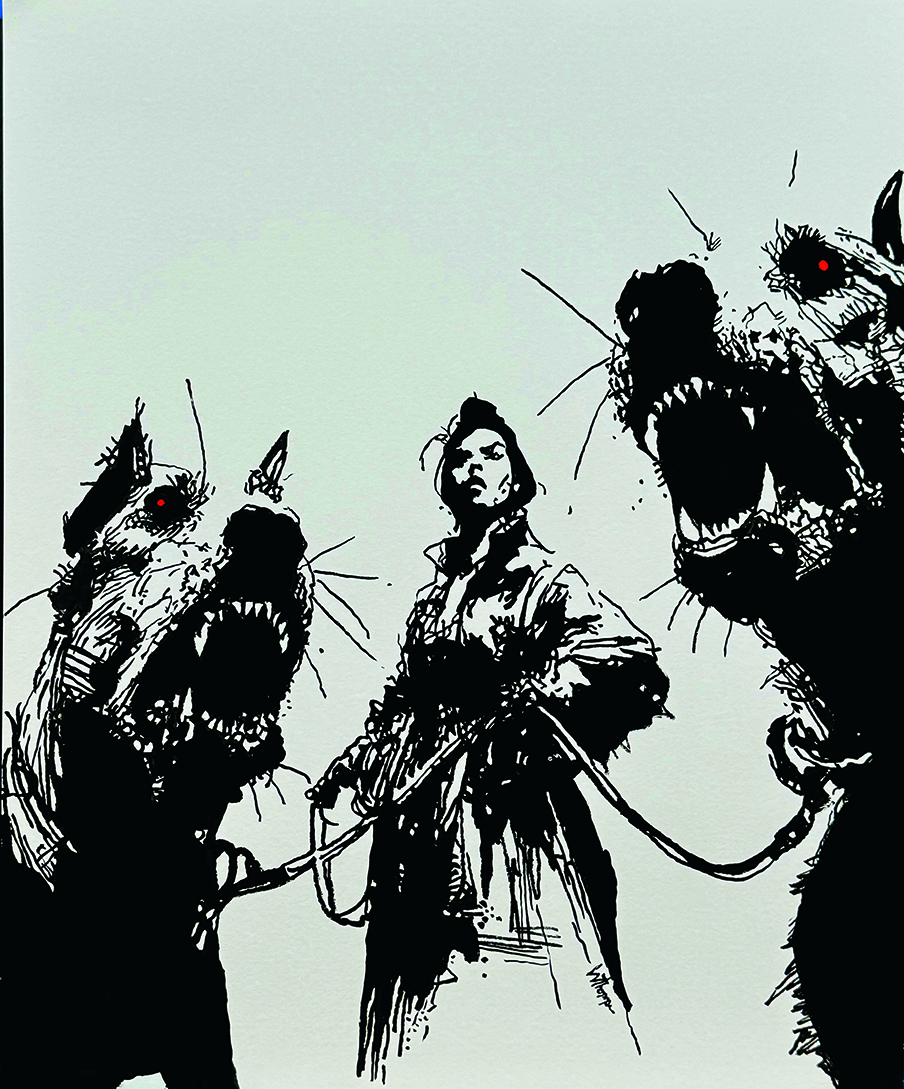
‘Prey’ shifts the tone from the cosmic to the predatory. The central figure is an embodiment of inevitable motion. By flanking the subject with two beasts, Thompson utilizes symmetry to create a sense of impending doom. The red, burning eyes of the companions act as the focal point, pulling the viewer’s attention away from the background and into the immediate, lethal presence of the character.
Case Study: ‘Darkest Dungeon’
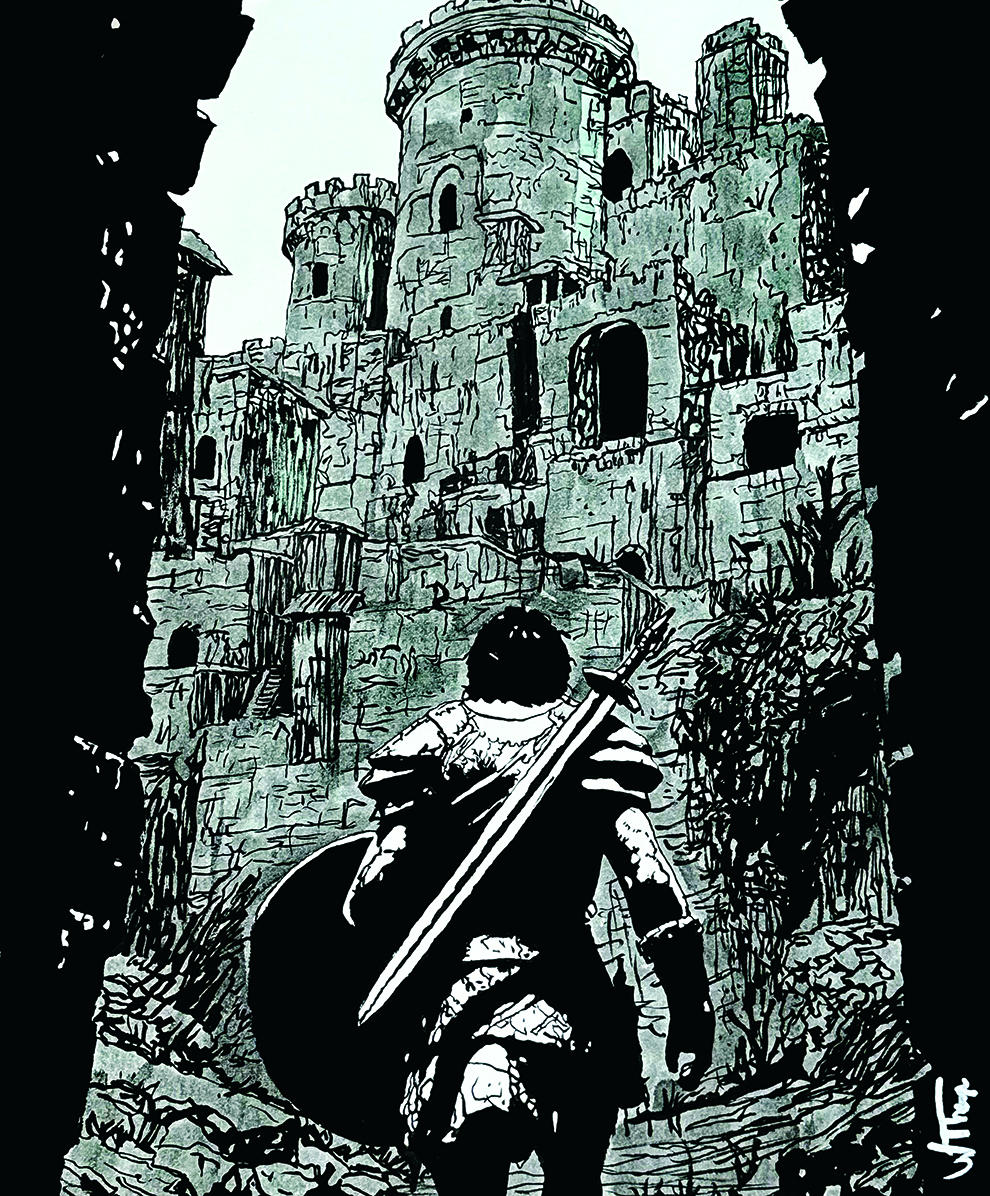
In ‘Darkest Dungeon,’ Thompson demonstrates his mastery of architectural scale. The looming, ruined fortress above the lone warrior is rendered with such minute, broken line work that the reader can almost feel the weight of the stone. Every crack is a story; every shadow is a threat. It is a quintessential example of his ability to imbue inanimate objects with a sense of malevolence.
Case Study: ‘Malfeasance’
‘Malfeasance’ serves as the aggressive counterpart to his more contemplative pieces. Here, the line work is sharper, more jagged. The subject “erupts” rather than stands, utilizing the physical properties of the ink to suggest movement that is both sudden and violent.
Professional Reception and Industry Implications
Within the illustration community, Thompson’s work has been lauded for its refusal to rely on digital shortcuts. In an era dominated by AI-generated imagery and vector-perfect digital painting, the “analog-first” approach of an artist like Thompson provides a necessary counter-narrative.
Critics and fellow artists have noted that the “Southern American Sumi-e” style is effectively a commentary on the endurance of the human hand. His work suggests that true artistic depth—the kind that requires the artist to live with a piece for weeks, adding tick by tick—cannot be replicated by algorithms.
Furthermore, his influence is beginning to show in the broader fantasy illustration space. By proving that traditional, ink-heavy, high-contrast styles can still be relevant in a digital-first marketplace, he has opened the door for a resurgence in classic pen-and-ink craftsmanship.
The Future of the Craft
For those looking to follow in Thompson’s footsteps, the artist emphasizes the importance of patience over perfection. “You cannot rush the shadow,” he often notes. His advice to aspiring illustrators is to embrace the imperfections of the hand. While he acknowledges the utility of digital tools, he maintains that the tactile feedback of a brush against vellum is an essential part of the artistic process.
As Thompson continues to develop his portfolio, he remains a figure of interest for enthusiasts of dark fantasy and traditional illustration. His work serves as a reminder that the most profound artistic statements are often those that are whispered in ink, one line at a time.
Essential Resources for the Ink Artist
For readers inspired by Thompson’s methodology, the following resources are considered essential in the industry:
- The Ink Drawing Foundation: Mastering the basics of line weight and brush control.
- Selection of High-Grade Vellum: Understanding the importance of surface texture for ink retention.
- The Evolution of Pigment: Exploring the differences between Sumi (soot-based) and synthetic inks, and how they interact with different substrates.
Ultimately, Will Thompson’s work stands as a testament to the idea that passion, when filtered through a disciplined technique, can create worlds that are not just seen, but felt. Whether he is drawing a mage facing the end of time or a beast on the hunt, his commitment to the ink remains as sharp as the lines he draws. As he continues to push the boundaries of what ink can achieve, one thing remains certain: the Southern American Sumi-e style is not just a technique—it is a way of seeing the world, one tick at a time.
 Nana Muazin
  Raul Delapena Setiawan
  Ammar Sabilarrohman