
 By Nana Muazin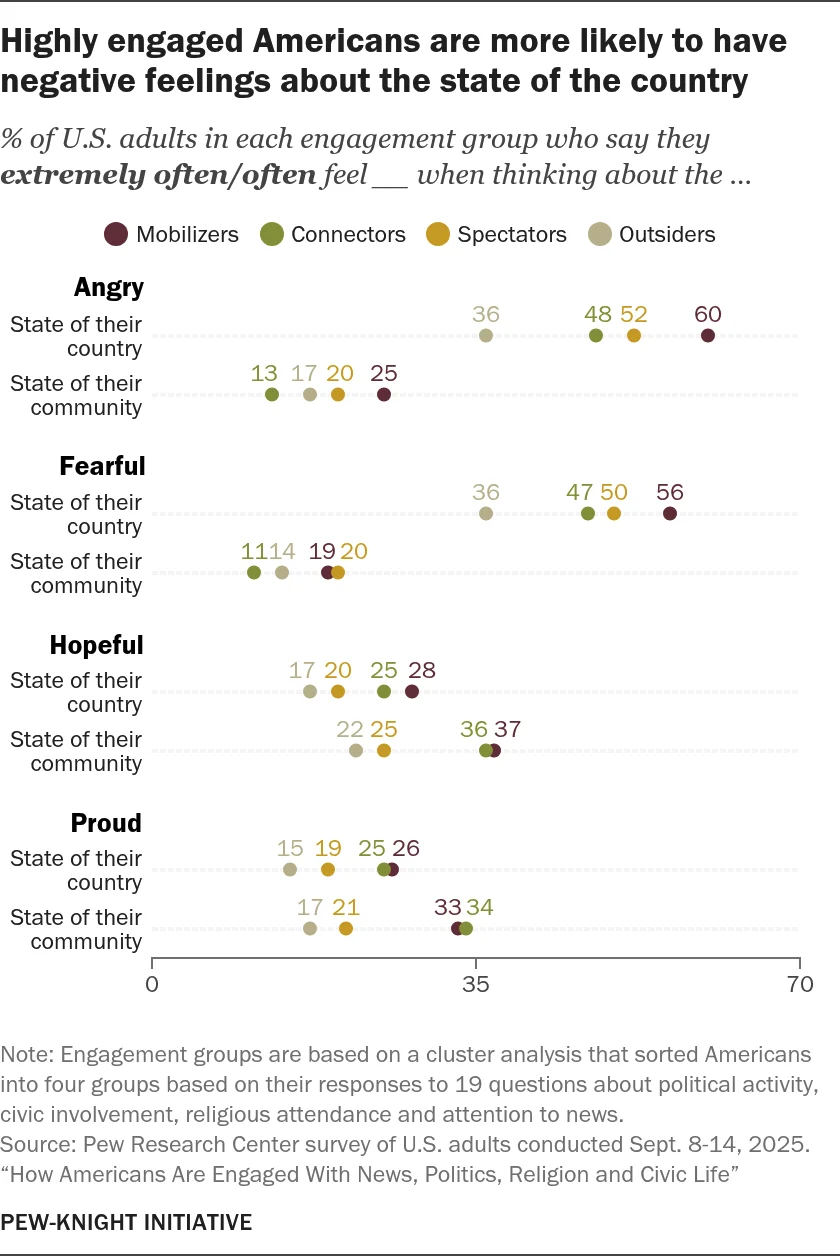
In an era defined by rapid technological shifts, intense political polarization, and evolving social structures, the way Americans participate in their democracy has become increasingly fragmented. A groundbreaking study from the Pew-Knight Initiative, released in July 2026, offers an unprecedented look into this landscape. By analyzing 19 distinct measures of participation—ranging from voting and volunteering to religious attendance and news consumption—researchers have moved beyond traditional binary metrics to identify four distinct "engagement groups" that define the contemporary American experience.
The research suggests that the degree to which an individual participates in public life is not merely a hobby or a set of disparate habits; it is a fundamental indicator of how they view their government, their communities, and the media.

The Four Pillars of Engagement: Defining the Groups
To create a holistic picture of the American public, the Pew Research Center conducted a cluster analysis based on surveys fielded in late 2025. The resulting classification system sorts U.S. adults into four categories, each representing a unique relationship with the civic fabric of the nation:
- Mobilizers: The most active participants, this group represents the "power users" of civic life. They are deeply involved in politics, community service, religious organizations, and news consumption. While they are the smallest group, they exert an outsized influence on public discourse.
- Connectors: Highly active in community and social spheres, these individuals frequently join groups and contribute through donations. However, their interest in high-level political maneuvering is notably lower than that of the Mobilizers.
- Spectators: As the name suggests, this group stays informed, following the news at high rates. However, they stop short of direct participation, rarely taking the step from being "informed" to being "active" in their communities or political movements.
- Outsiders: The least engaged segment of the population. This group reports the lowest levels of participation in voting, volunteering, and news consumption. They operate largely on the periphery of civic life.
Chronology of the Research
The study was conducted against the backdrop of the 2024 presidential election cycle, providing a high-stakes environment to measure civic behavior. The primary data was gathered via the Cross-Sectional Engagement Survey between July 9 and December 5, 2025, reaching 5,393 adults. This was supplemented by Wave 179 of the American Trends Panel (ATP), conducted in September 2025, which provided deeper insights into civic knowledge and attitudinal shifts. By utilizing both a broad cross-sectional survey and a representative panel, the researchers were able to ensure that traditionally "hard-to-reach" populations—those who might avoid typical political polling—were accurately captured in the data.
Supporting Data: The Link Between Engagement and Interest
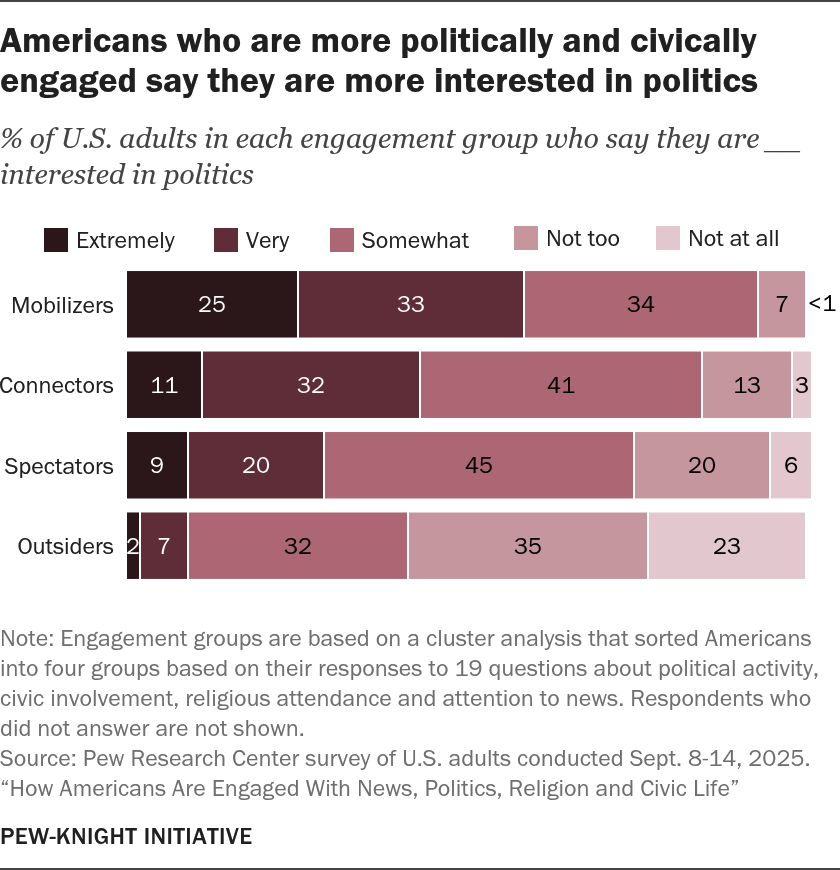
The findings establish a clear, positive correlation between public engagement and political interest. The more an individual participates in their community, the more likely they are to follow political developments.
For instance, 58% of Mobilizers report being "extremely" or "very" interested in politics. In contrast, among Outsiders, only 9% report a high level of political interest, while a majority (58%) describe themselves as having little to no interest in the political arena.

Interestingly, this trend remains consistent across partisan lines. Whether a respondent is a Democrat or a Republican, their level of political interest is dictated more by their "engagement group" than by their political ideology. This suggests that the "engagement gap" is a structural feature of American society that transcends the current red-blue divide.
The Emotional Landscape: Anger, Fear, and Hope
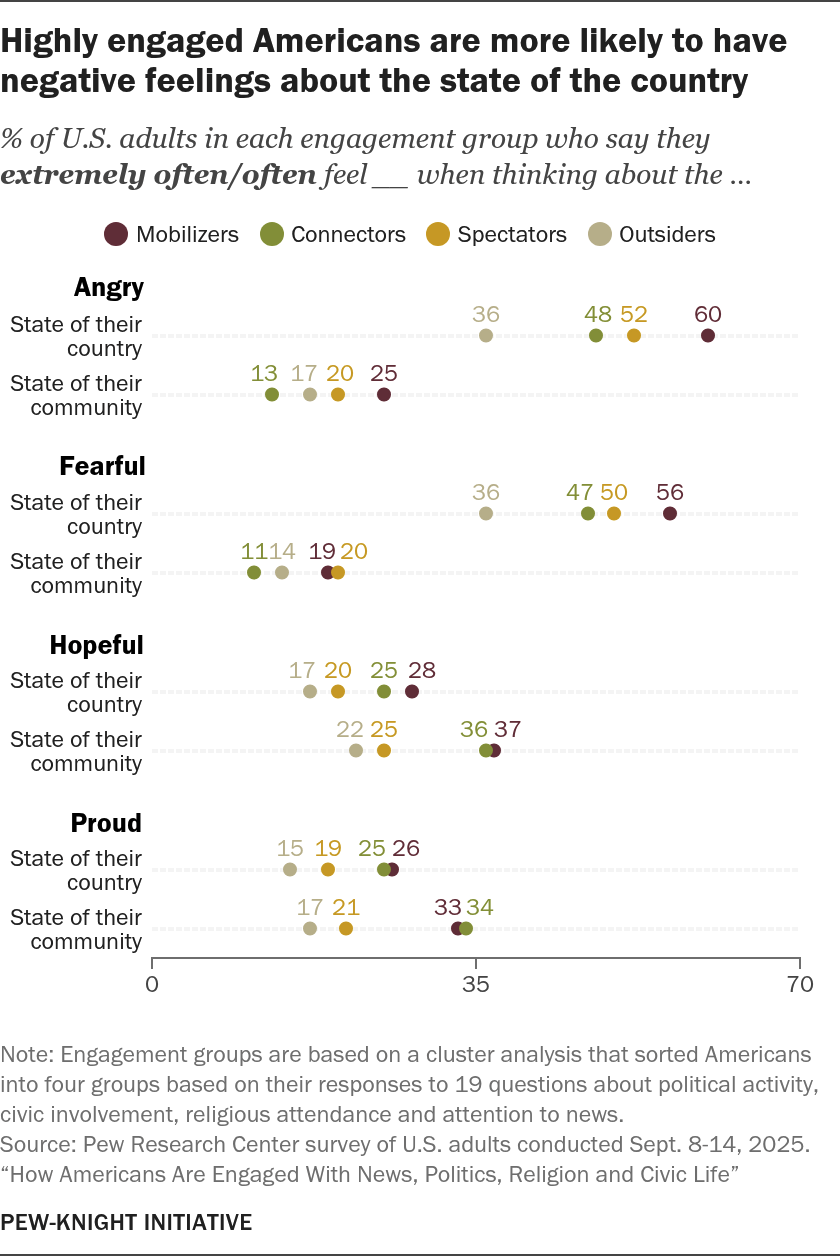
Perhaps the most striking data point concerns how different groups perceive the "state of the country." The study found that higher levels of engagement are often linked to higher levels of negative emotion.

Mobilizers and Spectators are more likely than Outsiders to report feeling "angry" or "fearful" when considering the state of the nation. For example, 60% of Mobilizers report feeling angry about the country’s direction, compared to only 36% of Outsiders.
However, this phenomenon is largely restricted to national-level concerns. When asked about their local communities, the intensity of negative sentiment drops significantly across all groups. Americans are generally more hopeful and proud of their immediate neighborhoods than they are of the federal government, regardless of how active they are in national politics.

Official Responses and Methodology Insights
The Pew-Knight Initiative designed this study specifically to address the limitations of traditional polling. By recognizing that non-participants are often invisible in standard survey data, the researchers implemented a rigorous multi-mode outreach strategy (online, paper, and telephone) to ensure a comprehensive sample.
The researchers emphasize that while these groups are stable, they are not static. "Patterns around political activity in particular may look somewhat different at other points in the political cycle," the report notes. The study aims to provide a baseline for future longitudinal research, allowing sociologists and political scientists to track how these engagement groups evolve as the political and social climate changes over the coming decade.

The Trust Deficit: Media and Government
The study reveals a profound, nationwide skepticism regarding the federal government. Trust in the federal government is uniformly low across all four groups, with roughly one-in-five adults in each category expressing confidence in the government to "do what is right" most of the time.
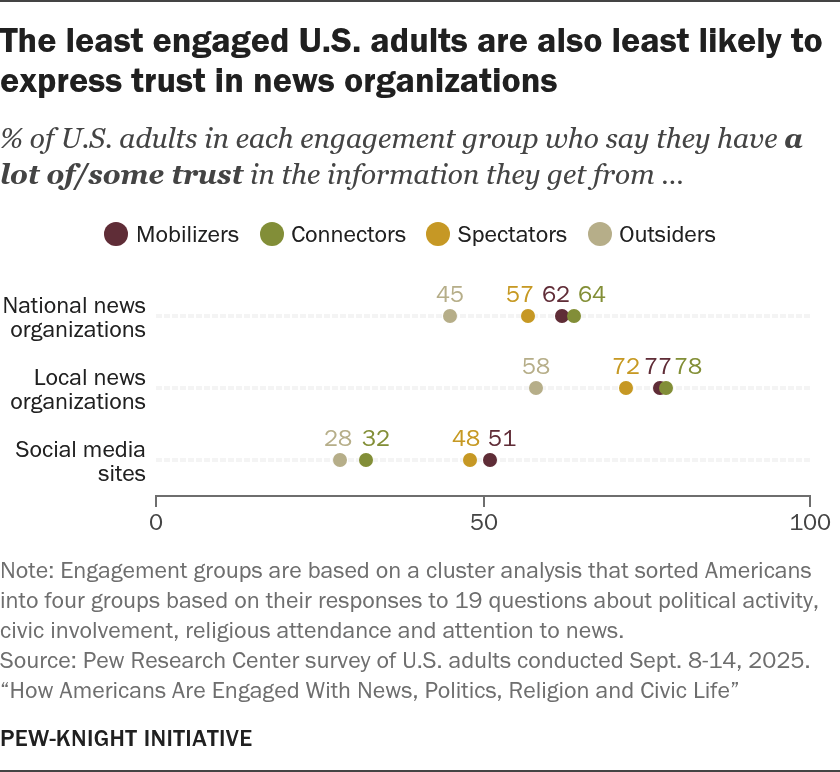
However, when it comes to the news media, the divide becomes stark.
- National News: 62% of Mobilizers and 64% of Connectors trust national news organizations. That figure drops to 45% for Outsiders.
- Social Media: The trust gap here is even more pronounced. Mobilizers are the most likely to trust information from social media (51%), while Outsiders remain the most skeptical (28%).
- The Fairness Question: Regardless of engagement level, the American public shares a deep-seated doubt about the impartiality of the press. Over 70% of respondents in every group believe that news organizations "tend to favor one side" when reporting on political and social issues.
Implications for the Future of American Democracy
The findings of this report carry significant implications for civic organizations, media outlets, and policymakers.
1. The Challenge of the "Outsiders"
The existence of a large, disconnected group of "Outsiders" suggests that efforts to boost voter turnout or civic participation often fail to reach those who are most detached from the system. If standard messaging, which often relies on political interest, does not resonate with this group, policymakers may need to rethink how they frame the value of public participation.

2. The Paradox of Engagement
The study reveals a "paradox of engagement": those who are the most informed and active (Mobilizers) are also the most likely to feel negative, angry, and fearful about the state of the nation. This implies that high engagement, while vital for a functioning democracy, comes at a personal psychological cost. It raises the question of whether the current information ecosystem is fostering "civic burnout."
3. Media Credibility and Fragmentation
The fact that Americans across all engagement levels doubt the fairness of the media suggests that the current crisis of confidence is not merely a result of misinformation or echo chambers, but a fundamental lack of trust in the institutions themselves. Bridging this gap will require more than just "fact-checking"; it will require a fundamental shift in how media organizations interact with a public that is inherently skeptical of any centralized narrative.
Conclusion
The Pew-Knight Initiative’s research serves as a mirror held up to the American public. It shows a nation that is deeply divided, not just by ideology, but by the very way its citizens choose to interact with the world around them. Whether through the hyper-active participation of the Mobilizer or the detached perspective of the Outsider, every American is navigating a complex, often frustrating, civic landscape. Understanding these four groups is the first step toward addressing the profound sense of alienation that many Americans feel toward their government and the institutions that define their public life.
As the 2026 midterms and future election cycles approach, the data provided by this study will be essential for anyone looking to understand the mechanics of American democracy and the people who—or who do not—keep it running.
 Pevita Pearce
  Neng Nana