
 By Raul Delapena Setiawan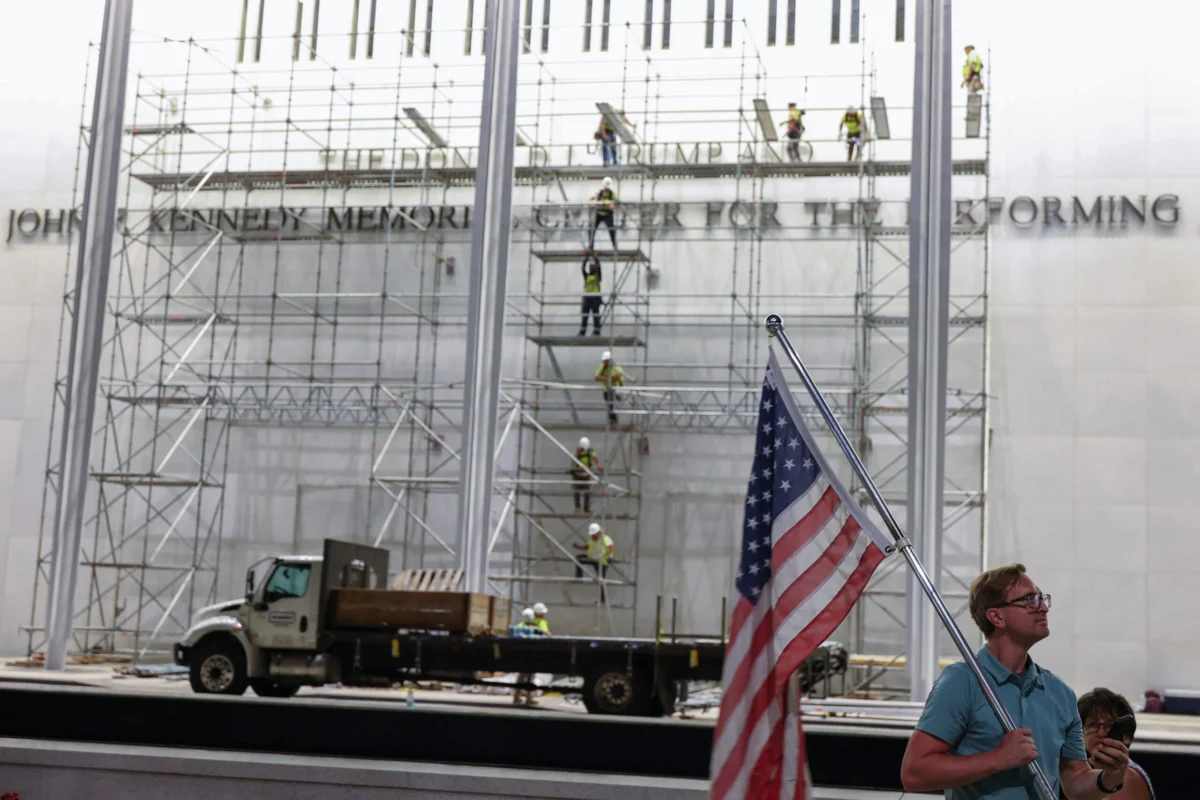
By Editorial Staff
In the quiet, predawn hours of Saturday morning, the Washington, D.C. skyline underwent a subtle but historic alteration. Under the shroud of heavy white tarps designed to conceal the operation from the public eye, work crews began the systematic removal of the name "Donald J. Trump" from the facade of the John F. Kennedy Center for the Performing Arts. The process, which commenced shortly after 3:00 a.m., marked the final chapter in a contentious legal and political struggle over the identity of one of the nation’s most storied cultural landmarks.
The removal follows a sweeping federal court order that deemed the renaming of the facility not merely a matter of controversy, but an explicit violation of federal law. As the sun rose on Saturday, the letters—which had stood as a lightning rod for national debate for months—were gone, signaling the end of a brief, turbulent era in the center’s history.
The Chronology of a Controversial Renaming
The saga of the Kennedy Center’s rebranding began in a climate of intense political friction. After the Trump administration appointed a new board of trustees to the center, plans were quickly set in motion to overhaul the institution’s identity. The President had previously declared the iconic building “structurally dangerous” and proposed a radical, two-year shutdown for a “complete rebuilding” beginning in July 2026.
However, the renaming of the institution—formally established by the 1964 National Cultural Center Act—sparked immediate backlash. When the board voted to append the President’s name to the structure, critics, historians, and legislators argued that the move was an illegal appropriation of a site dedicated to the memory of President John F. Kennedy.
The timeline of the legal confrontation unfolded as follows:
- December 2025: Rep. Joyce Beatty (D-Ohio) files a lawsuit against the Trump administration and the Kennedy Center’s board, alleging that the renaming violates the original charter of the institution.
- May 29, 2026: U.S. District Judge Christopher Cooper issues a landmark ruling, ordering the immediate removal of the President’s name from all digital and physical assets of the center within two weeks.
- Early June 2026: The center begins a digital purge, scrubbing the President’s name from websites, social media accounts, and donor literature.
- June 12, 2026: The court-mandated deadline for physical removal arrives. Despite a last-minute request for a 12-hour extension by the center’s director—citing inclement weather—preparations for the removal move forward.
- June 13, 2026: Citizens gather at the plaza, chanting "Take it down" as scaffolding is erected.
- June 14, 2026: In the early morning, the name is physically pried from the facade.
The Legal Foundation of the Ruling
The judicial decision delivered by Judge Christopher Cooper serves as a significant check on executive authority over cultural institutions. In his 40-page opinion, Judge Cooper emphasized that the Kennedy Center is a creature of statute, not an extension of the executive branch’s branding efforts.
The 1964 federal law that authorized the construction of the center specifically designated it as "The John F. Kennedy Center for the Performing Arts." Judge Cooper noted that the statute contains no provision allowing for the modification of that name, nor does it grant the board of trustees the authority to append names to the structure. By voting to include the President’s name, the hand-picked board effectively acted outside the scope of their legal mandate.
Furthermore, the judge issued an injunction blocking the planned two-year closure of the center. The administration had claimed that the closure was necessary for safety repairs; however, the court found the move to be a pretextual maneuver intended to facilitate the physical rebranding of the venue, which would have effectively shut the public out of the institution during the transition.
Official Responses and Political Fallout
The response to the removal has been as polarized as the political environment surrounding it. For those who opposed the renaming, the sight of the letters being pried from the stone was a moment of profound vindication.
"Today’s victory is the beginning of returning the Kennedy Center to the American people," Rep. Joyce Beatty stated in a press release issued shortly after the work was completed. "The rule of law prevailed, and that is worth celebrating. Let this send a message across the country: when we stand up, fight back, and defend our democracy, we can win. This is just the beginning."
Conversely, the former President’s response was characteristically defiant. Following the initial ruling in May, he publicly attacked Judge Cooper, noting his appointment by former President Barack Obama and questioning his impartiality. In a series of statements, the President characterized the center as a "failing institution" and insisted that his efforts were focused on public safety. He further threatened to initiate a transfer of the center’s oversight from the board to the Department of Commerce, suggesting that Congress should decide the ultimate fate of the building.
Supporters of the renaming had argued that the President was merely asserting his right to update federal facilities under his jurisdiction. However, the courts found that the specific statutory language protecting the Kennedy Center’s name created a rigid barrier that even presidential authority could not breach.
Implications for Future Federal Oversight
The removal of the name raises broader questions regarding the stewardship of federal landmarks. The Kennedy Center is unique among Washington’s institutions; it serves as a memorial, a performance venue, and a government-funded entity. By attempting to exert personal branding over such a site, the administration touched upon a deep-seated American consensus: that certain institutions are meant to transcend the political cycle.
Legal scholars suggest this case may serve as a precedent for how future administrations approach the modification of federal landmarks. The ruling underscores that the "original intent" of congressional legislation—in this case, the 1964 act—acts as a binding constraint on executive actions. It reinforces the principle that federal landmarks belong to the public trust rather than to the individuals who happen to occupy the White House.
As the scaffolding comes down and the plaza returns to its standard state, the center faces a period of rehabilitation. The institution must now contend with the logistical aftermath of a tumultuous six months. With the digital and physical rebranding efforts now reversed, the focus of the board—and the public—shifts back to the center’s core mission: the promotion of the performing arts.
For the staff and the patrons of the Kennedy Center, the removal of the name is more than just a maintenance operation; it is a restoration of the institution’s historical identity. While the political tremors caused by the attempt to rename it will likely be felt in the halls of Congress for some time, the physical removal of the name provides a tangible closure to one of the most unusual chapters in the history of Washington, D.C.
Whether the administration attempts to circumvent this ruling through legislative means or accepts the court’s decision as final remains to be seen. For now, however, the John F. Kennedy Center for the Performing Arts stands once again, in name and spirit, as it was established six decades ago.
 Lina Irawan
  Nana
Nana  Muslim