 By Dwi Wanna
September 15, 2026
By Sam Lauron
Main Facts: The 2026 Social Media Collaboration Landscape
Modern social media marketing has fundamentally outgrown the capabilities of individual operators working in silos. As content volume, channel fragmentation, and regulatory scrutiny scale exponentially faster than team headcounts, organizations are increasingly forced to overhaul how they plan, review, and execute campaigns.

A social media collaboration tool is no longer merely a scheduler or a digital calendar; it has evolved into sophisticated software that unifies teams across marketing, creative, legal, and customer service departments. According to recent market analysis from Gartner, social media management and social listening have formally converged into a single strategic market. In 2026, platforms in this category layer AI-assisted drafting, automated routing, and strict governance controls on top of everyday workflows, making audit trails just as critical as the creative content itself.
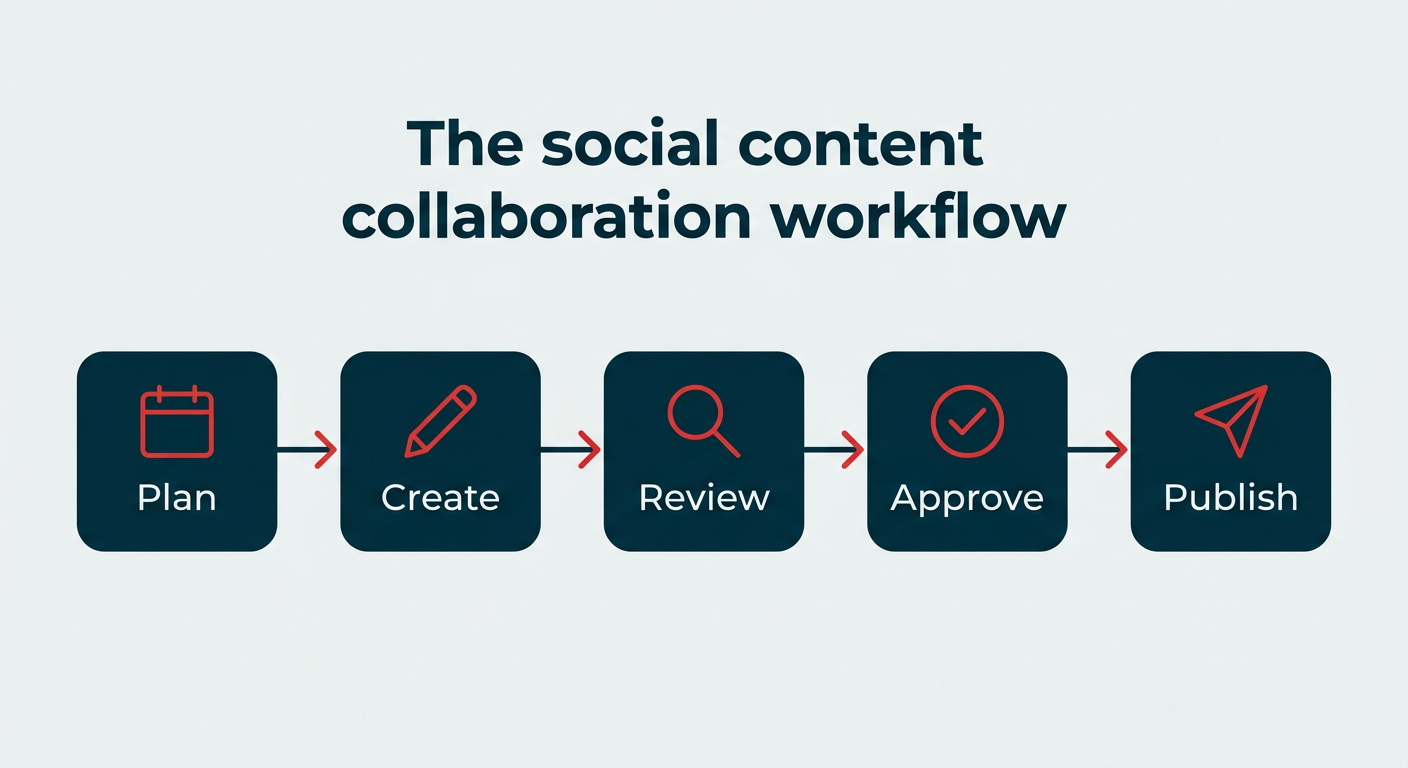
The core challenge facing contemporary marketing organizations is rarely a lack of creative effort or strategic vision. Instead, it is a persistent visibility gap. When strategy lives in one platform, drafts in another, feedback loops in email chains, and quick alignment questions in instant messaging apps, productivity breaks down. The primary objective of modern social media collaboration tools is to eliminate this friction, centralizing communication, multi-level approvals, shared planning, and performance analytics into a single, cohesive ecosystem.

Chronology: How Social Workflows Shifted From Silos to Unified Operating Systems
To understand why collaboration tools have become central to enterprise strategy, it is essential to trace the operational evolution of social media management over the past decade.
- The Era of Point Solutions (Early 2010s): Social media management began largely as a tactical publishing function. Teams utilized disparate tools to push content to individual networks. Scheduling, community management, and analytics existed in isolation, requiring manual data compilation and constant tab-switching.
- The Rise of Multi-User Dashboards (Mid-to-Late 2010s): As brands scaled their digital footprint, platforms began introducing multi-user accounts. Basic permission levels were established, but cross-departmental coordination remained cumbersome. Legal reviews and creative sign-offs typically occurred outside the platform via email attachments or external project management boards.
- The Convergence of Engagement and Analytics (Early 2020s): Platforms began merging social listening, publishing queues, and unified inboxes. However, workflows frequently remained fragmented between community management and creative production, leaving enterprise teams vulnerable to compliance missteps and communication bottlenecks.
- The Social Operating System Era (2026 and Beyond): Today, the market demands fully integrated "Social Operating Systems." Driven by the integration of artificial intelligence for drafting and routing, platforms now emphasize end-to-end governance, audit trails, and deep integrations with customer relationship management (CRM) and enterprise resource planning (ERP) software. Collaboration is treated as an organization-wide mandate rather than a localized marketing task.
Supporting Data: Comparing the Top 10 Collaboration Tools for 2026
When evaluating software to bridge communication gaps, organizations must weigh team size, pricing structures, and specific workflow needs. The market currently spans all-in-one enterprise governance suites down to lightweight visual approval tools and general project management frameworks.
| Tool | Best For | Key Collaboration Features | Starting Price | Ideal Team Size |
|---|---|---|---|---|
| Hootsuite | All-in-one social collaboration & governance | Approval workflows, shared calendar, unified inbox, permissions | $99/user/month | Mid-size to enterprise |
| Sprout Social | Analytics-led social teams | Shared inbox, approval workflows, reporting | ~$79/seat/month (billed annually) | Mid-size to enterprise |
| Agorapulse | Small teams and agencies | Shared inbox, calendar, client approvals | ~$79/user/month | Small to mid teams |
| Planable | Visual content approvals | Multi-level approvals, post previews, client workspaces | ~$33/workspace/month | Small to mid teams |
| Loomly | Structured content workflows | Approval steps, post ideas, asset library | ~$49/month (billed yearly) | Small to mid teams |
| Trello | Campaign tracking | Task boards with assignments and comments | Free; paid from $5/user/month | Small to mid teams |
| Monday.com | Project management | Custom workflows and shared dashboards | Free; paid from $9/seat/month | Mid-size teams |
| ClickUp | Cross-team visibility | Task databases, custom tags, dependencies | Free; paid from $7/user/month | Mid-size to enterprise |
| Slack | Real-time communication | Organized channels, app integrations, file sharing | Paid from $7.25/user/month | All team sizes |
| Canva | Content creation | Shared templates, commenting, brand kits | Free; paid from $12/month | Small to mid teams |
Deep Dive: Comprehensive Platform Analysis
1. Hootsuite Social OS
Positioned as a comprehensive social operating system, Hootsuite connects planning, publishing, customer care, and reporting into a governed framework. Through distinct modular layers—such as Perch for scheduling, Nest for unified customer service inboxes, Wisdom for AI-driven insights, and Vigil for policy and permission controls—the platform ensures that enterprise teams maintain absolute compliance without sacrificing creative agility.
- Pros: Robust governance, multi-channel unification, extensive third-party integrations (Canva, Zendesk, Dropbox).
- Cons: Steeper learning curve for smaller teams due to deep feature sets.
- Pricing: Standard plan at $99/user/month; Advanced at $249/user/month; custom enterprise pricing available.
2. Sprout Social
Renowned for its deep analytics capabilities and streamlined shared inbox, Sprout Social allows mid-size to enterprise teams to route messages efficiently and generate presentation-ready reports for executive stakeholders.
- Pros: Clean user interface, exceptionally strong reporting features.
- Cons: Per-seat pricing models can scale rapidly as organizations expand.
- Pricing: Essentials tier begins at approximately $79 per seat/month (billed annually).
3. Agorapulse
Designed specifically with small teams and digital agencies in mind, Agorapulse offers intuitive shared queues and robust moderation automation without the complex configuration overhead typical of enterprise suites.
- Pros: Straightforward setup, highly responsive client-facing capabilities.
- Cons: Listening tools and advanced approval chains are relatively lightweight.
- Pricing: Starts at around $79 per user/month, billed annually.
Official Industry Insights and Strategic Capabilities
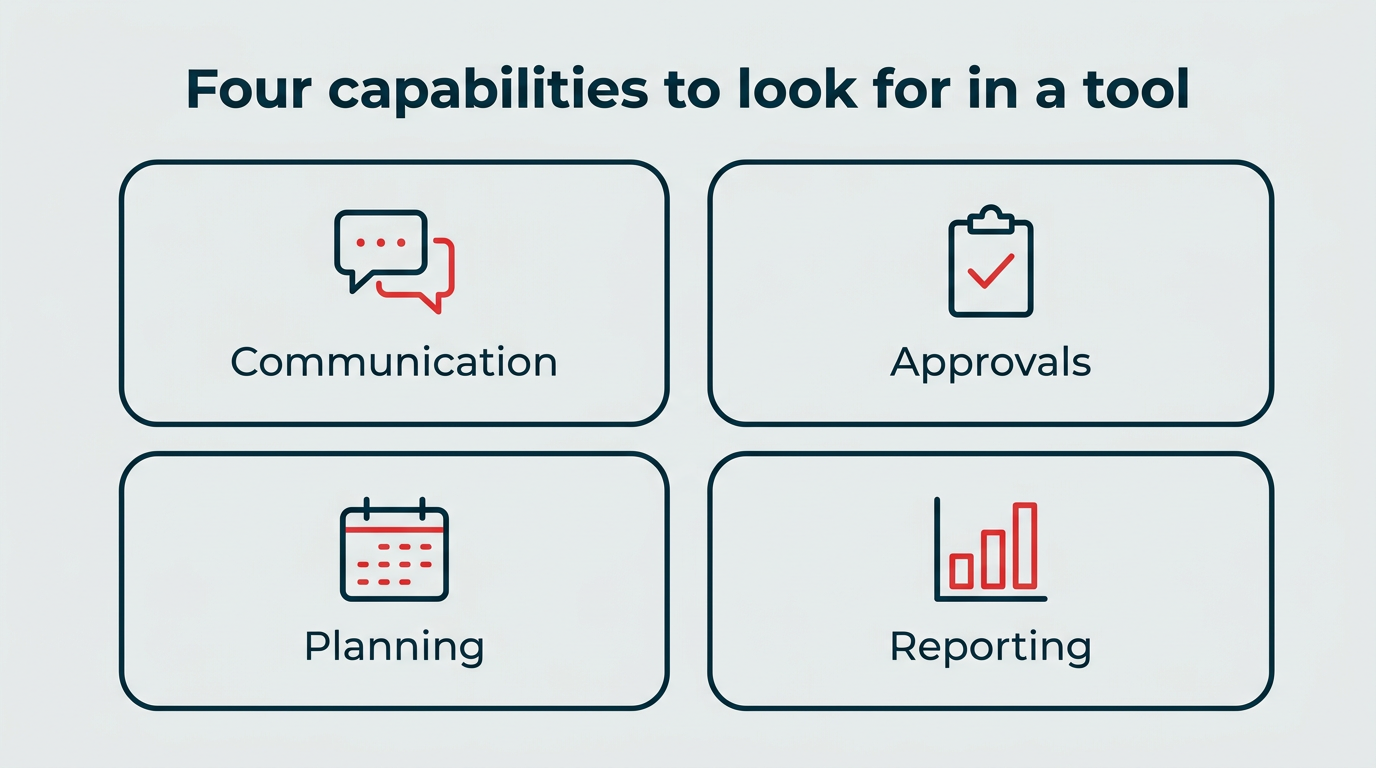
According to industry analysts, modern enterprise software must address four fundamental operational pillars to successfully eliminate workflow bottlenecks:
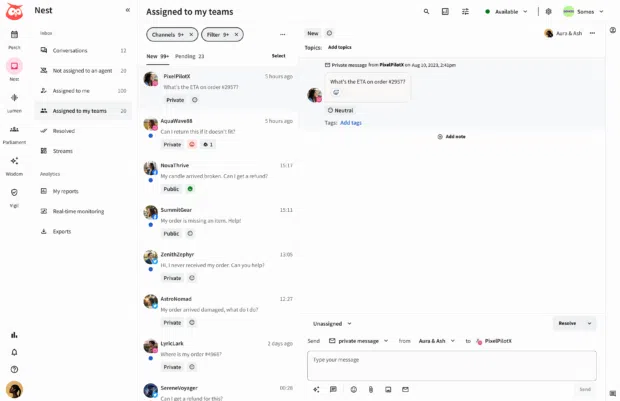
- Team Communication and Real-Time Commenting: Centralizing discussions directly within draft posts prevents context from evaporating into scattered messaging threads or forgotten email chains. Unified inboxes allow customer service inquiries and direct messages to be assigned, tracked, and resolved within a single interface.
- Approval Workflows and Role-Based Permissions: Multi-step approval routing defines precise handoffs between creators, editors, and legal compliance officers. Role-based permissions guarantee that only authorized personnel can execute final publication, protecting brands from costly public relations missteps.
- Content Planning and Shared Calendars: Shared visual planners provide a macro view of upcoming publishing schedules across all networks, enabling teams to spot content gaps, avoid duplication, and maintain consistent publishing cadences.
- Analytics and Reporting: Shared intelligence dashboards ensure that creatives, managers, and executives evaluate performance using identical metrics, directly tying social output to measurable business return on investment (ROI).
Implications: Building Sustainable Collaboration Habits
Implementing advanced software is only half the battle; long-term operational success depends entirely on the processes and organizational habits built around the technology. Industry experts recommend adopting five core disciplines to prevent collaboration systems from deteriorating into chaotic repositories:
- Define Clear Ownership: Every asset, campaign, and workflow must have a designated owner responsible for moving it through the pipeline.
- Standardize Review Stages: Establish explicit criteria for what constitutes a completed draft before it advances to the legal or executive approval tier.
- Limit Tool Sprawl: Audit your organization’s software stack regularly to ensure that new tools solve genuine operational gaps rather than creating redundant communication channels.
- Incorporate Compliance Early: For regulated industries, integrate compliance and legal review cycles into the initial content creation phase rather than treating them as last-minute roadblocks.
- Leverage AI Responsibly: Utilize artificial intelligence to accelerate drafting and data synthesis, but strictly maintain human oversight layers to protect brand voice and policy compliance.
Ultimately, when workflow structures, role clarity, and modern collaboration tools align, marketing organizations reclaim valuable hours, minimize costly errors, and deliver consistently impactful campaigns across every digital channel.
 Raul Delapena Setiawan
  Asep Darmawan
  Nana
Nana 