
 By Laily UPN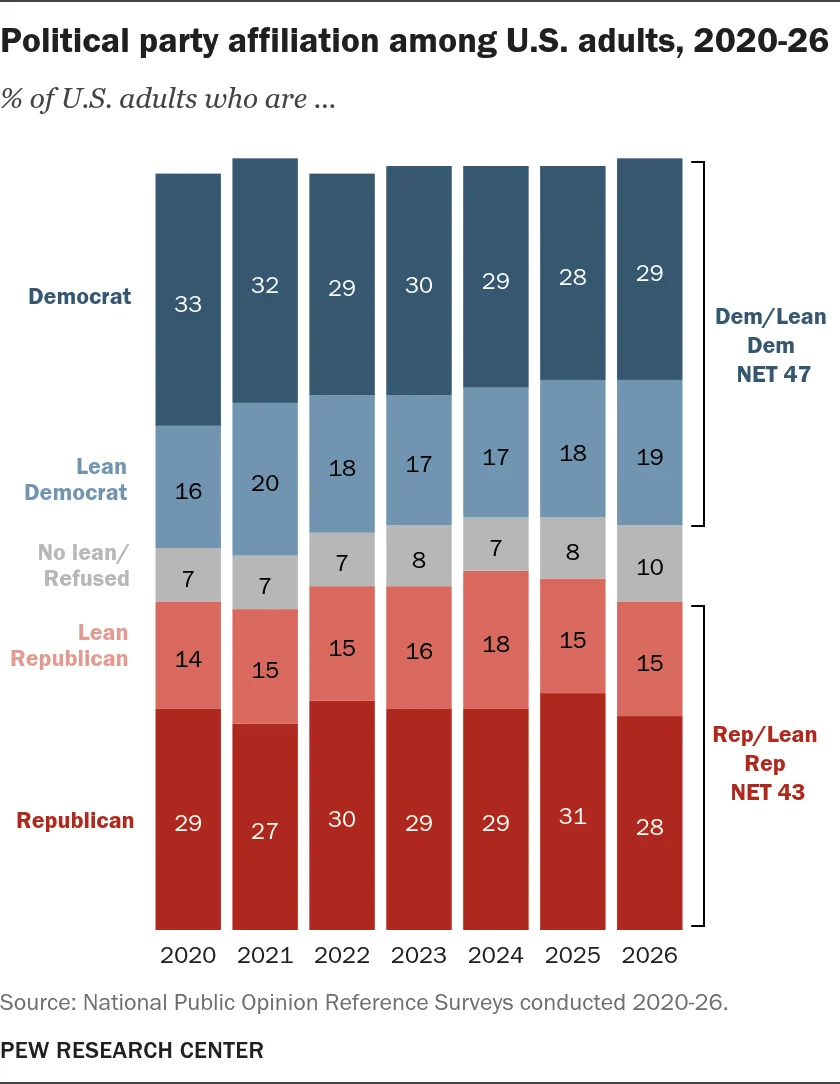
The landscape of American political identity is in a constant state of flux, shaped by shifting demographics, evolving cultural priorities, and the changing tides of national leadership. According to the latest findings from the Pew Research Center’s National Public Opinion Reference Survey (NPORS), the U.S. electorate is currently navigating a period of subtle realignment. With data collected between January and June 2026 from over 5,500 American adults, the study offers a comprehensive look at how the American public identifies with the two major parties and the independent "leaners" who often act as the true swing voters in a polarized nation.
Main Facts: A Return to the Democratic Edge
The most significant takeaway from the 2026 NPORS data is the current state of partisan balance. Among U.S. adults, 47% now identify with or lean toward the Democratic Party, while 43% align with the Republican Party. This 4-point advantage for the Democrats represents a notable shift from the period between 2022 and 2025, during which the public was essentially evenly split between the two camps.
This current Democratic edge mirrors the political environment of 2020, the final year of Donald Trump’s first term as president. While the shift is modest, it highlights the volatility of public sentiment in the post-pandemic era. Central to this balance is the role of "leaners"—individuals who do not identify as strict partisans but who consistently demonstrate a preference for one party over the other. These leaners are not merely fence-sitters; their political behaviors and policy preferences track remarkably closely with the partisans they lean toward, justifying their inclusion in broader partisan analysis.
Currently, 29% of Americans identify as Democrats and 28% as Republicans, while a significant 44% define themselves as independents or "something else." However, when these independents are forced to choose a side, the Democratic Party gains 19% of the electorate via leaners, while the Republican Party adds 15%. This suggests that the Democratic Party’s current strength is largely bolstered by a slightly larger reservoir of independent-leaning support.
A Chronology of Partisanship: 2020–2026
To understand where we are, one must look at the trajectory of the last six years. The 2020–2026 period has been defined by rapid political oscillations.
- 2020–2021: The decade began with the Democratic Party holding a comfortable lead, but the transition into 2021 saw the Republican Party gain momentum.
- 2022–2025: This period was defined by a remarkable equilibrium. As the country grappled with inflation, global instability, and domestic social issues, the partisan divide narrowed, with neither party able to maintain a consistent lead for more than a few months.
- 2026: The most recent data reveals a return to a modest Democratic advantage. This pivot suggests that the issues dominating the first half of 2026 have resonated more effectively with those on the left, or perhaps that the appeal of the Republican platform has seen a slight contraction among the electorate at large.
Supporting Data: Demographic Dissection
The "big picture" of American partisanship is composed of smaller, more complex mosaics. When broken down by demographic markers—gender, race, education, and age—the data reveals deep-seated structural trends.
The Gender Gap
The gender divide remains one of the most consistent features of American politics. Today, men are 11 percentage points more likely than women to identify as Republicans. Conversely, women are 9 points more likely to lean Democratic. While the Republican Party holds a 6-point advantage among men, this is a narrowing from the period of 2022–2025. This gender-based divergence remains a primary driver of electoral outcomes, influencing everything from legislative priorities to candidate recruitment.
Race and Ethnicity
The Democratic Party continues to hold a clear advantage among Black, Asian, and Hispanic adults. While the Republican Party had made modest gains among these groups in the years leading up to 2025, the 2026 data indicates a slight drift back toward the Democratic column. Meanwhile, White Americans remain the cornerstone of the Republican coalition, consistently showing a higher likelihood of aligning with the GOP than with the Democratic Party.
The Education Divide
Perhaps no variable has transformed as drastically as education. Historically, education was not a primary predictor of party affiliation, but that has changed fundamentally in the 21st century. Today, adults with a four-year college degree or higher are significantly more likely to identify as Democrats. In contrast, those without a college degree are now almost perfectly split down the middle between the two parties. This shift has altered the geographic and cultural focus of both parties, as the GOP increasingly court the working-class vote while Democrats lean into their strength among the professional and collegiate class.

Age and Generational Cohorts
Age remains a strong indicator of political preference, with those under 50 tilting Democratic and those between 50 and 64 tilting Republican. The oldest cohort—those 65 and older—remains the most volatile, often split evenly.
When looking at generational cohorts—tracking the same individuals over time—the data becomes more nuanced. The Democratic Party has regained a sizable edge among those born in the 1980s and 1990s. This suggests that as these generations age into their peak earning and parenting years, they are not necessarily shedding their Democratic tendencies, but rather bringing them into new stages of life.
Official Interpretations and Methodological Rigor
The Pew Research Center maintains that the NPORS is the gold standard for measuring these shifts. By utilizing an address-based, multi-mode protocol (web, mail, and phone), the Center ensures that the survey reaches a representative cross-section of the U.S. population, including those who are rarely reachable via traditional telephone polling.
According to researchers Baxter Oliphant and Andy Cerda, the significance of the 2026 data lies not just in the numbers, but in the methodology. The inclusion of "leaners" is essential because, as their research confirms, these voters often exhibit the most intense political engagement. The Center emphasizes that while the margin of error for specific subgroups (such as young men) requires caution, the overall trends indicate a statistically significant shift in the broader political climate.
Implications for the Future of American Governance
What does this mean for the future of U.S. policy? The data implies a nation that remains fundamentally "closely divided." While the Democratic Party currently holds a 4-point lead, the structural realities—such as the evenly split non-college-educated population and the consistent gender gap—suggest that the political landscape is fragile.
1. The Power of the Independent
With 44% of Americans identifying as independents, the two-party system is increasingly reliant on the "leaner" demographic to secure victory. This places immense pressure on both parties to avoid alienating these voters with extreme rhetoric.
2. The Persistence of the Gender Gap
The fact that the gender gap remains consistent across almost all age groups implies that political parties cannot rely on a "one-size-fits-all" messaging strategy. The challenge for the GOP is to broaden its appeal to women without sacrificing its base, while the Democratic challenge is to maintain its hold on female voters while preventing further erosion among male voters.
3. Generational Loyalty
The stability of the 1980s and 1990s birth cohorts suggests that partisan identity is increasingly "baked in" early in life. If these cohorts continue to favor the Democratic Party as they age, the long-term demographic trend may pose a sustained challenge for the Republican Party, forcing it to either evolve its platform or find new ways to connect with younger, more diverse, and more educated voters.
As the nation moves toward future election cycles, this data serves as a sobering reminder that the "divided state of the union" is not merely a political slogan, but a demographic reality. Whether this Democratic edge proves to be a temporary fluctuation or the start of a new, long-term trend remains the central question for political analysts in the coming months. What is clear, however, is that the American voter is more discerning, more complex, and more pivotal than ever before.
 Pevita Pearce
  Neng Nana