
 By Nana Wu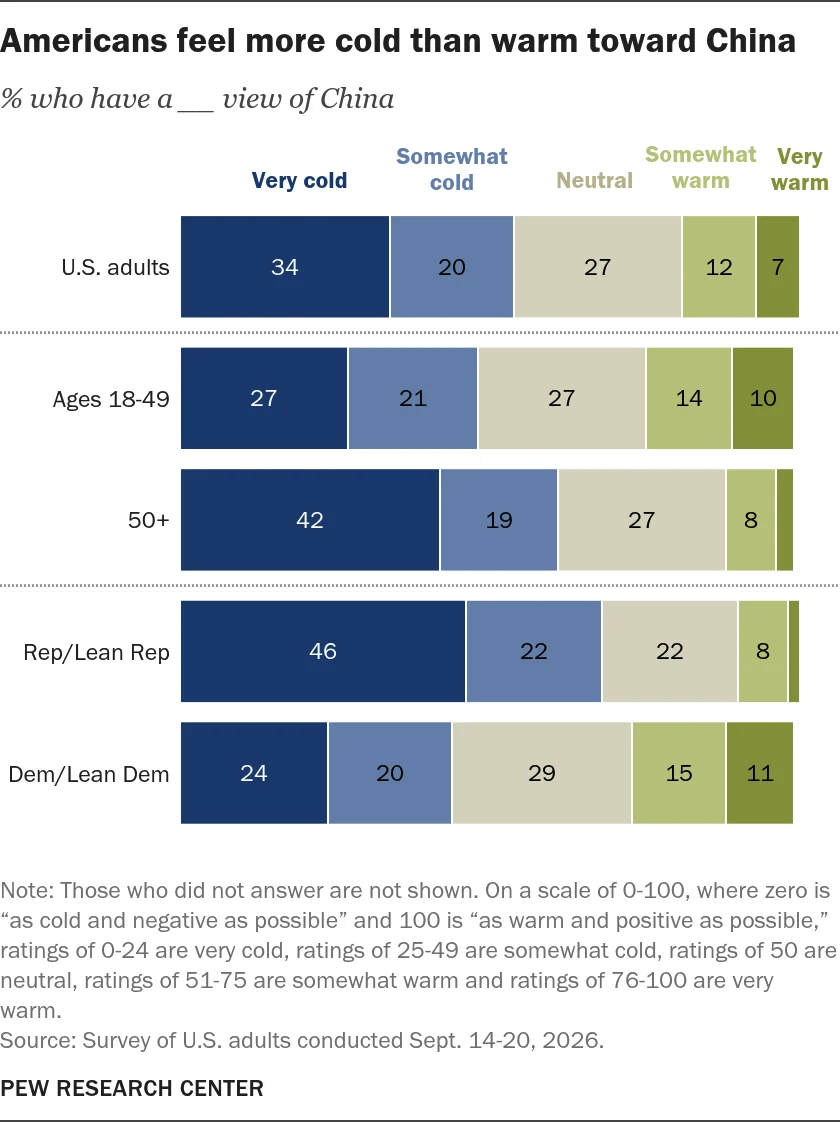
WASHINGTON — As diplomatic machinery spins into gear ahead of a high-profile Washington summit between U.S. President Donald Trump and Chinese President Xi Jinping, a new comprehensive study reveals a subtle yet noticeable shift in how the American public views China. While overall sentiment remains decidedly cool, recent data indicates that U.S. perceptions have thawed significantly from their historic lows earlier in the decade.
The findings, published by the Pew Research Center, arrive at a pivotal diplomatic crossroads. Trade tensions, technological competition, and geopolitical posturing have long defined the bilateral relationship between the world’s two largest economies. Yet, beneath the strategic friction at the elite political level, public attitudes reflect complex layers of division defined by generational gaps, partisan divides, and shifting definitions of international engagement.
Main Facts and Core Findings
The latest Pew Research Center survey, conducted among U.S. adults between September 14 and September 20, utilized a "feeling thermometer" ranging from zero to 100—where zero represents the coldest, most negative possible feeling, and 100 represents the warmest, most positive sentiment.
- The Overall Trend: Americans currently give China an average rating of 37 out of 100. While this score firmly places public sentiment in "cold" territory, it represents a notable rebound from the historic low of 28 in 2021.
- Distribution of Views: Approximately 54% of Americans still hold cold views of China (ratings between 0 and 49), while 27% express neutral views (exactly 50), and 19% report warm views (ratings between 51 and 100).
- Partisan Polarization: A clear political divide persists. Democrats and Democratic-leaning independents report a warmer average rating of 43, compared to an average of 29 among Republicans and Republican-leaning independents.
- The Generational Divide: Younger Americans view China significantly more warmly than older generations. Adults under 50 report an average rating of 42, contrasted with an average of 31 among Americans aged 50 and older.
Chronology of Public Sentiment: A Decade of Shifts
To understand how the American public arrived at its current stance, researchers point to a clear trajectory of shifting dynamics over the past ten years. Public opinion has oscillated alongside major geopolitical events, trade negotiations, and global health crises.
2016: The Baseline
A decade ago, prior to the onset of the prolonged U.S.-China trade conflicts and systemic decoupling debates, Americans gave China an average rating of 39. At the time, 50% of the public held cold views, 28% were neutral, and 18% felt warmly. Economic integration was still a dominant frame of reference for many citizens, even as political anxieties regarding intellectual property and market access began to mount.

2018–2019: The Trade War Escalation
As the Trump administration instituted sweeping tariffs on Chinese imports and bilateral rhetoric intensified, public opinion experienced modest fluctuations. By 2018, the average rating nudged upward slightly to 42, with warm views ticking up to 22%. Analysts note that public engagement during this period was heavily driven by economic headlines, though underlying partisan divergence was already widening.
2021: The Pandemic Low
The convergence of the COVID-19 pandemic, heightened geopolitical sparring over the origins of the virus, and growing human rights scrutiny catalyzed a steep decline in public sentiment. By 2021, the average U.S. rating plummeted to 28. A striking 68% of Americans expressed cold views of China, while warm views shrank to a mere 11%. This period marked the nadir of modern U.S. public opinion regarding Beijing.
2026: The Post-Pandemic Thaw
Fast-forwarding to the current surveys conducted this month, sentiment has rebounded toward pre-pandemic levels. The average rating has recovered to 37. While cold views remain the dominant baseline at 54%, the doubling of warm views from their 2021 low points to a stabilization of public sentiment, even as structural competition between Washington and Beijing remains the status quo.
Supporting Data: Deep Dive into Demographics
The complexities of American public opinion are laid bare when the data is disaggregated by political affiliation and age group. These breakdowns illustrate that "American opinion" is far from a monolith.
Partisan Cleavages
The data underscores a hardening partisan divide on foreign policy matters:

- Republican Views: A substantial 68% of Republicans and Republican-leaning independents harbor cold views toward China (with 46% falling into the "very cold" category of 0–24). Only 10% express warm views, and 22% remain neutral. Their average thermometer rating sits at 29.
- Democratic Views: Conversely, Democrats and Democratic leaners display a more moderate distribution. While 44% maintain cold views, 26% express warm views—more than double the proportion found among Republicans. Nearly three in ten Democrats (29%) register neutral feelings, yielding a higher average rating of 43.
Age and Generational Differences
Generational outlooks reveal distinct cultural and historical reference points regarding globalization:
- Ages 18–49: Younger adults give China a mean rating of 42. Within this cohort, 27% are very cold, 21% are somewhat cold, 27% are neutral, and 24% lean warm (14% somewhat warm, 10% very warm). Despite being the most receptive demographic, younger adults are still nearly twice as likely to view China coldly as they are warmly.
- Ages 50 and Older: Older Americans display significantly colder attitudes, registering an average score of 31. An overwhelming 61% hold cold views (with 42% classified as very cold), while only 11% report warm views.
Researchers note that this roughly 10-point gap between younger and older cohorts has remained remarkably consistent over the past decade, suggesting that life experience, media consumption habits, and generational definitions of national security shape enduring perspectives on foreign rivals.
Official Responses and Diplomatic Context
The release of these public opinion metrics coincides precisely with preparations for the high-level summit between President Donald Trump and Chinese President Xi Jinping.
In diplomatic briefings leading up to the Washington meeting, administration officials have emphasized that U.S. policy toward China remains guided by "extreme competition, risk mitigation, and the protection of American economic and national security interests." White House spokespeople have repeatedly stressed that fluctuations in public polling do not dictate the administration’s strategic imperatives, particularly regarding semiconductor export controls, maritime security in the Indo-Pacific, and fair-trade enforcement.
On the other side of the Pacific, Beijing’s state media outlets have framed the upcoming summit as an opportunity to "stabilize bilateral relations" and steer the world’s most consequential relationship back onto a path of "healthy, stable, and sustainable development." Chinese officials have consistently argued that mutual respect and win-win cooperation should supersede zero-sum competition, appealing directly to the international business community and global markets that favor diplomatic predictability.

Independent policy analysts observing the run-up to the summit note that while public opinion has warmed slightly, neither leader faces domestic political pressure to pursue a dramatic softening of stance. In Washington, a tough-on-China posture remains one of the few areas of genuine bipartisan consensus in Congress.
Broader Implications for U.S. Foreign Policy
The disconnect between public fatigue over endless geopolitical confrontation and the rigid bipartisan consensus in Washington carries profound implications for the future of U.S. foreign policy.
1. Navigating Public Nuance vs. Political Rhetoric
While policymakers often frame the relationship through the lens of an existential great-power competition, the public data demonstrates significant internal nuance. The fact that over a quarter of Americans remain neutral, and nearly one-in-five lean warm, suggests that the public does not uniformly view China through a lens of absolute hostility. This creates a subtle opening for diplomatic engagement, people-to-people exchanges, and targeted commercial collaboration without triggering immediate domestic political backlash.
2. The Partisan Foreign Policy Trap
The widening gulf between Democratic and Republican attitudes complicates long-term strategic consistency. When foreign policy becomes hyper-partisan, international agreements risk becoming vulnerable to shifting domestic electoral cycles. As future administrations inherit these dynamics, maintaining a cohesive, predictable long-term strategy toward Beijing becomes increasingly challenging.
3. Generational Shifts on the Horizon
As younger generations—who demonstrate comparatively warmer and more nuanced views of China—gradually assume leadership roles in civil society, corporate boardrooms, and government, the foundational assumptions of U.S. foreign policy may evolve. Whether this generational shift translates into altered diplomatic priorities or simply reflects a different contemporary worldview remains one of the most critical open questions in modern international relations.

As Presidents Trump and Xi sit down at the negotiating table in Washington this week, the broader backdrop of public opinion provides both a constraint and an opportunity: a population weary of hostility, yet fundamentally cautious about the future of global order.
 Nila Kartika Wati
  Pevita Pearce