
 By Ali Ikhwan
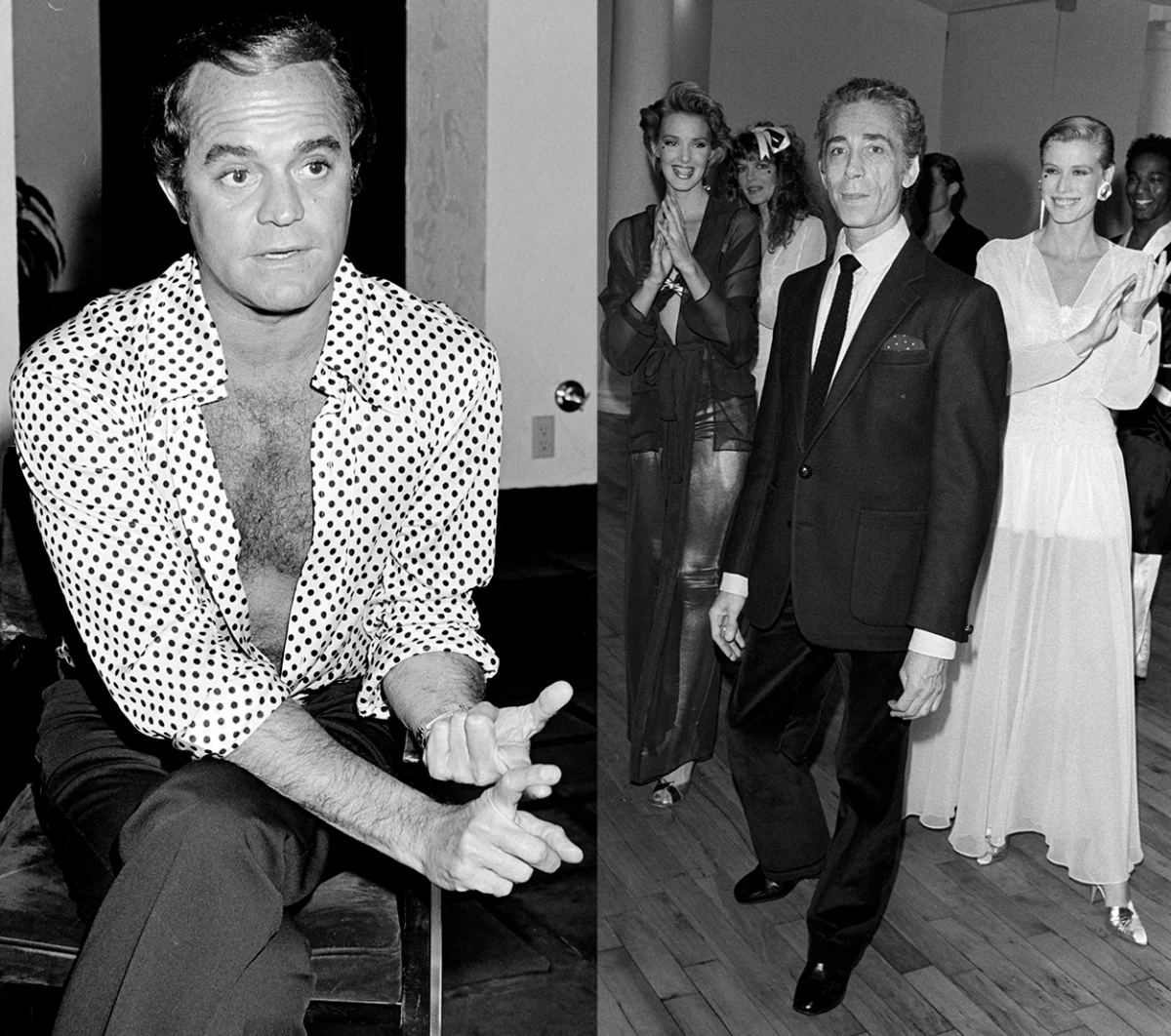
In the annals of American fashion history, the year 1990 serves as a pivotal point of reflection. It was during the sixth annual gala of Hispanic Designers Inc. that the industry paused to honor two titans who had spent decades shaping the aesthetic identity of the United States: Luis Estévez and Fernando Sánchez. By the time they were bestowed with the Lifetime Achievement Award and the MODA Award, respectively, both men had already etched their names into the bedrock of New York and Los Angeles couture. Their paths, while distinct in geography and specialization, were unified by a commitment to uncompromising craftsmanship and an intuitive understanding of the modern woman.
A Tale of Two Designers: The 1990 Recognition
The Hispanic Designers Inc. gala in Washington, D.C., was more than a celebratory evening; it was a formal acknowledgment of the seismic impact these two couturiers had on the evolution of style. Luis Estévez, the Cuban-born visionary who bridged the gap between Old World architecture and Hollywood glamour, stood alongside Fernando Sánchez, the Spanish-born master who revolutionized the boudoir by bringing lingerie into the light of day.
For the industry insiders in attendance, the awards were a long-overdue validation of designers who had navigated the volatile landscape of the garment trade with grit, grace, and an unapologetic sense of self. Their careers, which spanned the golden age of American ready-to-wear through the experimental excesses of the 1980s, provide a masterclass in how to build a legacy that transcends the fleeting nature of trends.
Luis Estévez: The Architect of Hollywood Glamour
Born in Havana, Cuba, in 1930, Luis Estévez was a man whose aesthetic was inextricably linked to the structural precision of his early architectural training. As the grandson of the sugar magnate Santiago Estévez, he was born into a world of privilege, yet he chose to forge his own path in the demanding world of fashion.

The Road to 550 Seventh Avenue
Estévez’s transition to fashion design was serendipitous. Upon arriving in New York in the late 1950s, he secured a position in the display department at Lord & Taylor—a retail institution that served as a testing ground for many of the era’s most influential talents. His sharp eye for proportion and structural integrity quickly caught the attention of the social set, leading him to Paris.
In France, he honed his craft under the tutelage of Jean Patou, the legendary couturier celebrated for his pioneering work in luxury ready-to-wear and perfumery. However, the energy of New York was an inescapable siren song. Upon his return, he partnered with Fred and Robert Greenberg and Ben Papell to launch the label Grenelle-Estévez in the mid-1960s. He established his showroom at 550 Seventh Avenue, a legendary Garment Center hub that served as a launchpad for his contemporaries, including the iconic Oscar de la Renta.
The Los Angeles Chapter: Chasing the Havana Sun
In 1967, at the height of his New York success, Estévez made a move that baffled many industry analysts: he relocated to Los Angeles. "I wanted the Havana of my youth," he famously told WWD. This shift was not merely geographical; it was an artistic recalibration.
In California, Estévez became the quintessential designer to the stars. His client roster read like a history of mid-century cinema and political influence, including Lana Turner, Zsa Zsa and Eva Gabor, Merle Oberon, Natalie Wood, and Princess Grace of Monaco. Even more significantly, First Lady Betty Ford became a champion of his work, consistently wearing his collections to official White House engagements, which vastly expanded the reach of his label.

Estévez’s commitment to his vision was famously stubborn. In 1976, he addressed his divergence from the "hip" fashion crowds of the era with characteristic candor: "I associate fashion with the reality of the people I know who wear fashion, and where and how they wear it. What I am talking about here is my fashion, and my theory. I know that it’s not ‘in’ with the very hip crowd of people, but I don’t give a damn."
Fernando Sánchez: The Alchemist of Lingerie
While Estévez conquered the red carpet, Fernando Sánchez (1935–2006) was busy deconstructing the very concept of the boudoir. Born in Spain, Sánchez brought a European sensibility to New York that prioritized the tactile, intimate experience of clothing.
From Couture Training to Iconic Loungewear
Sánchez’s pedigree was impeccable. He began his career at the houses of Maggy Rouff, Christian Dior—at the direct request of his friend Yves Saint Laurent—and Nina Ricci. Though he once humbly described his early work in lingerie as "dabbled," he would eventually transform the category into a pillar of high fashion.
Upon arriving in New York in the late 1960s, Sánchez took the reins as a designer for Warner’s bras and simultaneously developed his own namesake line, a rare feat of autonomy for the time. His artistic vision was a complex collage of influences: his mother’s innate style, his profound love for the textures of Morocco, the dramatic scores of The Last Emperor, and the gritty, electric nightlife of New York City.

The Philosophy of Flattery
Sánchez’s design philosophy was grounded in a deep, almost unconscious, love for the dress. "I design from a feeling," he noted. "I really am a dress designer—unconsciously, I make dresses. Lingerie should be glamorous and frivolous, but must be, first of all, flattering."
This ethos led to his most iconic innovations, such as the tricolor stay-at-home puff coat and intricate slipdresses that blurred the line between intimate apparel and evening wear. By infusing his collections with "razzmatazz"—leopard prints, metallic accents, and bold color palettes—he emboldened women to reclaim lingerie, moving it from the hidden corners of the bedroom to the center stage of the social calendar.
Implications: The Lasting Echo of a Golden Era
The legacies of Estévez and Sánchez are not merely historical footnotes; they are the foundations upon which modern luxury sits.
Cross-Pollination of Disciplines
One of the most striking implications of their careers is the way they treated fashion as a holistic, multi-disciplinary art. Estévez applied architectural principles to evening gowns, viewing the body as a structure to be supported and draped. Sánchez applied the rigorous construction of haute couture to soft, intimate apparel, proving that comfort and luxury were not mutually exclusive.

The Democratization of Glamour
Both designers understood that fashion is a language. By designing for women like Betty Ford and stars of the silver screen, they brought a high-fashion sensibility to a broader, more diverse audience. They were not interested in creating costumes for a fleeting season, but rather in creating garments that lived and breathed with the wearer.
A Legacy Beyond the Label
Though their namesake labels have largely faded from the contemporary retail landscape, the DNA of their work persists. We see it in the current obsession with "lingerie-as-outerwear," a trend Sánchez pioneered decades ago. We see it in the way designers today, much like Estévez, look beyond the runway to create comprehensive lifestyle brands that encompass furniture, home design, and social spaces.
Conclusion: A Toast to the Pioneers
In retrospect, the 1990 Hispanic Designers Inc. gala served as a poignant reminder that the history of American fashion is not a monolithic narrative but a mosaic of individual journeys. Luis Estévez and Fernando Sánchez, through their courage to remain true to their own aesthetic theories, provided a blueprint for future generations of designers.
Their work—characterized by an unapologetic glamour, a respect for the wearer, and an unwavering commitment to the craft—continues to resonate. They were more than just designers; they were architects of identity, providing the tools for the women of their time to present their best selves to the world. As we continue to look back at the archives of the 20th century, the contributions of Estévez and Sánchez remain a testament to the fact that while fashion is indeed a business, at its heart, it is an enduring, beautiful form of personal expression.
 Lina Hope
 Siti Muinah
 Nila Kartika Wati
