
 By Raul Delapena Setiawan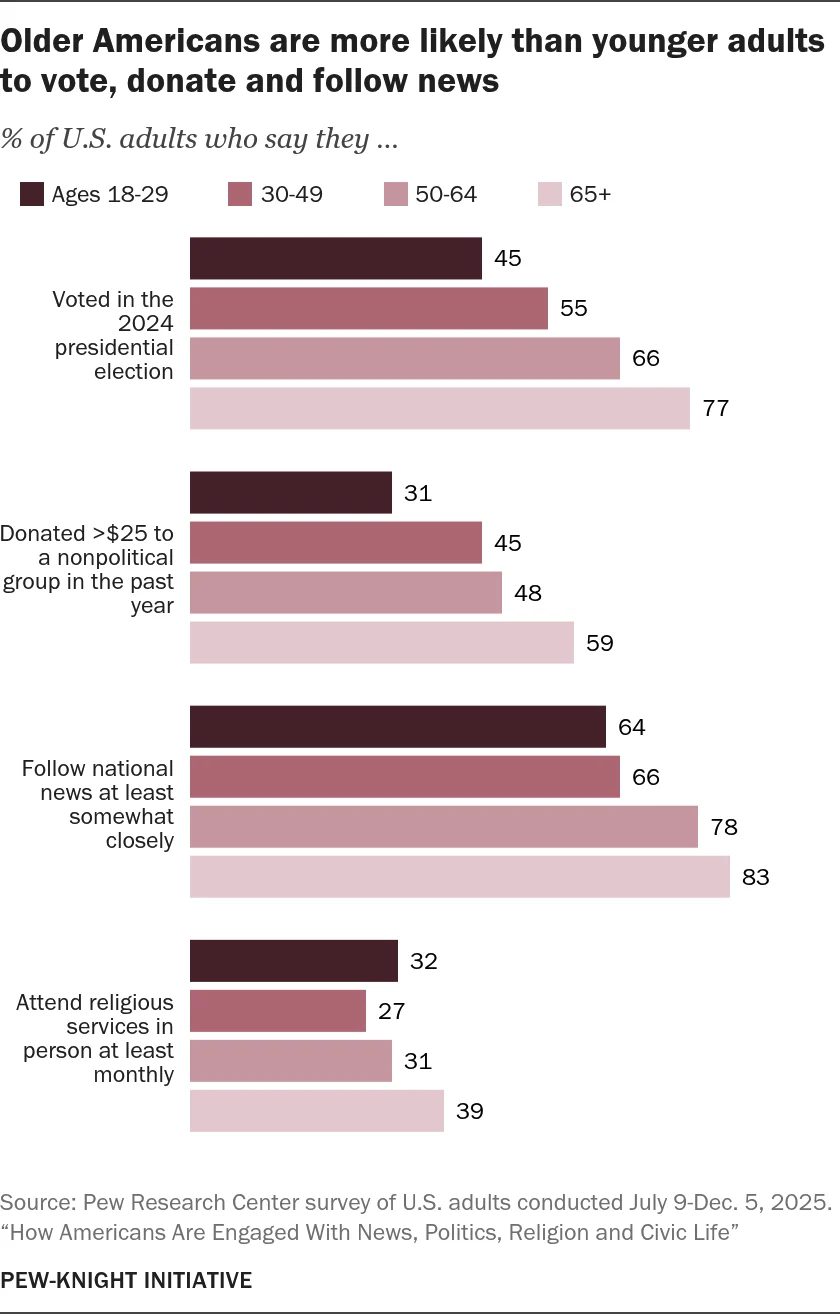
In an era of rapid technological transformation and shifting social norms, the way Americans engage with their communities, government, and the news has undergone a profound metamorphosis. A groundbreaking new report from the Pew-Knight Initiative, titled “How Americans Are Engaged With News, Politics, Religion and Civic Life,” provides an unprecedented, granular look at these behaviors. By analyzing 19 distinct measures of public participation—ranging from religious attendance and traditional voting to digital news consumption—the study reveals that age is not just a demographic marker, but a primary predictor of how an individual interacts with the public sphere.
The research paints a picture of a nation divided not only by ideology but by methodology. While older generations remain the bedrock of traditional civic institutions, younger Americans are forging new, digitally centered paths to participation that challenge long-standing assumptions about what it means to be an "engaged citizen."
The Four Pillars of Engagement: Defining the Groups
To move beyond anecdotal observations, the Pew Research Center conducted a comprehensive cluster analysis, sorting U.S. adults into four distinct "engagement groups" based on their behavioral patterns.

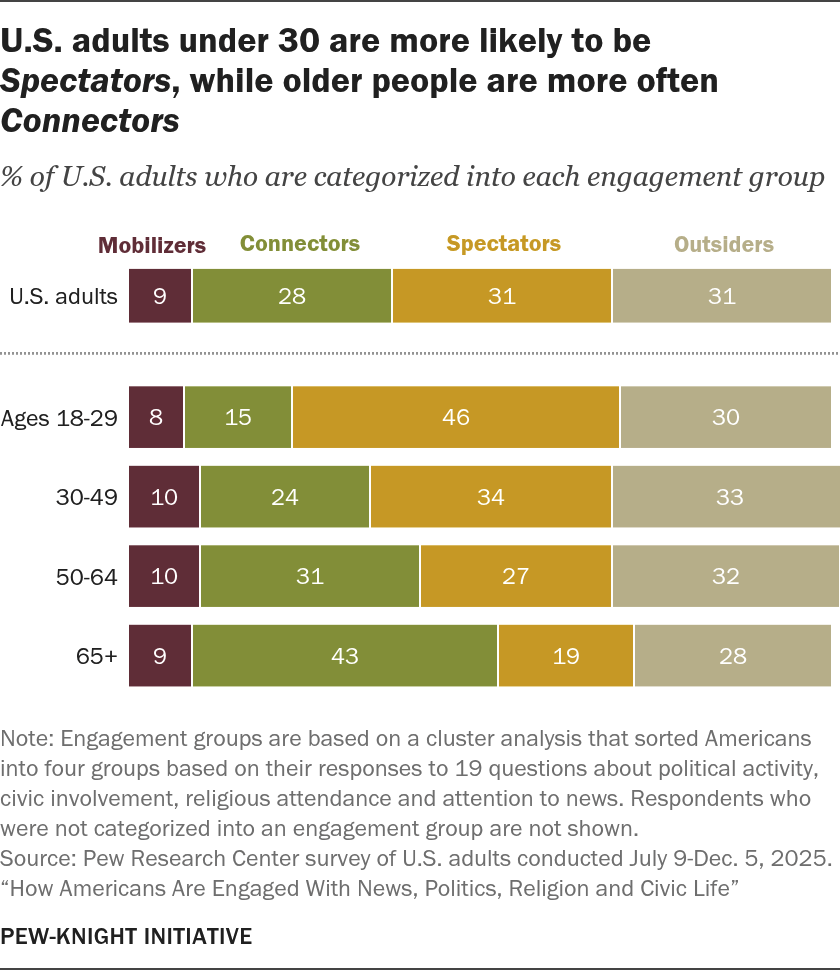
- Mobilizers (9% of the public): These are the most active participants. They are the "do-it-alls" who vote, attend religious services, volunteer, and maintain a high level of news consumption. They are the engine of civic life, though they represent the smallest slice of the population.
- Connectors (28% of the public): This group is the backbone of community infrastructure. They are highly involved in local organizations, donate to non-political causes, and participate in religious life, yet they remain noticeably less tethered to the high-intensity world of national partisan politics than the Mobilizers.
- Spectators (31% of the public): As the name suggests, these individuals are passive observers. They maintain high levels of news consumption and follow political discourse, but they are significantly less likely to participate in traditional "boots-on-the-ground" civic activities.
- Outsiders (31% of the public): Comprising the largest, albeit least active group, Outsiders report minimal involvement across almost all measured categories, including voting, volunteering, and consistent news consumption.
The report highlights a striking generational divergence: nearly half of all adults under the age of 30 (46%) are classified as "Spectators," whereas 43% of adults over the age of 65 fall into the "Connector" category.
A Chronology of Civic Participation
The research, which utilized two major surveys conducted between July and December 2025, captures a critical moment in American life: the immediate aftermath of the 2024 presidential election. Because the study focuses on behaviors within the preceding 12-month window, the findings reflect a period of high political saturation.
Historically, civic participation in the United States has followed a predictable arc: young people are often less involved, with participation growing as they age, accumulate assets, and become more integrated into their communities. The 2025-2026 data confirms this historical trend, yet it adds a modern twist. While the intensity of engagement has traditionally increased with age, the nature of that engagement has shifted.
In the past, the primary markers of citizenship were membership in fraternal organizations, church attendance, and consistent voting. Today, while those markers remain vital for older cohorts, they have been partially replaced or supplemented by digital interaction. For the 18-to-29 demographic, the "public square" is no longer the town hall or the church basement—it is the social media feed and the encrypted messaging app.
Supporting Data: The Generational Gap in Action
The statistical evidence provided by the Pew-Knight Initiative illustrates the widening chasm between the Silent/Boomer generations and Gen Z/Millennials.
Traditional Civic Pillars
When it comes to the "old guard" of civic life, the age gap is stark.

- Voting: A staggering 77% of adults aged 65 and older reported voting in the 2024 presidential election. In contrast, only 45% of adults under 30 claimed to have cast a ballot.
- Financial Contributions: Older Americans, who generally possess more discretionary income, dominate the donation space. 59% of the 65+ demographic donated more than $25 to a non-political group, compared to just 31% of those under 30.
- Religious Attendance: Attendance at religious services also skews older, with 39% of those 65+ attending at least monthly, compared to 32% of those under 30.
The Digital Shift
Conversely, the data reveals a different story in the digital realm. Younger Americans are far more likely to engage with information through "low-friction" methods.
- Digital Interaction: 59% of adults under 30 have "liked" or "saved" news posts in the past week, compared to just 32% of those 65 and older.
- Private Discourse: 65% of the youngest cohort reported privately chatting about or sharing news online, significantly outpacing the 53% of the oldest cohort who do the same.
Interestingly, the gap disappears when it comes to public commentary. Across all age groups, roughly one-quarter of Americans participate in public, online discourse, suggesting that the barrier to entry for public posting is not necessarily age, but perhaps a shared desire for privacy or a fatigue regarding public internet arguments.
Official Context and Methodology
The Pew Research Center emphasized that this study was designed to bridge the gap between fragmented research. By studying news consumption, religious participation, and civic action in tandem, researchers were able to see how these behaviors form a cohesive lifestyle.

"We conducted this study to provide a more integrated picture of how the public engages across these different domains," the report stated. To ensure accuracy, the team utilized a "Cross-Sectional Engagement Survey" of 5,393 adults, as well as data from Wave 179 of the American Trends Panel. The methodology was specifically calibrated to reach "hard-to-survey" populations—those who are less active in public life and, consequently, often less likely to participate in surveys. By utilizing multi-modal outreach (online, paper, and telephone), the researchers sought to capture the voices of the "Outsider" group, which is frequently underrepresented in conventional political polling.
Implications for the Future of American Democracy
The findings of this report carry significant implications for the future of the American democratic experiment. If nearly half of the youth population identifies as "Spectators"—individuals who follow news but do not participate in formal civic institutions—what does that mean for the longevity of those institutions?
1. The Challenge of Institutional Retention
Traditional organizations—from local political parties to non-profit volunteer groups—are facing an existential crisis. If their primary recruitment pool (younger, more active citizens) is moving away from formal structures toward loose, digital networks, these organizations must evolve. They must learn to "meet people where they are," likely by integrating digital activism into their traditional workflows.

2. The Quality of Information and Discourse
While younger Americans are highly engaged with news online, this engagement is largely "observational." "Spectators" consume information, but they are not necessarily engaged in the critical, community-based vetting processes that occur in person. This raises concerns about the quality of discourse: if digital news is consumed and shared but not debated in a local, physical context, does it lead to higher polarization or simply a more passive, less informed electorate?
3. The "Outsider" Problem
Perhaps most concerning is the 31% of the public labeled as "Outsiders." This represents nearly one-third of the U.S. population that is disengaged from almost all facets of civic life. As the country moves forward, the inability to reach these citizens could lead to a permanent disconnect between the government and a large portion of the governed, potentially fostering deeper social alienation and distrust in democratic systems.
Conclusion
The Pew-Knight Initiative study does not necessarily suggest that younger generations are "less engaged" in a moral sense; rather, it suggests they are engaged in a manner that is functionally different. The traditional "civic ladder" of the 20th century—voting, volunteering, and joining local clubs—is being bypassed in favor of a digital, networked approach.

As these cohorts age, the crucial question will be whether these digital habits serve as a gateway to more robust civic participation or if they represent a fundamental, permanent shift away from the institutional foundations of the past. For policy makers, community leaders, and journalists, understanding this shift is the first step in bridging the generational divide that threatens to splinter the American experience. The task at hand is not to force younger generations into the molds of their predecessors, but to build new, resilient structures that can accommodate both the traditionalist and the digital citizen.
 Pevita Pearce
  Neng Nana