
 By Iffa Jayyana
In an era defined by rapid geopolitical shifts and evolving social landscapes, the ability to measure public sentiment accurately has never been more critical. The Pew Research Center’s Spring 2026 Global Attitudes Survey stands as a cornerstone of international public opinion research, offering a granular look at how citizens across the globe perceive power, democracy, and national identity. However, the rigor of such a study is only as strong as its underlying methodology. Understanding how this data is collected, processed, and validated is essential for interpreting the complex findings that inform policy debates and international discourse.
Main Facts: The Scope and Integrity of the 2026 Research
The 2026 Global Attitudes Survey is a monumental undertaking, designed to capture a representative snapshot of national moods across a diverse array of countries. By employing a multifaceted approach—utilizing telephone, face-to-face, and online interviews—Pew Research Center, in partnership with leading research firms such as Gallup, Langer Research Associates, and the Social Research Centre, ensures that data collection methods are tailored to the specific infrastructure and cultural context of each participating nation.
The study is built upon national samples, ensuring that the findings are not merely anecdotal but statistically significant reflections of the broader population. To ensure the results are meaningful, the researchers categorize respondents using a variety of demographic variables. These include political ideology—determined through specialized scales—religious identification, and education, the latter of which is standardized using the United Nations’ International Standard Classification of Education (ISCED). By using these standardized metrics, the Center allows for cross-country comparisons that are both robust and intellectually honest.

Furthermore, the study utilizes World Bank classifications to distinguish between high- and middle-income nations based on per capita gross national income. This categorization is vital for contextualizing findings on sensitive topics like global views of China, the health of democracy, and the perceived benefits of globalization.
Chronology: The Lifecycle of a Data Wave
The integrity of any survey is rooted in its timeline and the precision of its execution. For the U.S.-based American Trends Panel (ATP), which provides the domestic data for these reports, the process is a well-oiled machine of recruitment, testing, and collection.
The specific data analyzed in this report stems from Wave 190 of the ATP, conducted in the spring of 2026. The journey for this wave began months prior with the ongoing recruitment of panelists via address-based sampling (ABS). By selecting households randomly from the U.S. Postal Service’s database—which covers an estimated 90% to 98% of the population—the Center ensures a democratic selection process where the "adult with the next birthday" in each household is chosen to participate.
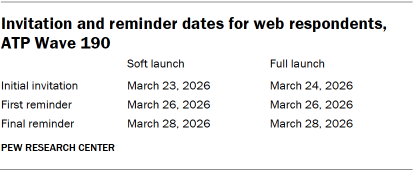
- March 20, 2026: Prenotification postcards were dispatched to potential telephone participants, setting the stage for the upcoming survey window.
- March 23, 2026: The survey officially entered the "soft launch" phase. Sixty panelists were contacted to test the survey’s functionality. Simultaneously, postcard notifications were mailed to online participants to ensure high visibility.
- March 24, 2026: The "full launch" commenced. All remaining English- and Spanish-speaking panelists were invited to contribute, utilizing a mix of email, SMS, and live phone calls to maximize engagement.
- March 29, 2026: The field period concluded. Over the course of these seven days, the researchers managed a complex flow of data collection, balancing digital responses with live interviews to ensure that even the less technologically connected segments of the population were represented.
Supporting Data: Ensuring Precision and Reducing Bias
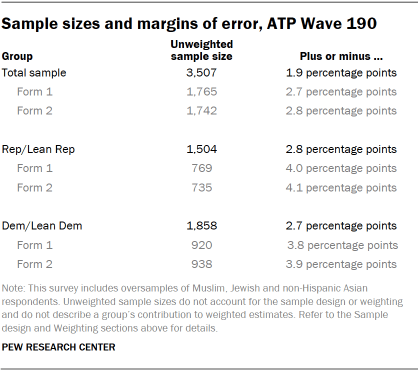
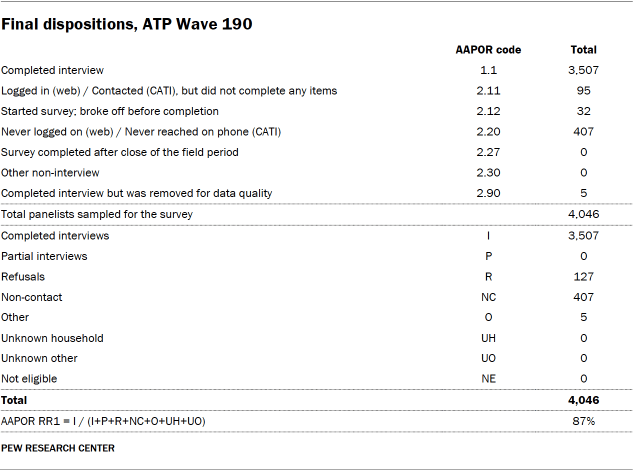
Statistical precision is the heartbeat of the Pew Research Center’s methodology. For Wave 190, the total sample size reached 3,507 respondents, resulting in an impressive 87% survey-level response rate. However, raw numbers are not enough; the Center employs rigorous weighting processes to ensure the sample reflects the true composition of the U.S. adult population.
To capture the nuances of smaller, often marginalized, communities, the survey purposefully oversampled Muslim, Jewish, and non-Hispanic Asian adults. This is a deliberate strategy to provide higher-precision estimates for these groups, which are then weighted back to match their actual proportions in the census.
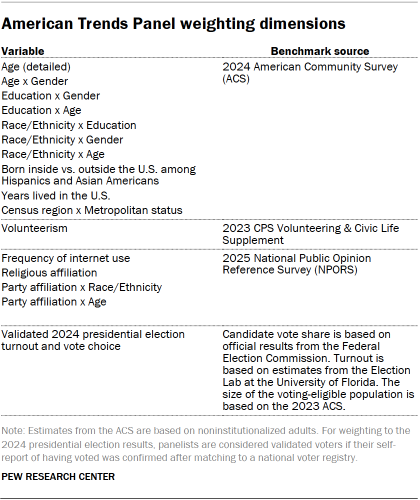
The weighting process itself is multi-staged. It begins with a "base weight" reflecting the probability of recruitment and is then calibrated against population benchmarks. This adjustment corrects for nonresponse and attrition. Finally, the weights are "trimmed" at the 1st and 99th percentiles to prevent outliers from skewing the final results. This exhaustive statistical cleansing results in a margin of error of plus or minus 1.9 percentage points for the full sample, a high standard of accuracy that allows for confident analysis of the data.
Data quality is further protected by "satisficing" checks. Researchers actively monitor for participants who may have rushed through the survey, such as those who left high numbers of questions blank or displayed "straight-lining" behavior (selecting the same answer for every question). During Wave 190, five respondents were identified and removed due to such patterns, ensuring the final dataset remained pristine.
Official Responses and Quality Control
The development of the questionnaire is a collaborative, high-stakes endeavor. Pew Research Center staff work in tandem with SSRS to craft questions that are not only neutral in language but also technically flawless. Before the survey goes live, the digital interface undergoes rigorous testing across various devices—including PCs, tablets, and smartphones—to ensure that the user experience does not introduce bias.
The incentive structure is another hallmark of the Center’s commitment to quality. Recognizing that participation requires time and effort, the survey offered post-paid incentives ranging from $5 to $20. By scaling these incentives to the difficulty of reaching certain demographic groups, the researchers actively mitigate the risk of a "participation gap," where the views of harder-to-reach populations might be excluded.
When asked about the potential for error, the Center is transparent. They acknowledge that while sampling error can be calculated and accounted for, other factors—such as the inherent difficulty of survey administration and the psychological impact of question wording—remain constant challenges in the field of public opinion research.
Implications: Why Methodology Matters
The implications of this meticulous approach are profound. In a world characterized by increasing polarization and competing "truths," the Pew Research Center’s commitment to transparent, reproducible, and rigorous methodology serves as a vital anchor.
When a reader encounters a finding about the decline of trust in democratic institutions or the shifting landscape of global alliances, they are not just reading an opinion; they are engaging with a carefully constructed map of human sentiment. By standardizing education levels, utilizing global income benchmarks, and accounting for nonresponse bias, the Center creates a language that policymakers, journalists, and citizens can all understand.
Furthermore, the use of longitudinal data—such as the American Trends Panel, which has been growing and evolving since 2014—allows us to see trends over time rather than just static moments. We can track how the definition of national identity has shifted from 2020 to 2026, or how views on globalization have ebbed and flowed in response to economic crises.
In conclusion, the methodology of the Spring 2026 Global Attitudes Survey is more than just a technical manual; it is a declaration of the importance of facts. By investing in robust sampling, intentional oversampling of minority groups, and rigorous data quality controls, the Pew Research Center ensures that the final reports are not merely reflections of current events, but reliable, actionable data that can help guide the world through a complex and uncertain future. As we move further into the 21st century, such commitment to methodological excellence will remain the primary defense against misinformation and the best tool for understanding our collective human experience.
 Pevita Pearce
  Neng Nana