
 By Muslim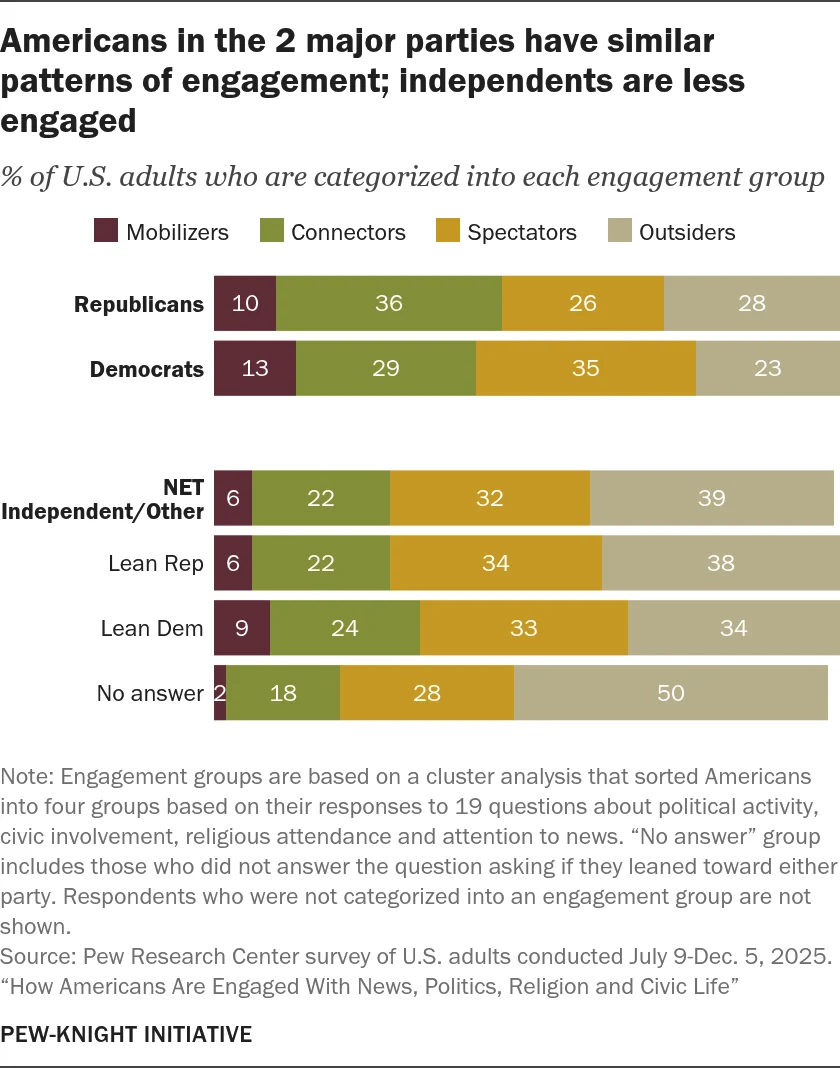
In the modern American landscape, public participation is often reduced to a single metric: the vote. Yet, a groundbreaking new study from the Pew-Knight Initiative suggests that the way citizens interact with their communities, their news, and their faith is far more complex than a binary checkmark on an election ballot. By moving beyond traditional political labels, researchers have uncovered a nuanced map of how Americans actually show up in society.
The study, which synthesizes data from two comprehensive Pew Research Center surveys conducted in late 2025, categorizes the U.S. adult population into four distinct "engagement groups." These groups—Mobilizers, Connectors, Spectators, and Outsiders—reveal that while partisanship may divide the nation on ideology, the fundamental mechanics of how people engage in civic life are strikingly similar across both the Democratic and Republican aisles.

The Four Pillars of Engagement
To understand the modern public, the Pew-Knight Initiative performed a cluster analysis on 19 distinct measures of participation, ranging from political activism and community volunteering to religious service attendance and news consumption habits. The resulting taxonomy provides a vivid picture of the American populace:
- Mobilizers (The "Do-It-Alls"): As the smallest and most highly active segment, this group is the engine of civic life. They are deeply involved in politics, consistently volunteer, stay informed through rigorous news consumption, and are active participants in religious life.
- Connectors (The Community Builders): Larger than the Mobilizers, this group is highly engaged in social and community spheres—such as joining groups and donating to causes—but they demonstrate a lower threshold for direct political activity. They are the backbone of civil society, even if they aren’t marching in the streets.
- Spectators (The Watchful Observers): As their name suggests, this group maintains a high level of news consumption, keeping a close eye on the national conversation. However, they are significantly less likely than the first two groups to translate that awareness into tangible, direct participation in politics or community service.
- Outsiders (The Disengaged): Comprising a significant portion of the population, this group reports the lowest levels of participation across nearly every metric measured, including voting, volunteering, and news consumption.
Chronology of the Study: Capturing a Pivot Point
The research arrives at a unique moment in American history. Fielded between July and December 2025, the study captures behaviors in the immediate wake of the 2024 presidential election. This timing is critical, as it allows researchers to examine how the political climate—specifically the transition to a Republican-led White House and Congress—influenced citizen activity.
During the first half of the year, the political environment was defined by the 2024 campaign. By the latter half, the shift in federal power created a "reactionary" dynamic. The researchers note that some behaviors, particularly political protests, contacting elected officials, and campaign volunteering, are inherently sensitive to the political climate. The study acknowledges that Democratic engagement, for instance, might have spiked in response to the shift in power, potentially appearing more intense than it would have been under a different administration.
Supporting Data: Partisanship and Engagement
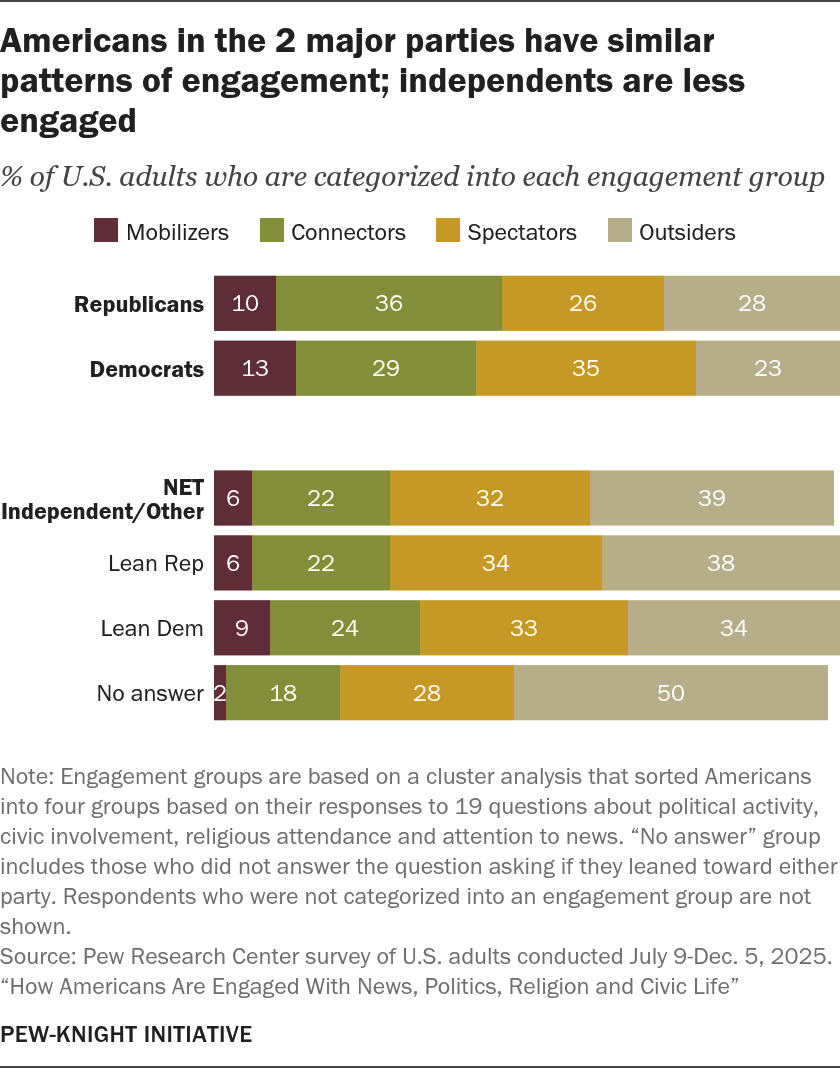
One of the most surprising findings is the lack of a significant "engagement gap" between the two major political parties. When analyzed through the lens of these four groups, Democrats and Republicans look remarkably similar.

While Republicans are slightly more likely to fall into the "Connector" category and Democrats are slightly more represented among "Spectators," the overall distribution is balanced. This suggests that the internal diversity of engagement is a characteristic of both parties. The real divergence appears among Independents. Those who do not lean toward either party are significantly more likely to be classified as "Outsiders." In fact, among those who gave no answer to political leaning, fully 50% fall into the Outsider category, with only 2% qualifying as Mobilizers.
The Ideological Spectrum
The link between engagement and ideology is equally revealing. There is a clear correlation between lower levels of engagement and a tendency to identify as politically "moderate."
- Outsiders (48%) and Spectators (43%) are far more likely to describe their views as moderate than their more active counterparts.
- Mobilizers are the most ideologically split, with 37% identifying as conservative and 37% as liberal.
- Connectors skew more conservative, with 42% identifying as conservative compared to just 21% as liberal.
The 2024 Voting Reality
Voting behavior further underscores these group dynamics. Mobilizers, unsurprisingly, show the highest turnout and the most decisive preferences, with 51% reporting a vote for Kamala Harris and 34% for Donald Trump. As engagement decreases, so does reported turnout. Nearly half of Spectators (49%) and a majority of Outsiders (56%) reported not voting in the 2024 election, though it must be noted that some of these individuals were ineligible or too young to participate.
Official Methodological Rigor
The research was conducted with an acute awareness of the challenges facing modern survey science—namely, that the people least likely to be engaged in public life are also the least likely to respond to surveys.

To overcome this, the Pew Research Center utilized the Cross-Sectional Engagement Survey (5,393 adults) and the American Trends Panel (5,195 adults). By employing multiple contact methods—online, paper, and telephone—and multiple follow-up attempts for non-responders, the researchers sought to capture the voices of the "Outsiders" who typically go unheard in traditional polling. This methodological transparency ensures that the resulting engagement groups are not merely artifacts of self-selection bias, but a genuine reflection of American behavioral patterns.
Implications for Democracy and Civil Society
The implications of this study are profound for policymakers, civic leaders, and the media. If "Outsiders" and "Spectators" represent a massive, largely moderate, and disengaged portion of the electorate, the traditional political strategy of appealing only to the "Mobilizers" may be inherently flawed.

For the media, the data suggests a need to rethink how news is framed. "Spectators" follow the news at high rates, yet they remain detached from other forms of civic action. This creates a potential opportunity for media organizations to bridge the gap between "knowing" and "doing," transforming passive consumption into meaningful community contribution.
For civic organizations, the "Connectors" represent an untapped reservoir of potential. Since they are already active in their communities and willing to donate time and money, they could be the key to revitalizing local institutions if provided with pathways that focus on community impact rather than national partisan politics.

Ultimately, the Pew-Knight Initiative study challenges the assumption that the "public" is a monolith. By recognizing that Americans occupy different "engagement spaces," we gain a clearer understanding of the health of our democracy. We see that while political combat often dominates the headlines, the daily, quiet, and often disconnected labor of millions of citizens—whether they are active in their church, their local library, or simply watching from the sidelines—is what truly keeps the American experiment moving forward.
As we look toward the future of civic life, the challenge will be to determine whether we can move more "Outsiders" into the sphere of connection, or if the current patterns of engagement are a permanent fixture of a modern, complex society. Regardless, this research provides the most detailed roadmap yet for navigating the diverse ways in which Americans live, work, and participate in their shared public life.
 Pevita Pearce
  Neng Nana