
 By Layla Zulfa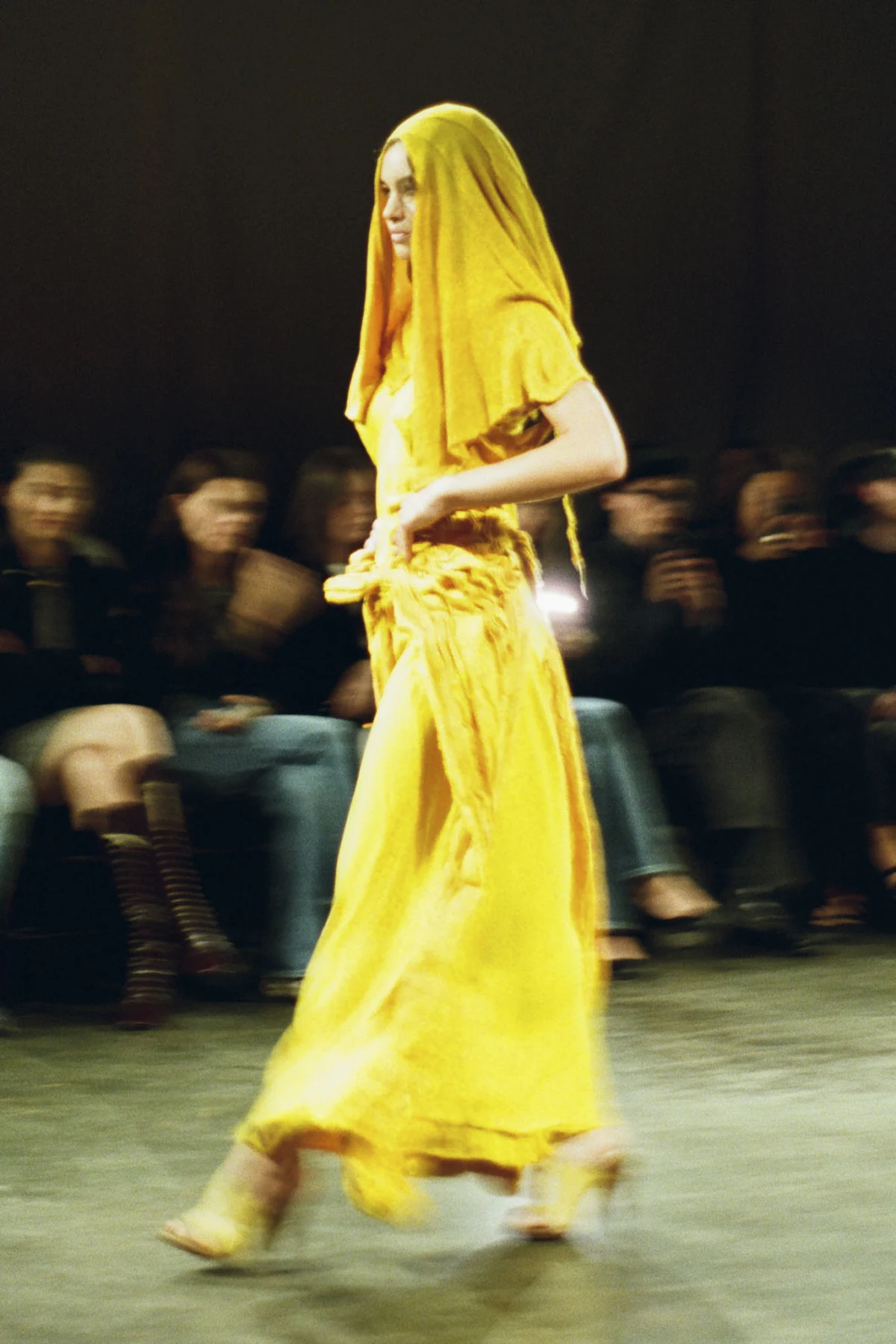
Introduction: A Victorian Tableau in Earls Court
On a quiet, nondescript street in London’s Earls Court, the atmosphere on a recent Tuesday felt less like a hub of contemporary fashion and more like the opening chapter of a long-lost Victorian gothic novel. The neighborhood, usually bustling with the rhythmic transit of city life, was rendered eerily still. The focal point of this stillness was Saint Cuthbert’s, a Grade I listed 19th-century church celebrated for its intricate Arts and Crafts interior. Inside, long panels of canvas obscured the sanctuary walls, casting long shadows that seemed to hold their breath.
It was within this sepulchral environment that Welsh designer Paolo Carzana unveiled his latest collection. If the venue suggested a narrative of hauntings and history, the presentation served as the perfect companion: a procession of models who appeared less like runway walkers and more like shrouded statues suddenly imbued with the spark of life. As the lights dimmed, it became clear that Carzana was not merely presenting a collection of garments; he was staging a séance for the textile arts.
Chronology: The Evolution of a Vision
Carzana has long been recognized as a designer who operates in the liminal spaces between high art and wearable sculpture. His trajectory—from emerging talent to a fixture of the London fashion vanguard—has been defined by a refusal to adhere to the traditional pace of seasonal trend cycles.
- The Early Years: Carzana first gained attention for his raw, tactile approach, often utilizing discarded materials and artisanal techniques that prioritized the hand of the maker.
- The Evolution of Craft: Over the past several seasons, his work has shifted from structural experimentation to a more fluid, organic exploration of the human form.
- The Saint Cuthbert’s Presentation: The recent show represented a culmination of this period of introspection. The preparation involved months of sourcing sustainable, deadstock fibers and developing proprietary dyeing processes that mirrored the aged patina of the church’s architecture.
- The Walkthrough: The show opened with a series of monochromatic looks, gradually introducing deeper, earthier tones that seemed to mirror the degradation and beauty of the church’s own stonework.
Supporting Data: The Anatomy of the Collection
At the heart of the collection was a masterful manipulation of tension and release. Carzana’s signature style—superpositions of shredded, filmy knits—was on full display. The garments appeared to "cling" to the body, a result of intricate layering and fraying seams that seemed to possess a life of their own as the models moved through the nave.
Materiality and Texture
The technical prowess required to execute these pieces is significant. Carzana utilizes a process of deconstruction, where woven textiles are subjected to stress-testing before being reassembled. Key elements included:
- Filmy Knits: Ultra-lightweight mohair and silk blends that provided a ghost-like transparency.
- Structural Fraying: Seams that were intentionally left un-hemmed, allowing for a "living" garment that changes slightly with every movement of the wearer.
- Ergonomic Cutouts: The strategic placement of openings, which offered flashes of skin—an inner thigh, the curve of a hip, or the nape of the neck—served to humanize the ethereal, sculptural silhouettes.
The Influence of the Old Masters
The visual language of the collection drew heavy inspiration from 16th and 17th-century European painting. Critics noted a distinct parallel to the works of Bartolomé Esteban Murillo. Much like the Spanish master, who elevated the "ordinary" subject to a place of reverence, Carzana’s work focuses on the beauty of the flawed and the common. By dressing his models in rags that were elevated to the status of haute couture, he forced the audience to look at the human form not as a mannequin for luxury goods, but as a vessel of history and emotion.
Official Responses and Critical Reception
The fashion community’s response to the show has been polarized, reflecting the divide between those who view fashion as a commercial commodity and those who view it as an expressive art form.
Industry analysts have praised the "sculptural integrity" of the work. "Carzana is doing something that very few designers are brave enough to do," noted one lead critic from a prominent trade publication. "He is creating garments that resist the gaze of the consumer. They don’t want to be sold; they want to be experienced."
However, the question of commercial viability remains the elephant in the room. In a retail climate that favors fast-turnover, high-impact branding, Carzana’s delicate, fragile, and labor-intensive pieces pose a logistical challenge. When asked about the marketability of the collection, a spokesperson for the designer’s studio remained coy: "The value of a garment is not measured solely in its retail price, but in the time, history, and craftsmanship invested in its creation. Our clients are collectors, not consumers."
Implications: Where Does Fashion Go From Here?
The Saint Cuthbert’s show raises profound questions about the future of independent design in London. If the commercial viability of such an ensemble remains "shrouded in mystery," as many have suggested, does this signal a decline in the appreciation for high-concept fashion, or is it a sign of a necessary pivot toward slow fashion?
The Sustainability Angle
One cannot discuss Carzana without addressing his commitment to ethical production. By focusing on deadstock and low-impact, hand-dyed materials, he is positioning his brand as an antidote to the waste-heavy machinery of modern fashion. The implications here are twofold:
- Production Scalability: Can these hand-crafted techniques be scaled, or is the future of such fashion limited to a small, ultra-luxury tier?
- Cultural Value: Carzana’s work challenges the audience to consider the "cost" of clothing. When a garment takes weeks to fray, dye, and assemble, the price tag becomes a secondary conversation to the ethical and aesthetic weight of the object.
The Role of the Venue
The use of Saint Cuthbert’s was not merely aesthetic. It served as a critique of the "white cube" gallery space that often houses fashion shows. By choosing a space that carries the weight of spiritual and communal history, Carzana reclaimed the show as a ritual rather than a marketing event. This suggests a growing trend among younger designers to use heritage sites to ground their work in a wider cultural context, moving away from the ephemeral nature of digital-first fashion weeks.
Conclusion: The Persistence of Mystery
As the last model exited the church, the canvas panels remained in place, keeping the secrets of the production hidden from the street outside. Paolo Carzana has once again succeeded in creating a collection that defies easy categorization. Whether these garments will ever find their way onto the high street is perhaps irrelevant to the designer’s broader mission.
By grounding his collection in the aesthetics of the past and the tactile reality of the present, Carzana has proven that fashion can still be a site of mystery and profound contemplation. In a world of over-exposure and constant digital consumption, there is something revolutionary about a collection that, like the Victorian ghosts of Earls Court, prefers to remain partially in the shadows. For those who witnessed the show at Saint Cuthbert’s, the takeaway was clear: fashion is not just about what we wear, but about how we carry the weight of our own stories.
The collection will likely be remembered not for its sales figures, but for the haunting, visceral experience it provided—a fleeting moment of beauty in a city that is always moving, but occasionally, if one knows where to look, stands completely still.
 Nila Kartika Wati
  Suro Senen