
 By Suro Senen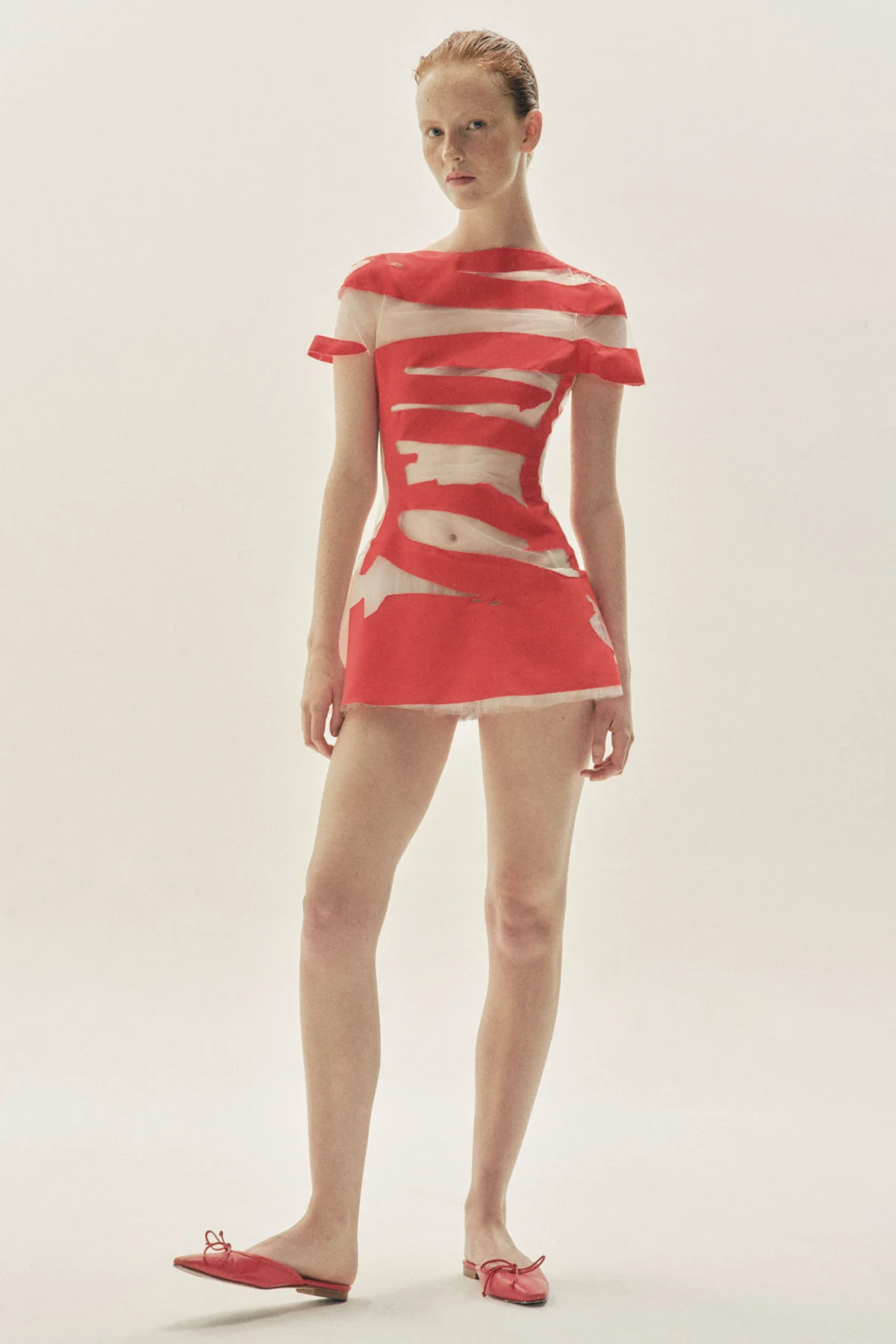
In an era increasingly dominated by the cold, algorithmic precision of artificial intelligence—where “AI slop” has begun to saturate the digital visual landscape—the arrival of Steve O Smith feels like a radical act of human rebellion. The Central Saint Martins graduate, recently heralded as the winner of the 2025 Karl Lagerfeld Prize at the prestigious LVMH Prize, is not merely designing clothing; he is transposing the chaotic, organic life of ink on paper onto the human form with a level of artisanal obsession rarely seen in modern ready-to-wear.
The Classroom as Catwalk: A Manifesto Against the Machine
The setting for his most recent presentation was as unconventional as his creative process. Tucked away in the subterranean depths of the Royal Academy of Art, a select group of fashion editors and industry insiders found themselves not in a sleek, mirrored showroom, but in a life-drawing classroom. The scent of linseed oil and graphite hung in the air, a deliberate sensory grounding that served as a vibrant riposte to the sterile, screen-based design processes currently sweeping the industry.
For Smith, the runway show was a lecture in disguise. Standing at a lectern equipped with small, potent bottles of red, cobalt, and Prussian blue ink, he functioned less like a traditional creative director and more like a professor of fine arts. As he tapped his paintbrush against the glass and brandished a stained blotting rag, the audience was treated to an intimate masterclass on the intersection of Fauvism and high fashion.
"It’s a bit like paint-by-numbers to scale," Smith explained, his voice echoing against the vaulted ceiling. He spoke of the meticulous process required to translate his small-scale drawings into structural garments. He has mastered the art of capturing the "accidents" of his medium—even going so far as to render, in shimmering glass beads, the way his ink congealed when it dried too quickly during the stifling heatwaves that plagued London this past summer.
The Geometry of the Negative Space: A Chronological Evolution
Smith’s journey to this moment of critical acclaim is a testament to the power of self-imposed limitations. After graduating from Central Saint Martins, he spent years refining a process that prioritizes the "spaces between." He often recounts a formative experience with a "very scary drawing teacher" who fundamentally altered his perspective.
"It’s the shapes you create between your lines that are the most interesting in a drawing," the teacher had insisted. That singular observation became the bedrock of Smith’s design philosophy. By focusing on the negative space—the voids and the intersections—Smith began to challenge the eons-old fashion dogmas that demand hemlines, middy collars, and Breton stripes adhere to rigid, linear conventions.
By 2024, his made-to-order practice began gaining traction among a niche, sophisticated clientele. He transitioned from experimenting on paper to utilizing complex fabric appliqué and exacting pattern cutting. This evolution reached a fever pitch in early 2025, when his ability to bridge the gap between fine art and functional fashion earned him the Karl Lagerfeld Prize, a validation of his unique, human-centric approach.
Technical Virtuosity: The Science of the Ink Blot
What sets Smith apart from his contemporaries is his refusal to "clean up" the reality of his work. While most designers use digital software to perfect the symmetry of a pattern, Smith employs a cadre of specialists to capture the messy, beautiful reality of his artistic failures.
For his latest collection, Smith enlisted a fringe specialist to interpret the way his ink bleeds into the fiber of his notecards. He tasked an embroiderer with finding the exact thread-color match for the muddy, unexpected hues that appear when red and blue ink collide on the page. The result is a collection that feels alive, almost vibrating with the tension of its own creation.
The pieces themselves are a triumph of textile engineering:
- The Pannier Dresses: Utilizing soft, architectural panniers, these garments manipulate the silhouette, pushing the fabric away from the body to create the very shapes Smith explores in his drawings.
- The Signature Coat: A "killer" piece that acts as a canvas for his brushstrokes, rendered in dense, textural fabrics that mimic the viscosity of heavy ink.
- The Gossamer Shirt and Tie: A playful, delicate ensemble that defies the stuffy dress codes of private members’ clubs. It is, as Smith suggests, an outfit designed to spark a conversation with a doorman rather than to blend into the background of a boardroom.
Official Perspectives and Industry Implications
The implications of Smith’s work go far beyond the aesthetics of his seasonal collections. In an industry currently grappling with the existential threat of AI-generated imagery and hyper-efficient, machine-led production, Smith represents a return to the "soul" of the garment.
Critics and buyers have noted that Smith’s work forces a re-evaluation of classic patterns. After observing his process, one cannot help but look at traditional tartans and stripes—once symbols of rigid conformity—and see them as fluid, living entities. His work suggests that if the "lines" of a garment are treated as a drawing rather than a technical specification, the potential for new, wearable forms is infinite.
"He is playing a dangerous game with traditional proportions," noted one editor in attendance. "But in doing so, he is liberating the wearer from the tyranny of the ‘perfect’ fit."
The Human Imperative in Fashion
As the fashion world looks toward 2026, the success of Steve O Smith serves as a critical data point. It confirms that there is a burgeoning market for work that is distinctly, intentionally human. His reliance on the "scary teacher’s" wisdom—that the beauty lies in the void—is a reminder that innovation is often found in the things we choose to leave undone or the accidents we choose to preserve.
By working on a strictly made-to-order basis, Smith also addresses the growing concerns surrounding overproduction in the luxury sector. His business model is one of scarcity and intent; each piece is a direct manifestation of a specific moment of creative impulse, rendered with the help of artisans who understand that perfection is not the goal—expression is.
Conclusion: A New Language for the Body
Steve O Smith is not just designing clothes; he is designing a new language for the body. By refusing to follow the straight lines mandated by centuries of tailoring, he has opened a door to a more erratic, expressive, and ultimately more human way of dressing.
As he stands at his lectern, blotting his brush and tapping his ink bottles, he isn’t just presenting a collection—he is presenting a challenge to the industry. The question he leaves us with is simple: If we stop trying to force our clothes into the rigid shapes of the past, what kind of human form might we actually discover underneath?
For now, the answer lies in the ink-stained cuffs, the bleeding embroidery, and the beautiful, complex shapes created between the lines. In the face of a future that promises to be increasingly automated, Smith has reminded us that the most interesting thing about a drawing—and perhaps about a person—is what happens when you let the ink run.
 Nila Kartika Wati
  Layla Zulfa
  Muslim