
 By Nana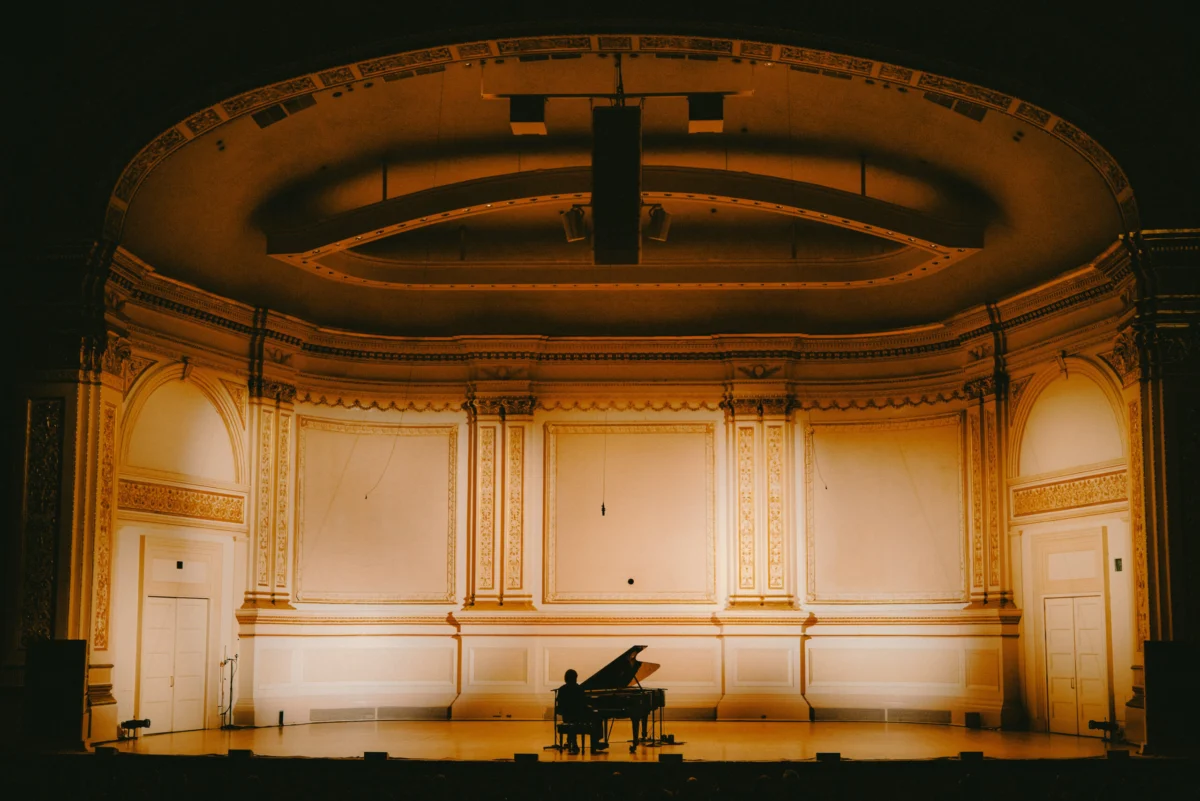
In the pantheon of concert films, where the spectacle of stagecraft often threatens to overshadow the music itself, a rare, crystalline moment has emerged. Cameron Winter at Carnegie Hall, directed by the visionary Paul Thomas Anderson, is not merely a record of a performance; it is a cinematic séance. Premiering to a rapt audience at the New York Film Festival, the 75-minute feature documents the solo appearance of Cameron Winter, the frontman of the indie band Geese, on December 11, 2025. It is a work of profound, meditative stillness that transforms one of the world’s most prestigious stages into a private cathedral of sound.
The Anatomy of an Incantation: Performance and Presence
The film’s premise is deceptively simple: one man, one Steinway grand piano, and a series of trance-like compositions. Yet, to describe it as a concert film feels reductive. It is a document of an artist operating at the precipice of a creative breakthrough.
Winter, known primarily for the jagged, nervous energy of his band Geese, sheds that skin entirely for this solo outing. Clad in a minimalist black ensemble, his aesthetic—shaggy, unkempt hair paired with a doleful, weary expression—invokes the solemnity of a late-career romantic poet. When he lopes onto the stage, his initial, reticent bow feels less like a performance for the gallery and more like an act of submission to the instrument awaiting him.
The piano, placed at a slight, unconventional angle, forces Winter to perform with his back largely turned to the audience. This is not a posture of ego or hostility, but one of necessity. By removing the visual crutch of stage presence, he forces the audience to engage exclusively with the vibrations of the Steinway and the architectural reach of his voice.
A Chronology of the Performance
The film tracks a meticulously paced setlist that functions more as a singular, cohesive song cycle than a collection of disparate tracks.
The concert opens with "It All Fell in the River," a haunting piece that sets the tone for the evening—a exploration of catharsis, likely rooted in the shedding of past grief. As the set progresses, the listener is guided through the relational inquisitions of "If You Turn Back Now," a track that manages to weave domestic drama into a theological questioning of the devil himself.
The mid-set shift brings the stark, biting "$0," a song that navigates the nuances of belittlement and power, before soaring into the defiant, spiritual affirmation of "God is actually real." The performance reaches its zenith with a transcendent rendition of "Take It With You." In this final act, Winter captures the scalded romanticism of Bob Dylan—specifically the Dylan of the mid-70s who treated the microphone not as a recording device, but as a confessional.
Sonic Texture: The Alchemy of Voice and Piano
The sonic engineering of this film is nothing short of a revelation. The piano, captured with a deep, bottom-heavy resonance, echoes through Carnegie Hall with the weight of a rhapsody from the deep. It is a sound that feels physical, lustrous, and remarkably grand.
Winter’s voice serves as the film’s central instrument. It is a baritone of astonishing range and control, capable of dropping into a low-octave murmur—reminiscent of a haze-drenched Thom Yorke or a sober, lyrical Tom Waits—before leaping into a soaring vibrato. There are echoes of the early, bard-like Bruce Springsteen, particularly in the plaintive delivery of his lyrics. However, the most apt comparison remains the young Dylan: a performer who lets his words pour out in a blissful, possessed torrent.
Winter’s lyrics, while often cryptic, are not meant for academic dissection. Their meaning is derived from the way they are sung—the subtle accusations, the gasps of awe, and the persistent, prayer-like quality of his phrasing.
The Directional Lens: Paul Thomas Anderson’s Visual Language
Paul Thomas Anderson, a filmmaker known for his meticulous control of light and shadow, approaches this project with a surprising, yet effective, restraint. Eschewing the hyper-edited, fast-paced style of modern concert films, Anderson allows the camera to linger.
The film is bathed in an amber, golden-hour glow, as if the entire interior of Carnegie Hall were illuminated by thousands of candles rather than electric stage lights. By framing the piano from various, intimate angles, Anderson brings the audience directly into Winter’s emotional orbit. The shots of the four balconies, separated by the stark lines of light, provide a sense of scale, contrasting the small, solitary figure on stage with the cavernous history of the venue.
This is a stark departure from Anderson’s previous foray into music film, the 2015 documentary Junun. While Junun was an exploration of global textures and collaborative movement, Cameron Winter at Carnegie Hall is a study in vertical focus. Anderson captures the "indie-operatic" nature of the performance, ensuring the viewer never feels like an outsider looking in, but rather a witness to a private, spiritual exercise.
Supporting Data: From Indie-Rock to Solo Virtuoso
The evolution of Cameron Winter’s career provides necessary context for this performance. As the face of Geese, Winter has been a polarizing figure in the indie scene. While critics have often categorized the band alongside the likes of Wilco and Arcade Fire, many have argued that the group’s studio output has yet to capture the raw potential of its frontman.
His 2024 solo record, Heavy Metal, acted as a necessary pivot, stripping away the noise-rock exterior to reveal a songwriter of immense, meditative depth. Cameron Winter at Carnegie Hall serves as the ultimate validation of that pivot. It presents a version of Winter that is more vulnerable, more mature, and more compositionally complex. The songs, devoid of verse-chorus conventionality, suggest a Leonard Cohen-esque commitment to the song cycle, where each piece is a chapter in a larger narrative of faith and heartbreak.
Implications for the Industry
The premiere of Cameron Winter at Carnegie Hall at the New York Film Festival sends a clear signal to the industry: the "concert film" genre is undergoing a renaissance. By focusing on the intimacy of the solo performance, Anderson and Winter have created a template that eschews commercial artifice in favor of artistic purity.
For the music industry, this film poses an interesting question regarding the nature of the "live" experience in the digital age. In a time where performances are often optimized for social media snippets, Cameron Winter at Carnegie Hall demands the viewer’s undivided attention for 75 minutes. It suggests that there is still a massive, hungry audience for slow-form, high-art musical experiences.
Conclusion: A Hope Never Found
In the final analysis, the success of the film rests on the fact that Cameron Winter appears to be truly, terrifyingly lost in his own music. He is not performing for us; he is performing through us. By the time the final notes of "Take It With You" dissipate into the rafters of Carnegie Hall, the viewer is left with a singular, lingering impression: that we have witnessed an artist who has successfully merged his sadness with his faith.
As Winter sits at that Steinway, caught in the throes of a musical possession, one finds themselves hoping that he never snaps out of it—that he remains forever in that space, singing to the empty air, leaving the audience to merely eavesdrop on a conversation between a man and his soul.
 Azzam Bilal Chamdy
  Suro Senen
  Evan Lee Salim