
 By Suro Senen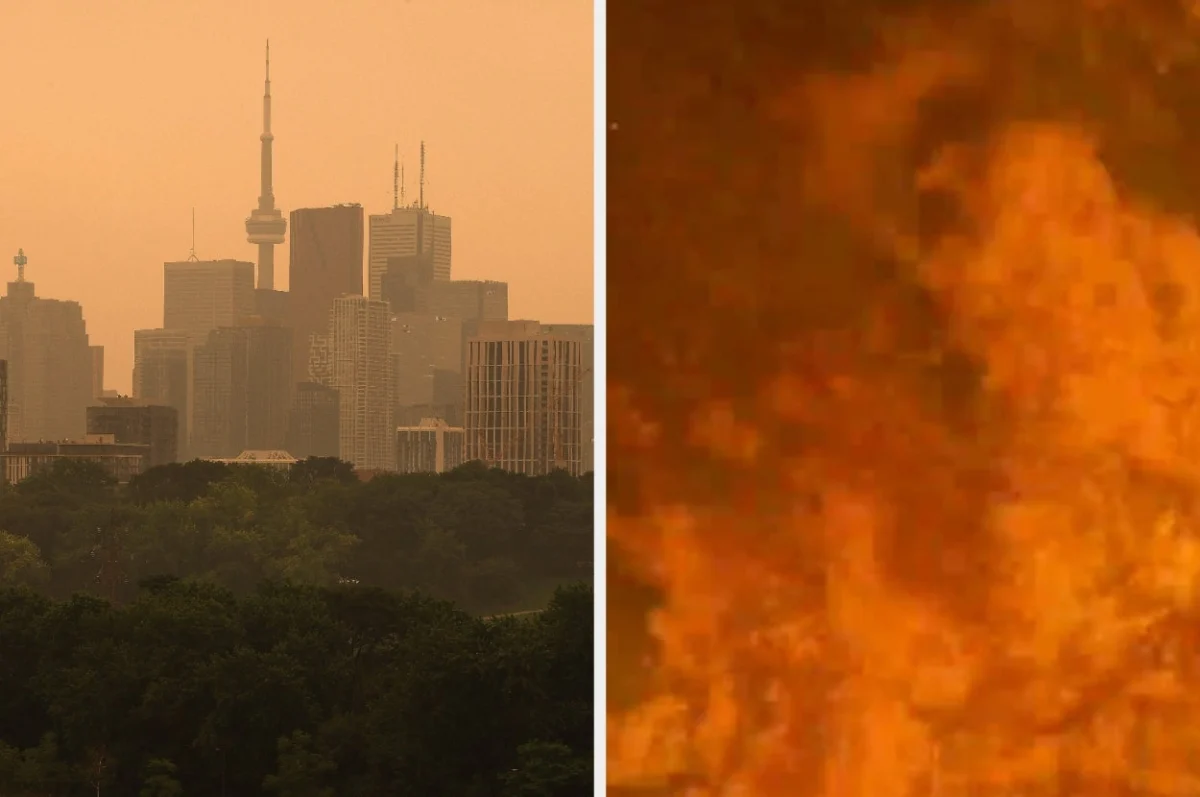
The atmosphere across Ontario has transformed into something out of a dystopian cinematic landscape. For residents navigating the province—from the bustling streets of Toronto to the remote reaches of the north—the sky has shifted to a haunting, opaque hue of orange and yellow. As of July 15, this visual distortion is merely the most visible symptom of a critical environmental crisis: Toronto has officially been ranked as having the worst air quality of any major city in the world, according to real-time data from IQAir.
This is not a localized inconvenience; it is a profound regional emergency. The province is currently grappling with the fallout of over 100 active wildfires burning across Northwestern Ontario. These blazes have created a toxic blanket of particulate matter that has drifted across provincial borders, suffocating communities in Ontario, Quebec, and even reaching deep into the United States.
The Geography of the Crisis: A Chronology of Escalation
The current wildfire situation is the result of a compounding series of environmental stressors. While wildfires are a natural, if destructive, part of the Boreal forest cycle, the current intensity and distribution represent a significant deviation from historical norms.
The Initial Ignition
The crisis began to gain critical momentum in early July. Unseasonably hot, dry conditions, combined with a lack of early-season precipitation, left the forest floor in Northwestern Ontario highly susceptible to ignition. Reports began trickling in of small, lightning-strike-induced fires, but these quickly evolved into large-scale, uncontrollable conflagrations.
The Peak of the Threat
By mid-July, the situation had reached a fever pitch. Major communities, including Thunder Bay, Armstrong, and the Namaygoosisagagun First Nation (Collins First Nation), found themselves in the direct path of the fire fronts. The urgency was underscored by NDP MPP Sol Mamakwa, who shared harrowing footage from the front lines. The video, which circulated widely on social media, depicted CN rail workers narrowly navigating a train through a corridor of fire near Armstrong. While Canadian National Railway (CN) has since confirmed that all personnel aboard the train were evacuated safely, the footage served as a chilling reminder of the volatility currently facing workers and residents in the North.
The Trans-Continental Drift
As the fires intensified, the prevailing winds acted as a distribution network for the smoke. By the second week of July, the particulate matter had traveled thousands of kilometers, resulting in "Code Red" air quality alerts in major urban centers. Cities that were hundreds of miles from the nearest active flame—including Toronto and, eventually, New York City—were suddenly plunged into a thick, acrid haze, forcing public health officials to issue urgent warnings regarding respiratory safety.
Supporting Data: Understanding the Air Quality Index (AQI)
The severity of the situation can be quantified through the Air Quality Index (AQI), which measures the concentration of fine particulate matter (PM2.5) in the atmosphere. PM2.5 refers to tiny particles, less than 2.5 micrometers in diameter, that are small enough to enter the human bloodstream through the lungs.
The Global Standing
When Toronto claimed the ignominious title of the city with the "worst air quality in the world" on July 15, the AQI readings were consistently exceeding 200, placing the air quality in the "Very Unhealthy" or "Hazardous" categories. In these conditions, even healthy individuals are advised to avoid prolonged outdoor exertion, while vulnerable populations—including children, the elderly, and those with pre-existing cardiovascular or respiratory conditions—are at significant risk of acute health events.
Meteorological Factors
The persistence of the smoke is due to a "blocking pattern" in the jet stream, which has prevented the smoke from dissipating into the upper atmosphere. Instead, it has been trapped at lower altitudes, creating a "dome" effect over the Great Lakes region. Meteorologists note that until a significant weather front moves through to shift these wind patterns, the particulate matter will continue to recirculate, maintaining the hazardous conditions.
Official Responses and Resource Allocation
The provincial and federal response to the wildfire surge has been met with both mobilization and scrutiny. The Ministry of Natural Resources and Forestry (MNRF) has deployed hundreds of firefighters, including specialized crews from across Canada and international partners, to bolster the defense of vulnerable communities.
Emergency Management
In Northwestern Ontario, emergency management protocols were triggered to facilitate the evacuation of communities most at risk. In areas like Collins First Nation, the focus has been on protecting critical infrastructure and ensuring the safe transport of residents to temporary shelters in larger urban hubs.
The Resource Debate
Despite the rapid deployment of resources, there is a growing debate regarding the adequacy of current firefighting infrastructure. Experts and advocacy groups, such as those featured in The Walrus, have pointed to a systemic lack of funding and specialized equipment for emergency firefighting. As the climate changes, the "fire season" is beginning earlier and lasting longer, stretching the existing pool of forest firefighters to their breaking point. The reliance on seasonal crews and the historical trend of under-investing in wildfire prevention have come under heavy fire from local leaders who argue that the status quo is no longer sustainable.
Implications: A New Climate Norm?
The most unsettling aspect of the current crisis is the growing consensus among climatologists that this is not an anomaly, but a preview of a "new normal."
Climate Change as a Multiplier
The intersection of human-caused climate change and natural forest cycles is creating a dangerous feedback loop. Warmer winters, earlier spring thaws, and prolonged summer droughts create a tinderbox environment. When fires occur, they release vast amounts of stored carbon into the atmosphere, which in turn contributes to further global warming—a cycle that is increasingly difficult to break.
Long-Term Public Health Impacts
The long-term health implications for the residents of the affected regions are still being studied, but experts are concerned. Repeated exposure to high levels of wildfire smoke has been linked to increased hospitalizations for asthma, chronic obstructive pulmonary disease (COPD), and cardiac arrests. For northern communities, which may have limited access to high-end air filtration systems and medical facilities, the threat is particularly acute.
Policy and Infrastructure Shifts
Moving forward, provincial policy will likely need to shift from a reactive model—where agencies scramble to put out fires after they start—to a proactive model. This includes:
- Increased Prescribed Burning: Controlled burns during safer seasons to reduce the fuel load in forests.
- Infrastructure Hardening: Improving fire-resilient architecture in northern communities and investing in better air filtration for public buildings.
- Enhanced Early Warning Systems: Utilizing satellite imagery and AI-driven weather modeling to detect ignitions within minutes rather than hours.
Conclusion
As the orange haze hangs over Ontario, the province finds itself at a crossroads. The visual evidence of the sky, the data from air quality monitors, and the harrowing stories from those in the North all point to the same conclusion: the environment is shifting in ways that our current infrastructure is not prepared to handle.
While we wait for the winds to change and the skies to clear, the focus remains on the safety of those on the ground. For those in the path of the smoke, health officials continue to urge caution: stay indoors, keep windows sealed, and utilize air purifiers if possible. As we navigate this challenging week, our thoughts are with the firefighters, the emergency responders, and the communities who are once again on the front lines of an environmental battle that shows no sign of abating. The "Dune-ian" landscape may eventually fade, but the lessons learned from this crisis must remain in the public consciousness to ensure a more resilient future.
 Ammar Sabilarrohman
  rifanmuazin