
 By Raul Delapena Setiawan
By Michelle Martin
Enriched & Expanded Editorial Report
Main Facts: The Anatomy of Modern Digital Visibility
In an era where the average global citizen spends approximately 141 minutes per day scrolling through various digital feeds, the battle for human attention is not fought by creators alone. It is adjudicated by invisible arbiters: social media algorithms.
At its core, a social media algorithm is a complex collection of rules, ranking signals, and computational calculations designed to determine the display order and priority of content for every individual user. Far from operating on simple chronological timelines, modern algorithms leverage advanced machine learning and artificial intelligence (AI) to curate a hyper-personalized experience. Consequently, no two individuals see the exact same feed.
In 2026, the stakes for understanding these ranking models have never been higher. Algorithms act as the supreme gatekeepers sitting between content creators, enterprise brands, and their target audiences. They do not ask, "What is the newest post?" Instead, powered by predictive AI, they constantly evaluate: "What is this specific user most likely to engage with, watch, or share right now?"
For marketing teams, this dynamic means organic reach is no longer guaranteed by consistency or follower counts alone. Content must compete against an infinite ocean of alternative distractions. Understanding the universal and platform-specific ranking signals across giants like Instagram, TikTok, LinkedIn, and YouTube has become a foundational prerequisite for digital survival.
Chronology: The Four Eras of Algorithmic Evolution
To understand how modern social media platforms dictate visibility, it is helpful to trace the evolution of their ranking systems. The journey from uncurated feeds to AI-driven predictive networks spans four distinct eras:
-
The Pure Chronological Era (Pre-2016):
In the early days of platforms like Facebook, Instagram, and Twitter, feeds were simple. Content was displayed in strict reverse-chronological order. If you followed a brand or a friend, their newest post appeared at the top of your screen. As networks grew and the volume of content exploded, this model quickly became unscalable, leading to overwhelming feeds and user fatigue. -
The Engagement-Weighted Era (2016–2019):
Faced with information overload, platforms introduced basic ranking filters. Algorithms began prioritizing posts based on explicit engagement metrics—predominantly likes, comments, and shares. If a post generated quick reactions, the system deemed it high quality and pushed it to a wider audience.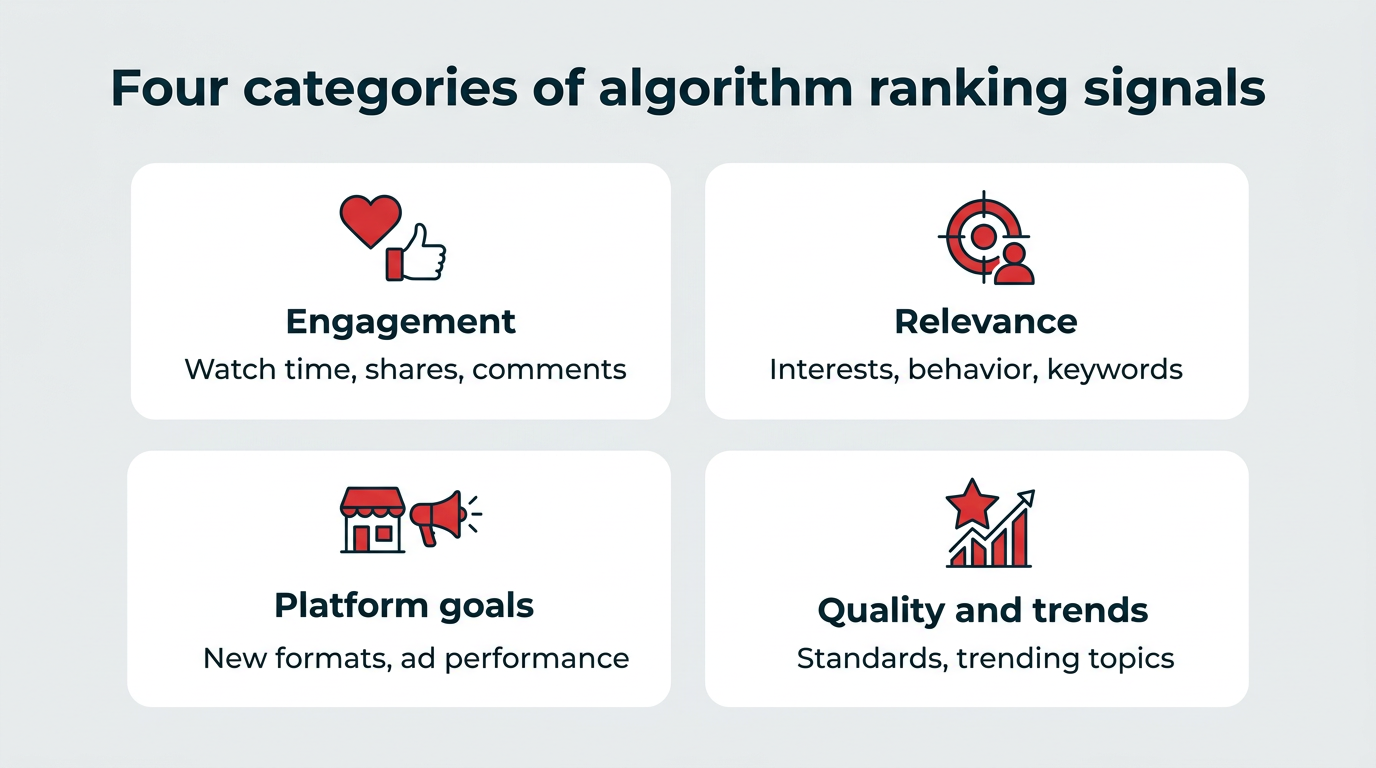
-
The Recommendation and Interest-Based Era (2019–2023):
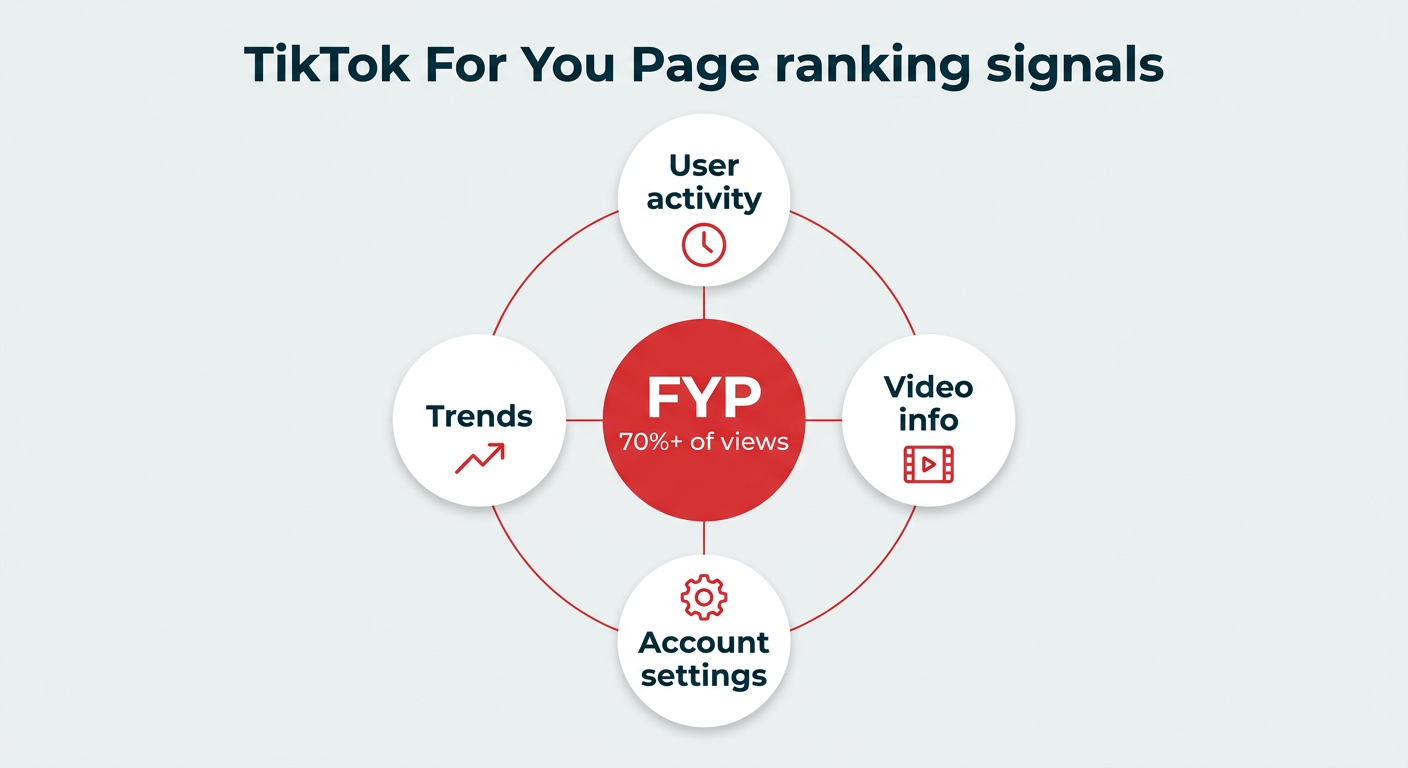
Propelled by the meteoric rise of TikTok and its revolutionary For You Page (FYP), platforms shifted away from purely relational graphs (content from people you follow) to interest graphs (content based on what you like to watch). Machine learning models began analyzing subtle behavioral cues, such as watch time, rewatches, and profile visits, introducing unconnected content directly into mainstream feeds. -
The Generative AI and Predictive Personalization Era (2023–Present):
Today, modern algorithms are deeply integrated with generative AI and advanced machine learning models. Systems no longer just react to past behavior; they predict future intent in milliseconds. Platforms synthesize multi-modal data—text, high-definition video, audio trends, and cross-platform behavior—to hyper-personalize every micro-interaction, shifting the focus toward deep engagement metrics like "sends" and long-form retention.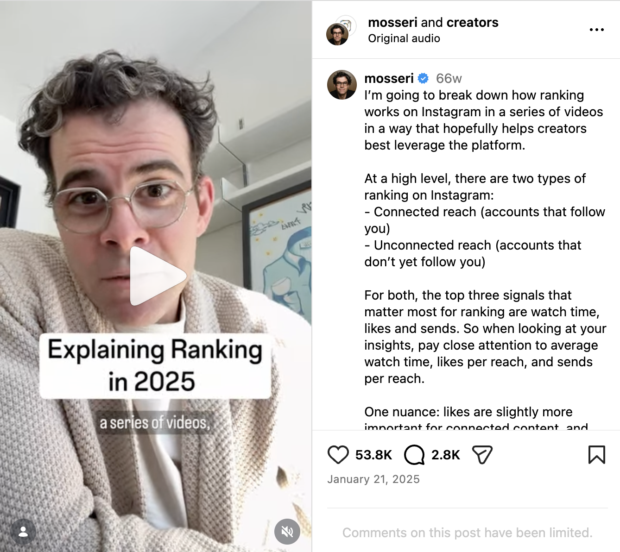
Supporting Data: Decoding Platform Priorities and Ranking Signals
While each network operates under its own unique proprietary logic, common threads bind them together. Across nearly every major platform, ranking signals fall into four broad categories: Engagement-based ranking (likes, comments, shares, watch time), Relevance and personalization (user history, location, language), Platform goals (promoting native video formats, encouraging commercial features), and Content quality/trends (audio traction, high-resolution media, prompt responses).
A comparative breakdown of the top platforms reveals how drastically strategies must shift depending on the ecosystem:
| Platform | Top Ranking Signals | Preferred Format | Chronological Option? | Top Tip for Marketers |
|---|---|---|---|---|
| Watch time, likes, sends | Reels, carousels | Yes | Create content people want to send to a friend via direct message. | |
| Predicted engagement, connections | Video, photos | Yes | Publish content that earns time spent, not just passive clicks. | |
| TikTok | Watch time, user activity | Short-form video | No | Hook viewers aggressively in the first three seconds. |
| Content quality, early engagement | Text, documents, video | No | Reply to comments actively within the first hour after posting. | |
| YouTube | Watch time, relevance | Long and short video | No | Optimize titles/thumbnails for click-through, then protect retention. |
| X (Twitter) | Connections, recency | Text, images | Yes (Following tab) | Post frequently and jump into live conversations immediately. |
| Threads | Predicted engagement, view time | Text | Yes (Following tab) | Ask open-ended questions that organically invite conversational replies. |
| Visual relevance, saves | Images, Pins | No | Design Pins optimized for saves and search intent, rather than quick likes. | |
| Bluesky | User-controlled, community | Text | Yes (default) | Build authentic presence within niche, user-generated custom feeds. |
| Upvotes, recency, moderation | Text, links, images | Yes (New sort) | Read individual subreddit rules carefully before posting promotional material. |
Deep Dive: Instagram’s Four-Stage Filtering Process
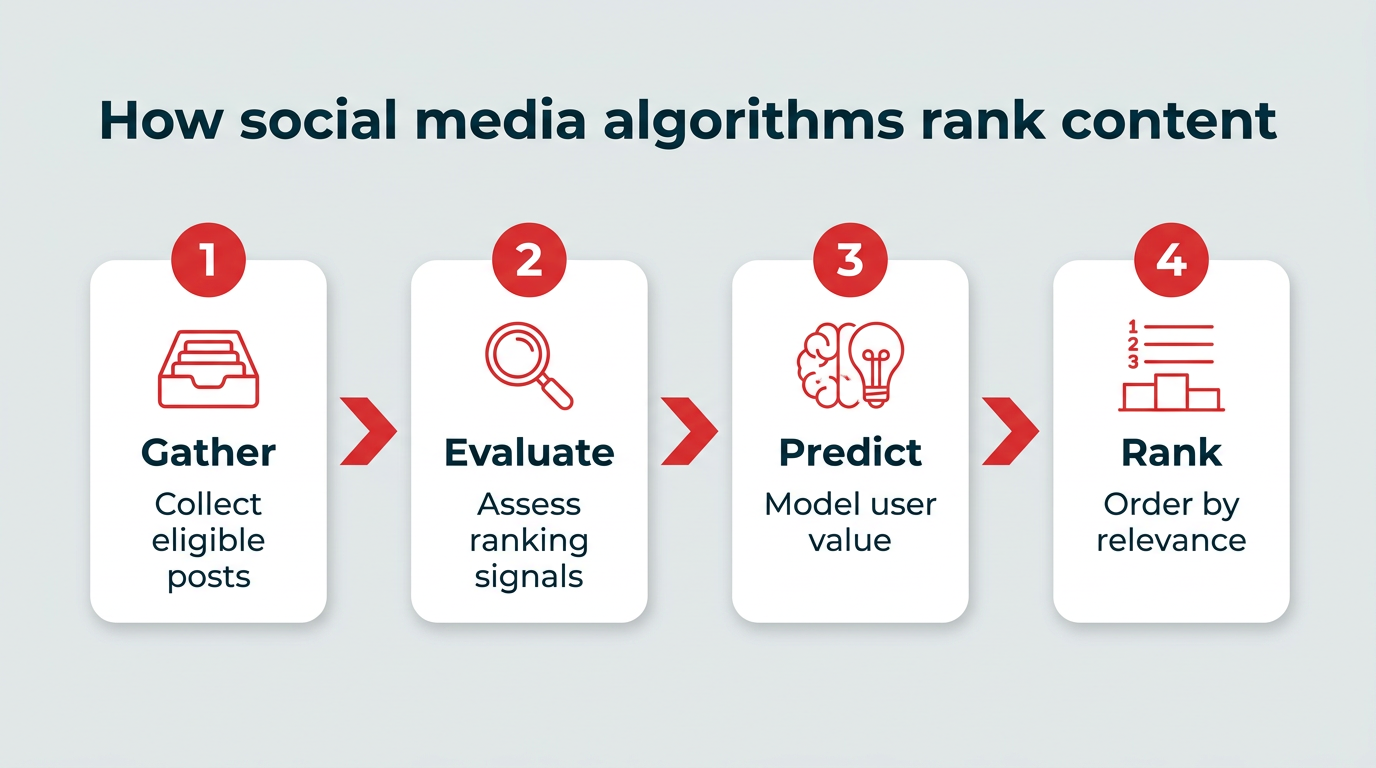
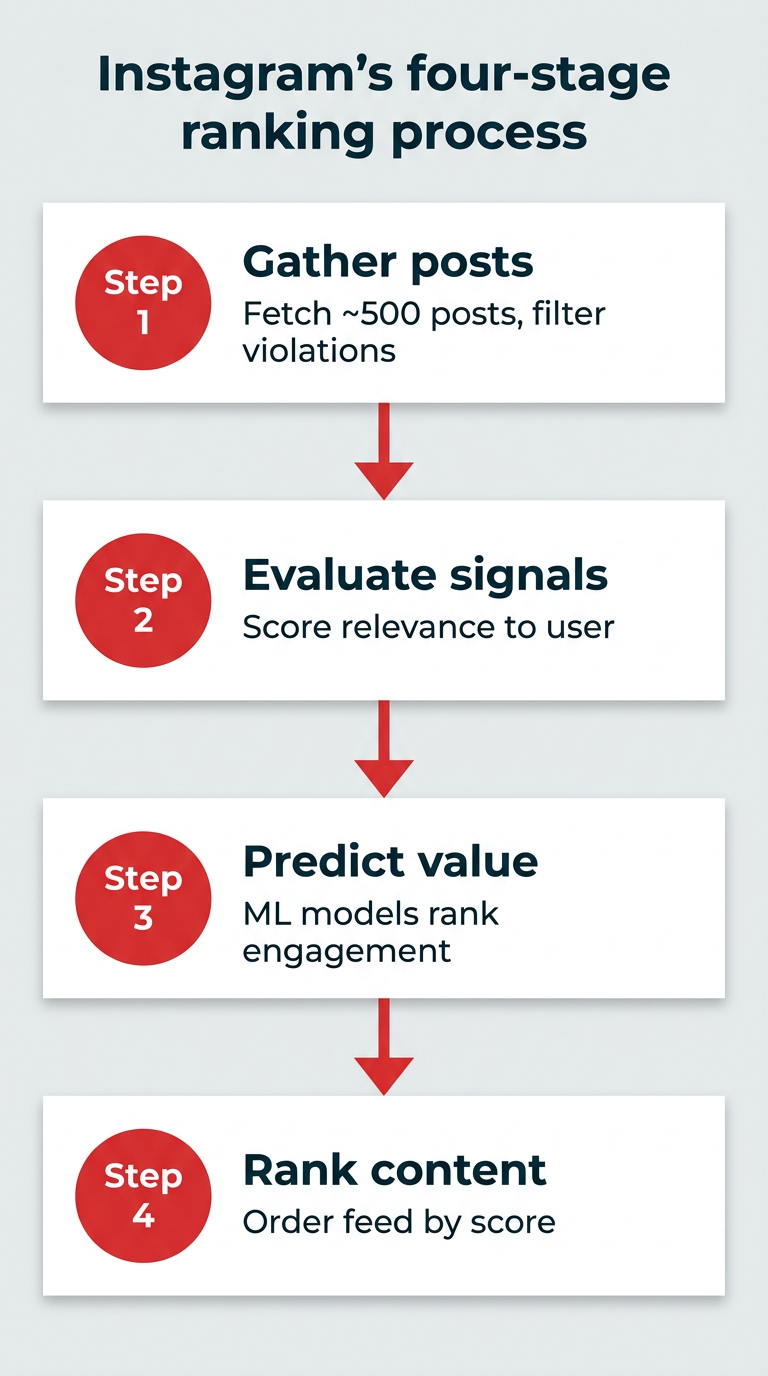
According to official disclosures from Meta leadership—including Head of Instagram Adam Mosseri—the platform relies on watch time, likes, and "sends" (shares) as its primary compass points. Instagram parses content through a rigorous four-stage pipeline:
- Retrieval: Gathering roughly 500 recent posts from followed accounts and recommended creators.
- Filtering: Eliminating any material that violates strict Community Guidelines or spam filters.
- Scoring: Predicting the likelihood of user engagement based on thousands of behavioral data points.
- Ranking: Ordering the feed from most to least relevant in a matter of milliseconds.
Critically, Instagram notes that while likes drive connected reach among existing followers, sends (shares) are the ultimate catalyst for breaking into unconnected, viral reach.
Official Responses and Platform Transparency
In recent years, mounting regulatory pressure and user curiosity have forced social media corporations to shed light on their inner workings. Meta, TikTok, and YouTube have rolled out transparency centers, allowing users to view why specific posts are recommended to them.
Industry leaders frequently utilize video essays and direct announcements to demystify algorithm shifts. For instance, Adam Mosseri regularly takes to Instagram Reels to clarify that the platform does not "shadowban" accounts arbitrarily, but rather demotes content that fails to meet user retention thresholds or violates safety guidelines.
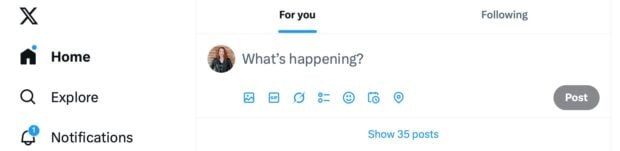
Similarly, X publishes open-source documentation regarding its "For You" recommendation engine, emphasizing social graph connections and real-time recency. Platforms argue that these transparent measures are vital for maintaining creator trust. However, digital marketers frequently counter that frequent, unannounced shifts in algorithm weighting keep brands in a perpetual state of adaptation, forcing a heavy reliance on paid advertising buffers when organic reach fluctuates.
Implications: Strategic Takeaways for Creators and Enterprises
For marketing professionals and enterprise organizations, the dominance of algorithmic curation carries profound operational implications:
- Quality Over Frequency: Because content competes against an infinite stream of personalized distractions, mindless high-volume posting is dead. Relevance, exceptional storytelling, and high retention value outweigh sheer output.
- The Death of the One-Size-Fits-All Playbook: Deploying identical creative assets across six different social networks guarantees underperformance. Teams must tailor hooks, pacing, aspect ratios, and narrative styles to match each platform’s distinct algorithmic appetite.
- The Interplay Between Organic and Paid Reach: Algorithms use remarkably similar foundational signals for both organic content and paid advertisements. High-performing organic creative serves as a natural testing ground; content that resonates organically is far more likely to succeed when backed by advertising budgets.
- Tracking the Right Analytics: To stay ahead of sudden algorithmic shifts, marketing teams must monitor five core metrics per platform: connected reach, unconnected reach, engagement rate, average watch/view time, and share/send rate. A sudden, unexplained drop across these metrics often signals a silent algorithm update, requiring immediate strategic agility.
As artificial intelligence continues to refine recommendation engines, the digital landscape will only grow more personalized. Success in modern social media marketing belongs not to those who try to game the algorithm, but to those who deeply understand human psychology, align with platform goals, and consistently deliver genuine value to the end user.
 Evan Lee Salim
  Laily UPN