
 By Dwi Wanna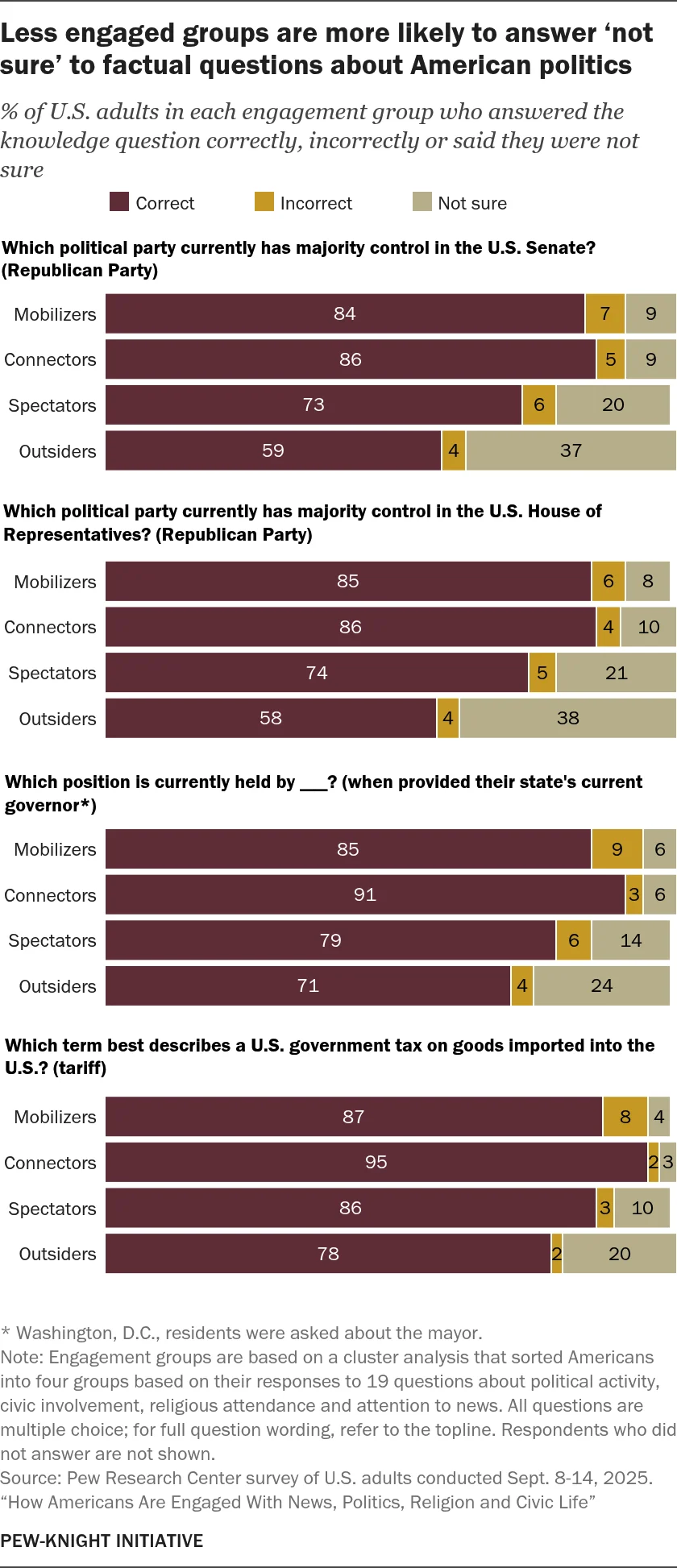
In an era defined by rapid information cycles and shifting social dynamics, the question of how Americans participate in public life has never been more pressing. A groundbreaking new report from the Pew-Knight Initiative provides a comprehensive, multidimensional look at the U.S. public, moving beyond simple metrics of voting to examine how political involvement, community service, religious attendance, and news consumption weave together to form distinct patterns of behavior.
The findings, derived from extensive research conducted throughout 2025, suggest that engagement is not merely a binary of "active" or "inactive." Instead, the American public operates within a complex ecosystem of four distinct "engagement groups," each with unique profiles of civic literacy and knowledge. Perhaps most notably, the study reveals a clear correlation: the more deeply an individual is embedded in the mechanics of public life, the more likely they are to possess a nuanced, fact-based understanding of the American political system.

The Four Pillars of Public Engagement
To understand the modern American, the Pew-Knight Initiative utilized a cluster analysis based on 19 distinct measures of participation. This methodology allowed researchers to segment the population into four primary archetypes, each representing a different way of existing within the American body politic:
- Mobilizers: Representing the most active segment of the population, this group is characterized by high levels of activity across all measured domains—politics, community service, and news consumption. They are the "all-in" participants of society.
- Connectors: This group maintains high levels of social and community involvement—such as joining groups and donating to causes—but they are notably less focused on direct political participation than their counterparts in the Mobilizer category.
- Spectators: Primarily consumers of information, this group follows news developments with high intensity but maintains a lower profile when it comes to direct civic or political action.
- Outsiders: This group reports the lowest levels of participation across the board, including lower rates of voting, volunteering, and news consumption.
Chronology of the Research
The data supporting these findings were collected during a period of heightened public attention, spanning from July 9 to December 5, 2025. This timeframe is critical, as it captures a year marked by the tail-end of the 2024 presidential election cycle and the subsequent settling of the new political landscape.

By employing two distinct survey vehicles—a large-scale Cross-Sectional Engagement Survey of 5,393 adults and the American Trends Panel (Wave 179), which queried 5,195 respondents—researchers were able to triangulate behavioral patterns with factual knowledge. The use of multiple survey modalities, including online, paper, and telephone, was a deliberate strategy to reach "hard-to-count" populations who might otherwise be excluded from traditional polling, thereby ensuring a more representative view of those who typically remain on the periphery of public life.
The Knowledge Gap: Supporting Data
The core of the study involved testing participants on four factual markers of American political life: control of the U.S. Senate, control of the U.S. House of Representatives, the identification of one’s state governor, and the definition of a tariff.

The data reveal a stark, linear relationship between engagement and knowledge. While majorities of all groups were able to identify the correct answers, the "Outsiders" group consistently lagged behind. For instance, while 84% of "Mobilizers" correctly identified the party holding the U.S. Senate majority, only 59% of "Outsiders" did the same.
Crucially, the study finds that the "knowledge gap" is not driven by misinformation—that is, people choosing the wrong answer—but rather by a lack of confidence. In every instance, respondents who were less engaged were significantly more likely to select "not sure" rather than provide an incorrect response. Among "Outsiders," 50% admitted uncertainty on at least one of the four questions, whereas only 15% of "Mobilizers" felt the same lack of clarity.

The Interplay of Demographics and Literacy
While the study confirms that engagement is a primary driver of political literacy, it also underscores the enduring impact of structural factors such as education and age.
The Education Factor
Education remains the most reliable predictor of high-level political knowledge. Across all four engagement categories, the presence of a college degree correlates with a higher likelihood of answering all four test questions correctly. For example, among "Spectators," 67% of those with a college degree provided perfect answers, compared to 46% of those with a high school diploma or less.
The Generational Divide
Age plays a similarly profound role. Older Americans, regardless of their engagement group, demonstrate higher levels of political knowledge. The "age-gap" is particularly wide among the most and least engaged. Among "Mobilizers," there is a 34-percentage-point difference between those under 30 (49% correct) and those 50 and older (83% correct). This suggests that the accumulation of life experience and sustained exposure to political processes over time remains a significant factor in civic literacy.
The Gender Gap in Confidence
A fascinating, albeit long-documented, trend appears in the data regarding gender. Women were consistently more likely than men to report being "not sure" when faced with political trivia. However, the study adds a vital nuance to this finding: the gap vanishes among the most engaged groups. Among "Mobilizers," there is no significant statistical difference between men and women in their rates of "not sure" responses. It is only in the less engaged segments, particularly among "Outsiders," that the disparity widens, with 59% of women in that group reporting uncertainty compared to 38% of men. This supports the long-standing sociological theory that men are more prone to "guess" on factual questions, whereas women may be more cautious about expressing knowledge unless they are entirely certain.

Official Responses and Methodology
The Pew-Knight Initiative maintains that these findings are not meant to pathologize the "Outsiders" or the "Spectators," but rather to provide an "integrated picture" of the American public. By moving away from the traditional, singular focus on voting behavior, the study highlights that many Americans who are "uninformed" are also simply "unconnected."
The researchers emphasize that the survey questions used—while basic—are well-validated proxies for broader political competency. By controlling for other variables like socioeconomic status, the study provides robust evidence that active participation in one’s community or religious organization serves as a catalyst for maintaining a baseline of political awareness.

Implications for the Future of Democracy
The implications of this research are twofold. First, it challenges the assumption that low political knowledge is solely a product of a lack of interest or intellect. Instead, the data suggests that for a significant portion of the population, the barriers to entry—whether they be social, economic, or logistical—prevent them from becoming the kind of "engaged citizens" that the political system relies upon.
Second, the study highlights a critical vulnerability in the democratic process: the "Outsider" group. As these individuals continue to withdraw from the mechanisms of news consumption and civic activity, they become less equipped to navigate the factual landscape of governance. If a large segment of the population defaults to "not sure" on basic questions about who controls their government, their ability to participate effectively in that government is inherently diminished.

The "Mobilizers" and "Connectors" serve as the bedrock of current civic health, but the study implies that the strength of a nation’s democracy may ultimately depend on the ability of its institutions to pull "Spectators" and "Outsiders" into the fold. Whether through increased community programming, better access to reliable information, or structural changes to how civic life is facilitated, the goal remains clear: closing the engagement gap is the first step toward closing the knowledge gap.
In conclusion, the Pew-Knight Initiative’s comprehensive analysis serves as both a map and a warning. It provides a nuanced understanding of how we live, how we learn, and how we participate, leaving policymakers and citizens alike with a clear directive: to understand the state of our union, we must first understand the state of our engagement.
 Pevita Pearce
  Neng Nana