
 By Jia Lissa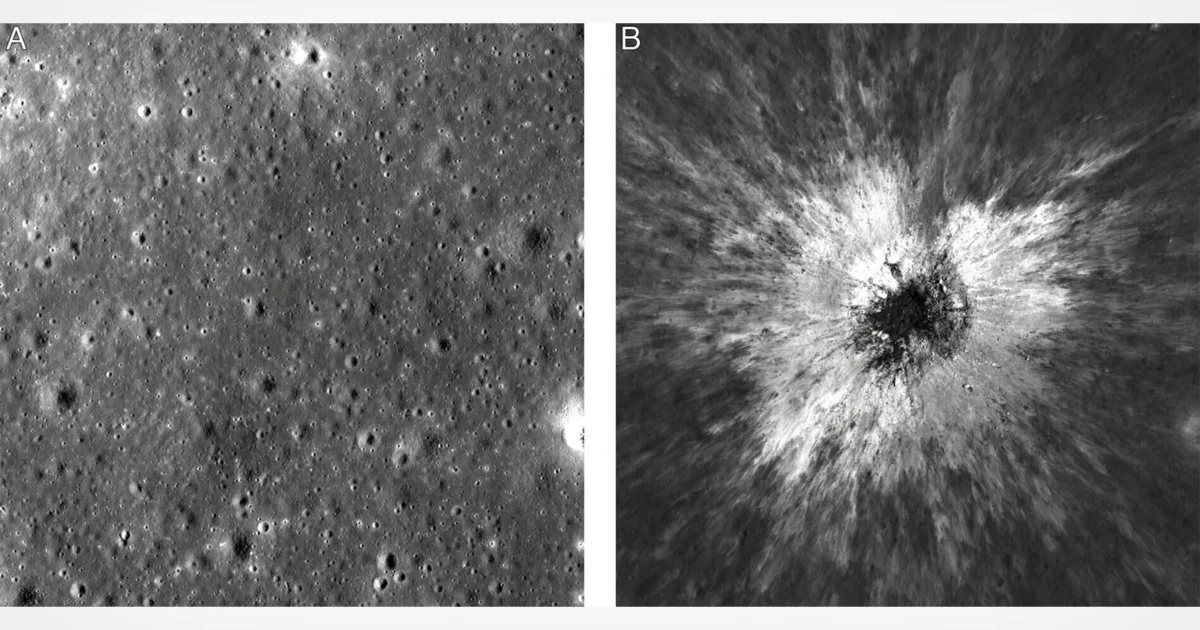
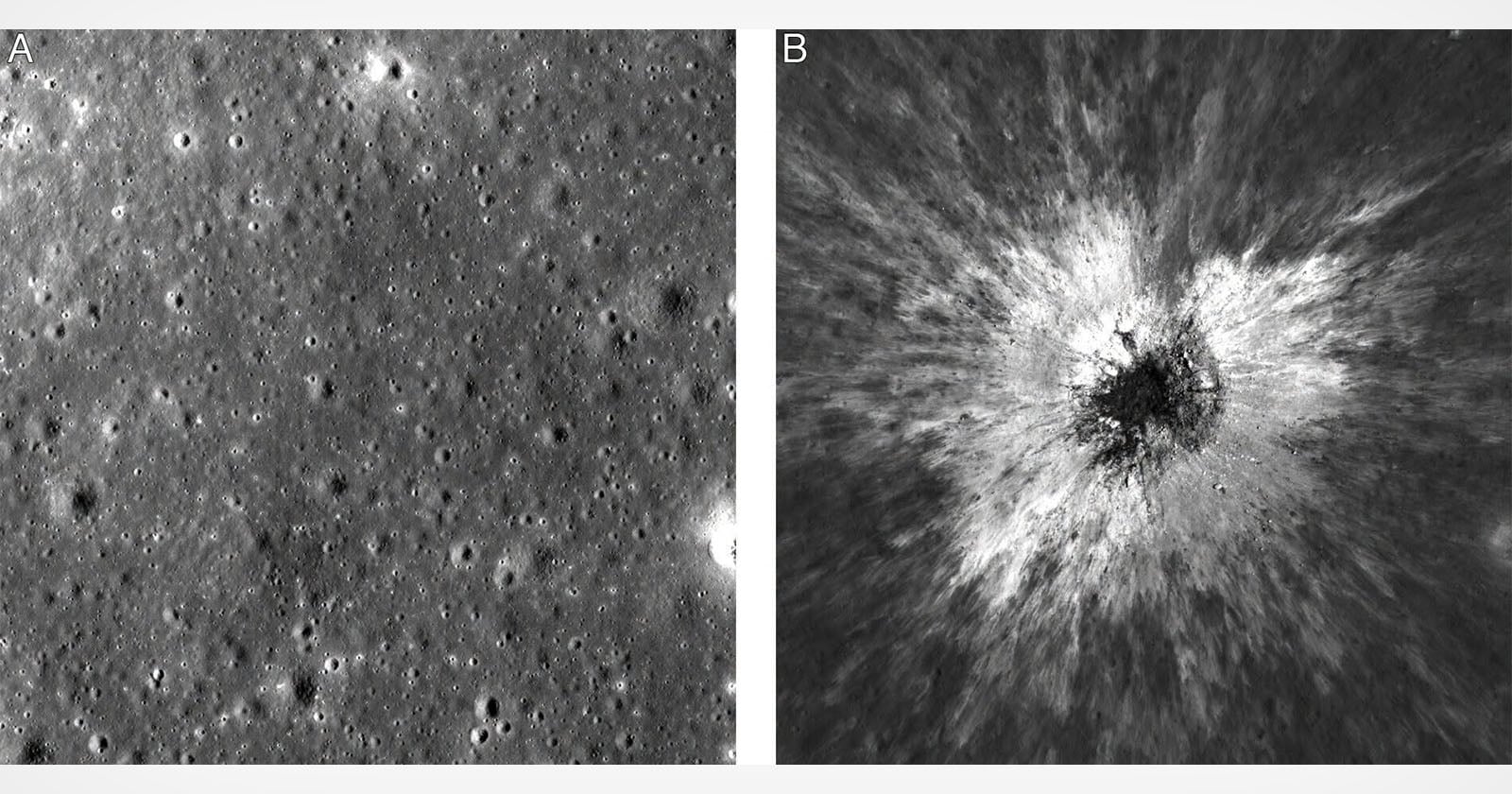
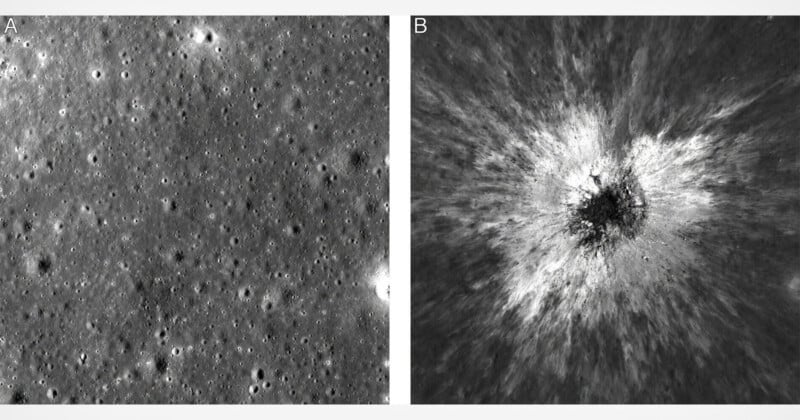
WASHINGTON — In what planetary scientists are calling a truly historic observation, NASA has released a compelling series of before-and-after photographs documenting the violent birth of a massive new impact crater on the Moon. The colossal scar, officially named the McGetchin crater, offers researchers an unprecedented, pristine window into the hyper-velocity impact mechanics that have shaped planetary bodies across our solar system for billions of years.
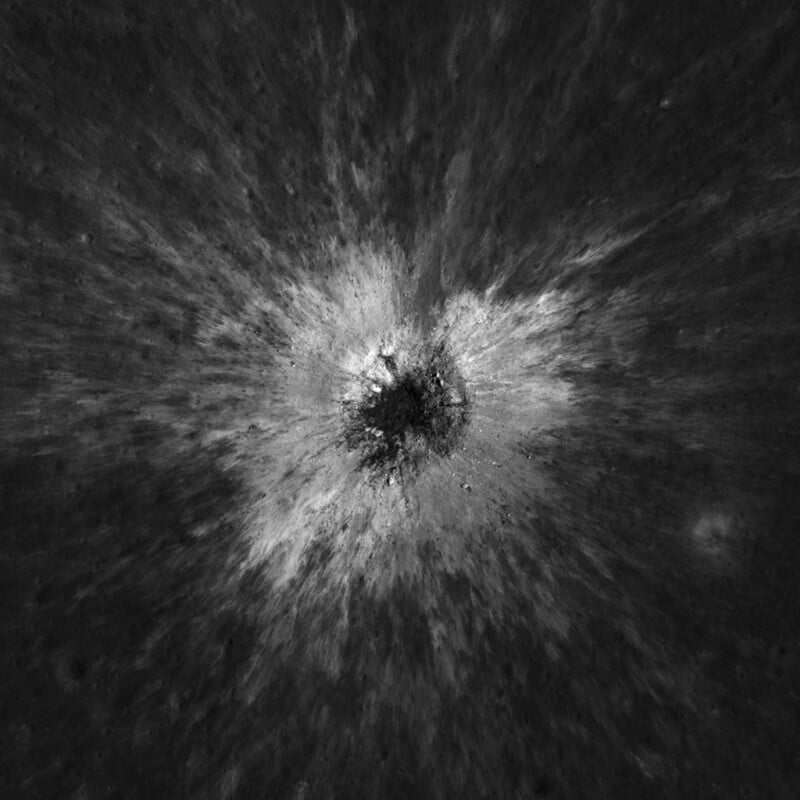
Measuring roughly 728 feet (222 meters) in diameter and plunging to a depth of approximately 141 feet (43 meters), McGetchin is not just another pockmark on the heavily weathered lunar landscape. It is, by a wide margin, the largest newly formed impact crater ever identified by NASA’s veteran Lunar Reconnaissance Orbiter (LRO). According to statistical models and impact frequency data compiled by researchers, an event powerful enough to carve out a crater of this magnitude occurs on the Moon only about once every century.
The discovery has been detailed in a pair of landmark studies published in the prestigious journal Science Advances, igniting excitement and intensive analysis across the global planetary science community.
Main Facts: Anatomy of a Lunar Cataclysm
Named in honor of the late Thomas McGetchin—a renowned volcanologist and former director of Houston’s Lunar and Planetary Institute—the newly minted crater is a behemoth of orbital geology.
To put its scale into perspective, McGetchin is roughly three times wider than the previous record-holder for a newly formed crater detected by the LRO during its long tenure orbiting the Moon. The cataclysmic impact did far more than simply punch a hole in the lunar ground; the sheer kinetic energy of the collision blasted a chaotic blanket of pulverized dust, regolith, and broken rock (known as ejecta) across more than 60 miles of the surrounding lunar terrain, leaving behind striking radial rays that stretch out across the surface like glowing spokes on a wheel.
The culprit behind this cosmic excavation was likely a rogue fragment of an asteroid or an active comet core measuring several stories tall. Striking the Moon’s near side at hyper-velocity, the impactor released energy equivalent to a massive tactical thermonuclear blast, though the event quietly transpired without alerting ground-based telescopes or space-borne monitoring instruments on Earth.
Chronology of a Discovery: How LRO Caught the Impact
The timeline of how McGetchin went from an invisible, silent explosion to one of the most significant lunar discoveries of the decade reads like a cosmic detective story.
- April 11 – May 22, 2024: Sometime within this roughly six-week window, the asteroid or comet fragment slammed into the Moon. Because the strike occurred without a visual flash detected by terrestrial astronomers, the event passed completely unnoticed in real time.
- May 2024: During a routine data-quality and calibration check of incoming telemetry, LRO researcher Robert Wagner spotted an anomalous, highly reflective bright patch surrounded by a stark, dark halo in a broad lunar map. The visual signature screamed recent surface disturbance.
- August 2025: After months of cataloging massive influxes of orbital data, researchers actively flagged the anomaly as a candidate for a major new impact site, initiating focused, high-resolution imaging runs using the LRO’s Narrow Angle Camera (NAC).
- Early 2026: Follow-up high-resolution imaging and stereo-photogrammetry confirmed the nature of the feature, culminating in formal peer-reviewed publication and public announcement later that year.
"I just stopped, dropped everything, and started looking into what that spot was," Wagner recalled in a NASA blog post, describing the moment he realized the data was showing something extraordinary.
Supporting Data: Why Pristine Craters Matter
The vast majority of lunar craters visible through telescopes or mapped by spacecraft are ancient—millions or even billions of years old. Over vast stretches of geological time, these older features have been heavily degraded, softened, and modified by subsequent micrometeoroid bombardments, solar wind weathering, and seismic shaking from distant impacts (a process known as impact gardening).
McGetchin represents a radical departure from the norm. Because the LRO had previously mapped the exact coordinates of the site prior to April 2024, scientists possess crystal-clear "before" imagery to contrast directly against the fresh "after" state. This direct pairing removes much of the guesswork inherent in lunar geology.
Furthermore, McGetchin occupies a unique geographic sweet spot: it sits right near the geological boundary separating the Moon’s darker, iron-rich basaltic mare plains from its brighter, aluminum-rich highland terrains. This complex geological setting means the impact excavated and mixed two entirely distinct types of crustal material.
Official Responses and Expert Insights
The scientific community has responded to the discovery with a mixture of awe and professional urgency. For researchers who spend their careers parsing the violent history of the inner solar system, finding a fresh crater of this size is the planetary equivalent of finding a smoking gun.
"This event constitutes a statistically rare, effectively once-in-a-lifetime observation," the study authors wrote in Science Advances.
Tyler Powell, lead author of one of the companion studies, emphasized that while orbital reconnaissance has given humanity an unprecedented high-altitude look at the scar, the ultimate verification will require boots—or wheels—on the ground. Speaking to Space.com, Powell noted that orbital cameras can only reveal so much.
"Observations from the surface would be really valuable because they would allow us to correlate what we see and map from orbit with small-scale changes to surface texture, the distribution of ejected material, and other properties that can only be studied in detail from the surface," Powell explained. "This would improve our understanding of many aspects of the impact cratering process."
The discovery also highlights a growing sub-discipline in planetary tracking: forensic lunar archaeology. Just months prior to the formal announcement of McGetchin, the LRO made headlines by capturing images of a very different kind of fresh lunar crater—one intentionally and artificially created by the spent booster of a SpaceX Falcon 9 rocket striking the far side of the Moon.
Broader Implications for Future Lunar Exploration
As NASA, international space agencies, and private commercial enterprises gear up for sustained human return to the lunar surface under programs like Artemis, the study of impact mechanics is shifting from pure academic curiosity to a matter of operational safety.
Understanding how frequently objects of this size strike the Moon, how much ejecta they throw, and what kind of seismic shockwaves they generate is critical for planning long-term habitats, communication networks, and surface infrastructure. A multi-story asteroid fragment striking near a crewed base could prove catastrophic; studying natural laboratories like the McGetchin crater helps scientists model these rare threats with far greater precision.
For now, McGetchin stands as a monument to the dynamic, unyielding violence of our cosmic neighborhood—a stark reminder that even a world as seemingly dead and silent as our Moon is still an active participant in the cosmic shooting gallery of the solar system.
 Raul Delapena Setiawan
  Basiran